India as a Space Power
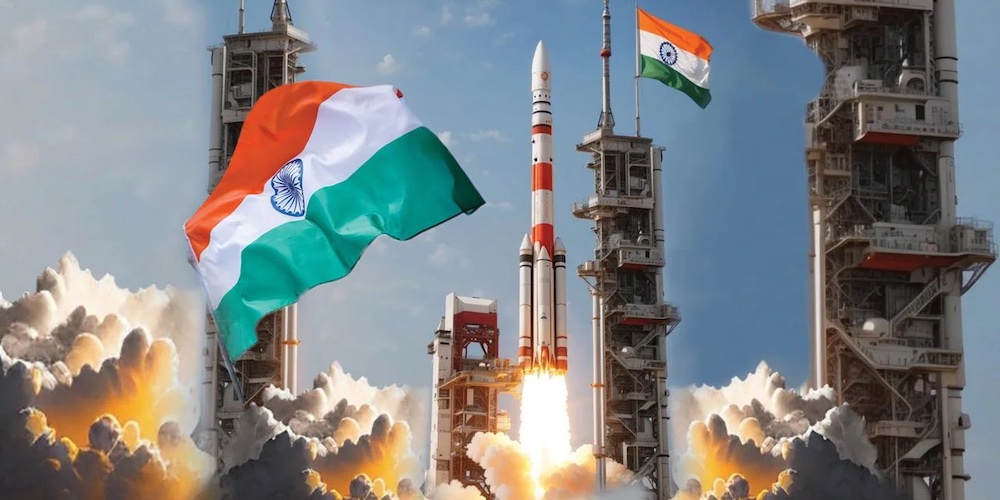
India’s meteoric rise from a developing nation building basic satellites to a dominant global space powerhouse is one of the defining technological stories of the 21st century. Championed by the Indian Space Research Organisation (ISRO), India’s space journey represents a strategic blend of frugal engineering, scientific ambition, and inclusive national development
Over the last twelve years, India’s space programme has emerged as a symbol of national confidence, technological self-reliance, and global ambition. What began as a scientific endeavour has evolved into a strategic national asset that supports development, strengthens security, drives innovation, and enhances India’s standing in the world. This journey reflects the spirit of 12 Years of Vishwas Ke, Nirman Ke and Jan Kalyan Ke—building trust through achievement, creating new opportunities through innovation, and delivering benefits that reach every citizen.
Three defining pillars have shaped this transformation. Firstly, India’s Space Capability has extended the nation’s reach beyond Earth through landmark missions, advanced launch systems, and indigenous technologies. Additionally, building National Capacity has leveraged space-based applications to strengthen governance, connectivity, disaster management, agriculture, healthcare, education, and economic growth. Moreover, the global partnerships and collaborative leadership have enhanced India’s credibility as a trusted space partner, expanding international cooperation and reinforcing its role in the peaceful and responsible use of space.
These achievements tell the journey of a nation that is not only reaching new frontiers in space but also harnessing space technology to empower its people, strengthen its institutions, and elevate India’s standing in the global arena. It is a journey guided by national purpose and focused on improving lives.
The Genesis: Space for Socio-Economic Development
Conceived in the 1960s under the visionary leadership of Dr. Vikram Sarabhai, India’s space program was fundamentally grounded in “Jan Kalyan” (citizen welfare). Rather than participating in the Cold War-era space race for geopolitical prestige, India utilised space technology to solve pressing socio-economic challenges. The launch of the Aryabhata satellite in 1975 marked the country’s entry into orbit, paving the way for systems that revolutionised agricultural planning, meteorological forecasting, telecommunications, and disaster management. The development of the highly reliable and cost-effective Polar Satellite Launch Vehicle (PSLV) further cemented India’s reputation for highly affordable and reliable launch capabilities.
Deep Space Ambitions and Interplanetary Milestones
In the past decade, India’s space endeavours have evolved from developmental missions to monumental feats of scientific exploration and strategic prestige. The watershed moment occurred in 2008 with Chandrayaan-1, which definitively confirmed the presence of water molecules on the Moon. This was followed by the landmark Mars Orbiter Mission (Mangalyaan) in 2014, making India the first Asian nation to reach the Red Planet and the fourth globally to achieve this — all executed at a fraction of the cost of similar Western missions.
In 2023, India reached the zenith of lunar exploration by executing the historic Chandrayaan-3 mission, making it the first nation in history to successfully land a spacecraft on the Moon’s rugged and unexplored south pole. This was closely followed by the launch of Aditya-L1, India’s premier solar mission aimed at studying the Sun’s dynamics.
Expanding Horizons: Human Spaceflight and Defence
As India’s strategic capabilities have grown, so have its defence and manned spaceflight ambitions. The demonstration of Anti-Satellite (ASAT) capabilities in 2017 placed India in an elite group of nations capable of neutralizing space-based threats, thereby underscoring its national security imperatives.
Furthermore, the highly anticipated “Gaganyaan” programme signifies India’s transition to a human spacefaring nation, with indigenous orbital spaceflights in the pipeline. Building on these successes, ISRO is actively laying the groundwork to establish a national space station, marking yet another milestone in its long-term space exploration trajectory.
India has strengthened its position in advanced space science through astronomy and in-orbit technology demonstrations.
AstroSat, India’s first multi-wavelength space observatory, completed a decade in orbit in September 2025 and has contributed several important scientific discoveries.
XPoSat, launched on 1 January 2024, further expanded India’s capabilities in X-ray astronomy. Both missions continue to operate as proposal-driven observatories serving researchers worldwide.

India also achieved a major technological breakthrough through the Space Docking Experiment (SPADEX) in January 2025. The mission made India the fourth nation, after the United States, Russia, and China, to demonstrate autonomous docking and undocking in space. ISRO also demonstrated power transfer between docked satellites and tested a robotic arm in microgravity.
The successful development of the indigenous Bharatiya Docking System marks a major milestone, enabling the seamless conduct of India’s landmark upcoming missions such as the Bharatiya Antriksha Station (BAS), Chandrayaan-4, and Gaganyaan.
Building on its achievements at the Moon and Mars, India is preparing its first mission to Venus. The Venus Orbiter Mission, approved by the Government of India, is targeted for launch in March 2028. The mission will study Venus’ geology, surface composition, atmosphere, ionosphere, and resurfacing processes. Scientists will also examine how solar activity influences the planet’s atmospheric and near-space environment. The mission represents a significant technological leap for India’s space programme. It will attempt advanced capabilities such as aerobraking and sophisticated thermal management systems to operate in Venus’ extreme conditions. These technologies are being undertaken by ISRO for the first time and will further strengthen India’s expertise in deep-space exploration and planetary science.
The Private Sector and Future Trajectory
Today, India boasts a burgeoning commercial space ecosystem, moving rapidly away from a strictly government-led monopoly. Catalysed by progressive space policies, the privatisation of the industry has flourished, with over 400 space startups operating across the country as of early 2026.
India’s space economy is currently valued at $8 billion with a share of 2–3% in the global space economy. It is projected to grow five-fold to $40–45 billion over the next decade, with its global share targeted at 8% by 2030. Over the last twelve years, the Government has significantly accelerated the commercialisation of the space sector through major institutional reforms and private sector participation.
NewSpace India Limited (NSIL), established in 2019, and IN-SPACe, established in 2022, have created a strong institutional framework for industry participation, technology transfer, and private investment. While NSIL commercialises ISRO’s technologies, launch services, and satellite services, IN-SPACe facilitates and authorises private-sector activities through a single-window mechanism.
Supported by liberalised Foreign Direct Investment (FDI) norms and dedicated funds spearheaded by IN-SPACe, India is rapidly expanding its share of the global commercial space market.
These reforms have delivered measurable outcomes. According to the Economic Survey 2025-26, NSIL revenues increased from ₹321.77 crore in FY 2021-22 to ₹3,246.09 crore in FY 2024-25. As of 31 January 2026, IN-SPACe had facilitated 71 ISRO technology transfers to industry and startups. Six Indian Non-Governmental Entities launched 18 satellites, while 25 payloads were flown or scheduled on POEM (PSLV Orbital Experimental Module) platforms. The approval of an Earth Observation satellite constellation under the PPP model in 2026 and the transfer of SSLV technology to HAL in 2025 further strengthened India’s commercial space ecosystem.
Ultimately, India’s ascendance as a major space power is defined by its unique model of combining state-of-the-art technological advancement with developmental utility and cost-effective execution. As it strives toward its Viksit Bharat (Developed India) goals for 2047, India’s space program continues to serve as an invaluable tool for international diplomacy, scientific innovation, and national pride.
To conclude, over the last twelve years, India’s space programme has shown how technological advancement can directly support national development. Space technology now supports governance, strengthens economic growth, and improves everyday life. India’s progress has been driven by indigenous innovation, scientific excellence, and public welfare. Simultaneously, India has emerged as a trusted global space partner through international cooperation, commercial launches, and knowledge sharing. The country continues to promote the peaceful and responsible use of outer space.
As India advances towards Space Vision 2047, the focus remains on expanding scientific frontiers while creating benefits for society. The journey ahead aims to build a stronger, self-reliant, and globally respected India through space-led innovation and development.