RIGHT ANGLE – Time To Stand Up for Saving Hinduism
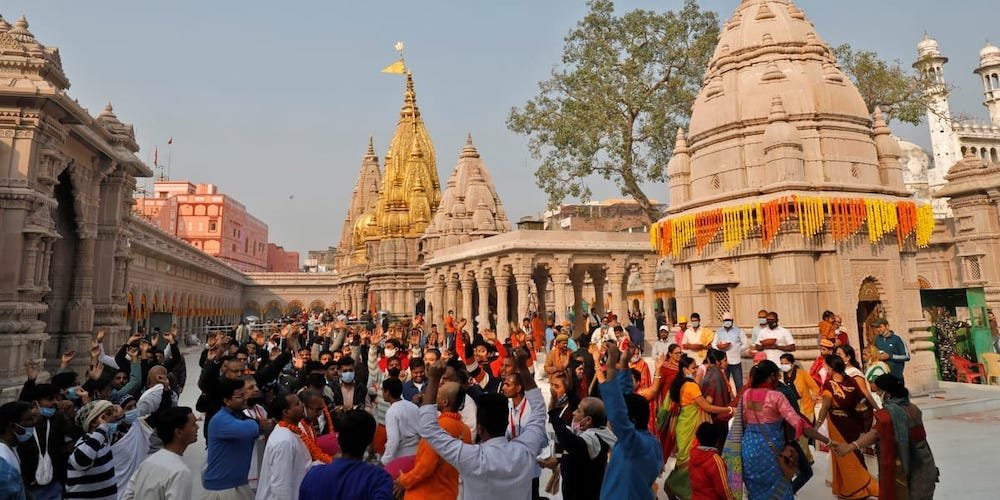
Astrange paradox marks the modern world. The civilisation that gave the world the ideas of tolerance, pluralism, non-violence and the search for truth is today the civilisation that finds itself most under attack, most mocked and most defenceless. That civilisation is Hinduism.
From Sydney to Toronto, from London to Leicester, from California to Dhaka, Hindus are being targeted. And inside India itself, the land where Hinduism was born, Hindus are being told that their faith is a disease, their gods are a joke, their festivals are a nuisance, and their unity is a danger.
This is not an accident. It is the result of decades of a political and intellectual framework that punishes Hindus for being Hindus while rewarding everyone else for asserting their identity.
Let us go to little details:
In the last few years, the attacks on Hindus abroad have become too frequent to be called isolated incidents.
In the United States, temples have been vandalised in California, New York and Texas. Swastikas, a sacred Hindu symbol for thousands of years before its misuse in Europe, have been painted on temple walls with hate slogans. Hindu students in American universities report being mocked for their vegetarianism, their festivals, their tilak, their gods. A Hindu who wears his faith openly is made to feel like a foreigner, even if he was born in America.
In Canada, the situation has turned more dangerous. Temples in Brampton and Surrey have been attacked. Hindu processions have been confronted. Khalistani extremists, protected in the name of free speech, have openly threatened Hindus. The Canadian state, which is quick to act on every other form of hate, has looked the other way when the victims are Hindus.
In the United Kingdom, Leicester in 2022 was a warning. Hindu homes and temples were attacked after a cricket match, but the violence did not stop with sport. It became a targeted campaign against Hindus. In London, temples have been vandalised, and Hindu schoolchildren have been bullied for being Hindu. A child who says he is proud to be Hindu is treated as a problem in many British classrooms.
In Australia, temples in Melbourne and Sydney have been defaced repeatedly. Graffiti glorifying separatism has been left on sacred walls. Hindu Australians, who are among the most law-abiding, educated, and peaceful communities in the country, are told to keep quiet and not provoke.
This is not a coincidence. Across the West, there is a new acceptable prejudice of Hinduphobia. You can mock a Hindu god on a comedy show and be called brave. You can abuse Diwali as noise pollution and be called progressive. You can call for the eradication of Hinduism and be invited to a university conference.
If the same words were used against any other faith, there would be resignations, protests and criminal cases. When the target is Hinduism, there is silence.
However, what is more concerning is this – if what is happening abroad is bad, what is happening inside India is worse. Because here Hindus are a majority and yet treated as second-class citizens in their own civilisation.
Let me cite a personal experience. A few years ago, a diplomat from an important country was addressing a small gathering at one of New Delhi’s intellectual nerve centres. It was his farewell address to his Indian friends and colleagues after a six-year posting in India. He described his “wonderful experiences” in “the great country of India”. But one thing, he said, surprised him the most. “I had heard a lot about Hindus and Hinduism before I was posted in India. I thought during my stint in India I would learn and hear more about one of the great and ancient religions of the world. But what I found during my stay was that the leading Indians were more vocal about the interests of Islam and Christianity than about the protection of Hinduism. In fact, the sharpest attacks on Hinduism come invariably from Indians themselves”.
The diplomat in him obviously did not give any impression that he was happy or sad about the treatment of Hinduism in a country that is inhabited mainly by the Hindus. But then he did make an important point, a point that was validated by a “Hindu” journalist-friend of this writer the very next day.
According to this friend, Hinduism is the most absurd, unscientific, and cruel religion of the world that perpetuated casteism, inequality, and exploitation. My friend was not convinced when I pointed out that every great religion or civilisation has its pluses and minuses and as times pass by, the minuses get corrected.
After all, it is under Hinduism that people worship women as goddesses, whereas women are not equal to men under Islam; even till recently, women did not have voting rights in many developed Christian countries. I told my friend that casteism, as a concept, was highly scientific – since it espoused the principle of division of labour, a principle that ensured that every section of society is “wanted”. True, the concept got corrupted when one’s place in life depended not on one’s ability but on one’s birth. There is thus a need to de-corrupt the principle; but it does not mean that one should throw Hinduism into the Indian Ocean for good.
In fact, unlike any other religion in the world, Hinduism promoted pluralism in the form of pluralities of Gods and Goddesses. There is no compulsion on Hindus to worship a particular God or Goddess, nor does it compel one to worship his or her God in a particular way or method; in fact, Hinduism even respects those who do not want to worship at all. As a faith, Hinduism is inclusive and inner-directed. It does not impose itself on its own adherents. So no question of its imposing itself on others arises.
This principle of life has been observed and unfailingly put into practice by the inhabitants of this land since time immemorial. That was why they could receive invading Sakas and Hunas and assimilate them and integrate them into their society. That was why they could receive the Jews, Parsis, Shia Muslims and the early Christians – all of whom came as refugees, with their thoughts and beliefs orphaned in their own lands – and treat them as equal members of this ancient society. There was no modern constitution that guaranteed rights to minorities then; there were no secularists to protect them from the majority. It was the majority inhabitants, steeped in their Hindu Dharma, who protected them.
The non-conflicting nature of Hindu Dharma is not just a matter of theory, but an observed practice that has been followed and adhered to for ages. But my journalist friend was not convinced of all these great attributes of Hinduism.
Incidentally, this friend of mine is a great admirer of Jawaharlal Nehru, independent India’s first prime minister. And he stands for everything that goes with Nehruvianism. It is instructive here to note that in 1949, Nehru had said that ‘to talk of Hindu culture would injure India’s interests’. He had admitted more than once that by Education he was an Englishman, by views an internationalist, by culture a Muslim, and a Hindu only by accidental birth. In 1953, Nehru had written to Kailash Nath Katju in 1953: “In practice the individual Hindu is more intolerant and more narrow-minded than almost any person in any other country. ” In fact, it is not wrong to say that Nehru had total contempt for the Hindu religion, for Hindu culture, for Hindu society and for the average Hindu.

The point that I want to make is that if the above-mentioned diplomat heard more concerns about the Muslims and Christians, and if my journalist friend has such a nasty opinion about Hinduism, the main reason is the dominance of Nehruvian thoughts in India’s politics, bureaucracy, intelligentsia and media since 1947.
This is still the case, though we have had a BJP government in Delhi under the leadership of Narendra Modi over the last 12 years. Nehruvians and the so-called secularists continue to have a field day, and those opposed to Nehruvianism continue to suffer, if the mainstream intelligentsia is taken into account.
The Modi government takes the intellectual support of some proud Hindus for granted but acts like a coward when they are kept out of the government-funded intellectual or information-related organisations; these continue to be firmly under the control of the Nehruites.
Under this Nehruvian framework, the state has taken control of Hindu temples but left mosques and churches free. Hindu festivals are regulated, Hindu processions are restricted, Hindu schools are controlled. At the same time, minority institutions are given special rights, special funds, and special protection.
Hinduism is painted in textbooks as caste, superstition and oppression. Other religions are painted as equality, compassion and peace. A generation of Hindus has grown up ashamed of their own heritage, taught to apologise for being Hindu.
That framework continues to live on in universities, in media, in the courts, in the opposition parties and even the BJP.
The most shocking example came from Tamil Nadu. A minister of the DMK, a party that is part of the INDI alliance, stood on a public platform and said that Sanatana Dharma is like dengue, malaria, and corona, and it must be eradicated. He did not say reform. He did not say debate. He said eradicate, as if Hinduism were an epidemic.
Imagine if a minister had said the same about any other religion. There would have been arrests by nightfall. There would have been nationwide protests. Edit pages of the English dailies and television channels would have run prime-time debates for a week.
But when the target was Hinduism, there was silence from the so-called secular parties. No senior Congress leader condemned it in clear terms. No INDI alliance partner broke the alliance over it. The courts, so active in other cases of hate speech, remained largely silent.
The same language was repeated in Karnataka. Congress President Mallikarjun Kharge and his son, a minister in the Karnataka government, used similar language against Sanatana Dharma. The message was clear: attacking Hinduism is not hate speech; it is secularism. Defending Hinduism is not a right; it is communalism.
This is the moral inversion at the heart of Indian politics. Those who want to destroy Hinduism are called progressives. Those who want to protect it are called extremists.
Nothing exposes this double standard more than the case of Nupur Sharma. On a television debate, she was responding to continuous, vulgar attacks on the Shiva Linga by a Muslim panelist. She was defending her faith, in anger, on live television. For that, she was made a national villain. FIRs were filed across the country. The Supreme Court made observations that were seen across India as blaming her for violence elsewhere. She was forced to go into hiding. Even the BJP betrayed her. Her life remains under threat even today.
Compare this with the treatment of those who openly call for the eradication of Hinduism. No FIRs across states. No Supreme Court lectures. No forced apologies. No hiding.
One woman defends Shiva and is punished. She is admonished by the Supreme Court. Ministers call Hinduism a disease and are protected. The Supreme Court remains silent. This is not justice. This is a system that has been trained to fear offending one community and to ignore offending Hindus.
A true secular judiciary would protect all faiths equally. It would punish all hate speech equally. Until that happens, Hindus will continue to feel that the courts are not their courts.
Coming to politics, the Congress and the INDI alliance have a clear electoral strategy, and it has been used for decades: divide Hindus by caste, unite Muslims and Christians by religion. For Hindus, they talk of caste census, sub-castes, backward versus forward, Dalit versus Brahmin, north versus south, Hindi versus non-Hindi. Every election brings a new effort to fracture Hindu unity.
However, for Muslims and Christians, they talk of minority rights, minority fears, and minority protection. They promise funds, institutions, reservations, special laws. They never ask Muslims to divide into Shia and Sunni, or Christians to divide into Catholic and Protestant. That division is reserved only for Hindus.
The result is that Hindus, who are 78 percent of India, vote as fragments, while minorities vote as blocs. Politicians then claim they are secular because they have minority support, even as they ignore Hindu concerns on temples, conversions, cow slaughter, illegal infiltration, and attacks on Hindu festivals.
This is not social justice. This is political engineering. Real social justice would uplift the poor of all communities without breaking the Hindu society that holds India together.
Hinduism, as pointed out above, is the only faith that has never claimed that only its path leads to salvation. It says Ekam Sat Vipra Bahudha Vadanti, truth is one, and the wise call it by many names. It accepts that a Muslim can reach God through Islam and a Christian can reach God through Christianity. That is why India, under Hindu kings, gave shelter to Jews, Parsis, Syrian Christians, and Tibetans when no one else would.
No other religion in the world has this level of acceptance built into its theology. To call such a faith intolerant is not just false; it is a historic lie.

To put it differently, as long as Nehurianism continues to be the guiding principle of India’s governing class, the plights of Hindus will worsen in India in the days to come. After all, in a democratic setup like ours, the legal and administrative decisions of the government entirely depend upon the nature and composition of the governing group, and if it is “pseudo-secular”, it will act for the minorities and against the Hindu cause. The Nehurivian governing class will do everything possible to divide Hindus and derive their strength from vote-bank politics. This is even though this sort of vote-bank politics is the greatest threat to national development, national unity, national integrity, and internal security, because the majority of people feel excluded and lack the opportunity to help themselves to a better life.
What then is the solution?
Saving Hinduism means five practical things.
First, legal equality. Hindu temples must be freed from government control. Hindu institutions must have the same rights as minority institutions. The same law must apply to all hate speech, whether the victim is Hindu or non-Hindu. The courts must act with the same speed when a temple is attacked as when any other place of worship is attacked.
Second, political unity. Hindus must stop allowing themselves to be divided by caste for electoral gain. Caste is a social reality that needs reform and upliftment, but it cannot become a weapon to destroy Hindu unity. A Dalit Hindu and a Brahmin Hindu are both Hindu. Their temples, their festivals, their gods are the same. Politicians who use caste to break this bond are the real enemies of social justice.
Third, intellectual confidence. Hindus must stop apologising for their faith. Diwali is not pollution; it is light. Holi is not harassment; it is joy. The Kumbh Mela is not superstition; it is the largest peaceful gathering in human history. The Ram Mandir is not communalism; it is the restoration of a civilisational wound. Young Hindus must be taught their history with pride, not shame.
Fourth, global solidarity. Hindus in India must stand with Hindus in America, Canada, Britain, Australia, Pakistan, Bangladesh and Fiji. When a temple is attacked in California, the voice of protest must rise in Delhi. When a Hindu girl is abducted in Pakistan, it must become an international human rights issue. The world protects other Diasporas. Hindus must learn to protect their own.
Fifth, true secularism. India does not need less secularism; it needs real secularism. Real secularism means the state respects all religions equally, does not fund one religion by taxing another, does not control one religion while freeing others, and does not allow any religion to claim a veto over free speech. A Hindu who respects all religions is the true secularist. A politician who abuses Hinduism to please others is not secular; he is communal in reverse.
For doing all these, all true Hindus must consider the following their “fundamental duties”:
• They must work towards building comprehensive organisations to cater to the needs of Hindu Religious Education, Research and Training encompassing the disciplines of religion, philosophy, culture and history in Indian languages in an integrated manner.
• They must propagate and condemn effectively, in an organised manner, the social evils such as dowry, the practice of sati, and untouchability. These practices are unauthentic in the Hindu Dharma Shastras.
• They must support and establish sufficient mass media organisations capable of conveying Hindu point of view on historical, cultural, religious, political and social aspects of Indian people. At present, there is serious lack of effective means of propagating the Hindu point of view on national issues in different regional languages, as print and electronic media, both, particularly the English one, is deadly opposed to Hindu cause and Hindu organisations. What one has to do is to unite – i.e., the middle class, the ‘intellectuals’, the media, the business community, film & sports personalities, the NRI and anyone with a voice should think together and get together and kick up a storm sufficient enough to change vote bank politics from being religion & caste based to being based on performance and good governance.
• The Hindus must realise that they can now ill afford the absence of strong political will to vote and support, en masse, only a pro-Hindu (which does not mean anti-minority) candidate and the political party, during the local, state and central Government elections. Besides, slackness in exercising the right to vote in elections among the well-placed and middle-class Hindus is a disease, and that must be cured.
Let us all remember that if Hinduism is weakened in India, India itself is weakened. India is not just a piece of land. It is a civilisation that survived invasions, colonialism, partitions, and poverty because Hinduism kept its soul alive. The Vedas, the Upanishads, the Ramayana, the Mahabharata, the Bhagavad Gita- these are not just books; they are the memory of India.
If Hinduism is reduced to a museum faith, India will become just another country, divided by caste, language, and imported ideologies. If Hinduism remains strong, India will remain India, a land that can be modern and ancient, scientific and spiritual, democratic and dharmic at the same time.
The world also needs Hinduism. In a world torn by religious wars, by terrorism in the name of God, by cancel culture and intolerance, Hinduism offers a different path: that God can be worshipped in many forms, that doubt is allowed, that debate is sacred, that ahimsa is strength, that vasudhaiva kutumbakam, the whole world is one family, is not a slogan but a philosophy.
To save Hinduism is not to save one community. It is to save the idea that humanity can live together without forcing everyone to believe the same thing.
This is the moment for Hindus, in India and across the world, to stand up, not in hatred, but in pride. To protect their temples, their festivals, their children and their future. To demand equality, not privilege. To demand respect, not appeasement. To say, without fear and without apology: We are Hindu, we are proud, and we will protect our dharma.
That is true secularism. That is true India. That is the task of our time.