India’s Solar Revolution
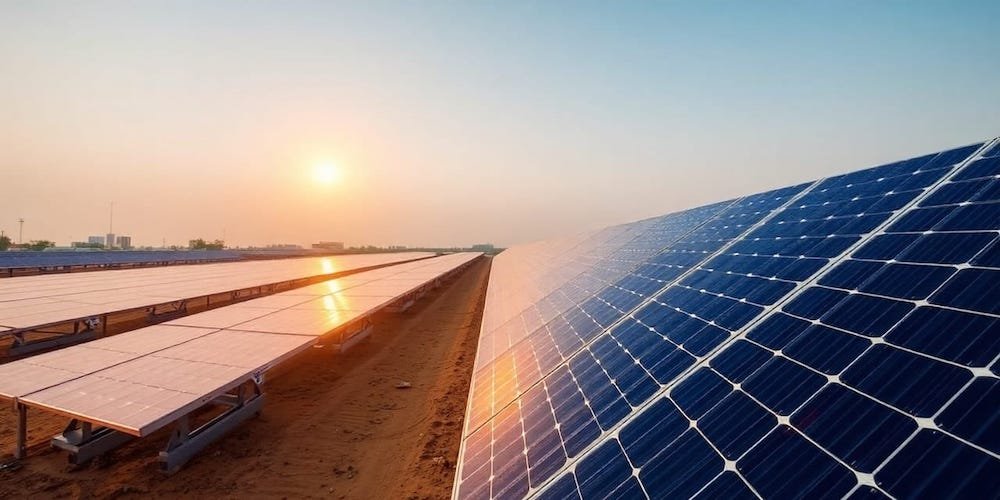
India’s solar energy sector has expanded significantly over the past decade, emerging as a key driver of the country’s energy transition. Growth in installed capacity, domestic manufacturing and distributed solar adoption reflects the sector’s expanding reach. Policy support, infrastructure development and citizen participation are accelerating this transformation. Solar power is strengthening energy security, supporting economic development , advancing climate action and powering a sustainable as well as self–reliant future
Over the past decade, India has transformed its energy landscape, turning its abundant sunlight into a cornerstone of national development and climate action. Blessed with over 300 sunny days a year across vast stretches of its geography, the country has moved solar power from the margins of its electricity grid to the center of its clean energy transition.
What began as an ambitious policy vision under the National Solar Mission has evolved into one of the world’s fastest-growing renewable energy programs, positioning India as a global leader in sustainable power.
The sheer scale of India’s solar expansion is reflected in its capacity numbers. In 2014, India’s installed solar power capacity stood at a modest 2.82 gigawatts (GW). By October 2026, that figure surged approximately 62-fold to nearly 175 GW.
This momentum accelerated sharply in recent years, with the country adding a record 44.61 GW of solar capacity in the 2025–26 financial year alone—nearly double the additions of the preceding year.
By surpassing major economies in annual capacity additions, India has cemented its status as the world’s second-largest solar growth market and the third-largest solar producer globally.
Today, solar energy accounts for the single largest share of India’s 308 GW non-fossil fuel capacity, bringing the nation steadily closer to its target of 500 GW of non-fossil fuel capacity by 2030 and net-zero emissions by 2070.
This remarkable trajectory rests on a multi-pronged strategy combining utility-scale infrastructure with decentralised, citizen-centric adoption. States with high solar irradiance — such as Rajasthan, Gujarat, Karnataka, Tamil Nadu, and Madhya Pradesh — host some of the world’s largest utility-scale installations, including the massive Bhadla and Pavagada solar parks.
Transparent competitive bidding and exemptions on inter-state transmission charges have driven solar tariffs down to globally competitive lows, making solar electricity cheaper than conventional coal-based power.

Recognising land constraints in densely populated regions, the government has also begun pioneering floating solar projects on reservoirs through initiatives like the Pradhan Mantri Surya Sarovar Yojana, pairing generation with battery storage to meet evening peak demand.
Equally transformative is the democratisation of solar power through distributed generation. Under the PM Surya Ghar: Muft Bijli Yojana, launched in 2024, rooftop solar adoption has shifted from commercial buildings to millions of middle-class and rural households. Supported by direct financial subsidies and collateral-free loans, roughly 65 lakh households have installed rooftop systems by late 2026, with over 21 lakh families enjoying zero electricity bills.
Simultaneously, the PM-KUSUM scheme is empowering the agricultural sector by replacing diesel irrigation pumps with solar-powered alternatives and enabling farmers to earn extra income by selling surplus electricity back to the grid.
Alongside deployment, India has aggressively pursued self-reliance in clean-energy supply chains. Historically reliant on imported equipment, the nation utilised the Production Linked Incentive (PLI) scheme and the Approved List of Models and Manufacturers (ALMM) to build a robust domestic ecosystem. Consequently, India’s domestic solar module manufacturing capacity expanded dramatically from just 2.3 GW in 2014 to over 190 GW by mid-2026.
Beyond its borders, India has championed global climate equity through the International Solar Alliance (ISA), mobilising finance and technical expertise to help developing nations across the tropics harness solar power.
Despite these milestones, sustaining this growth requires overcoming critical structural hurdles. Integrating intermittent solar power into the national grid demands massive investments in high-voltage transmission corridors and grid-scale Battery Energy Storage Systems (BESS) to ensure round-the-clock reliability.
Furthermore, scaling domestic manufacturing deeper into upstream components — such as polysilicon, ingots, and wafers — remains vital to insulate the sector from global supply chain shocks.
Ultimately, India’s solar journey is a compelling blueprint for developing economies. It demonstrates that rapid economic growth, energy security, and environmental stewardship need not be competing priorities.
By pairing decisive policy frameworks with technological innovation and grassroots participation, India is not merely illuminating its own homes and industries — it is helping light the path toward a cleaner global future.