Record–Exports for Seven Consecutive Months
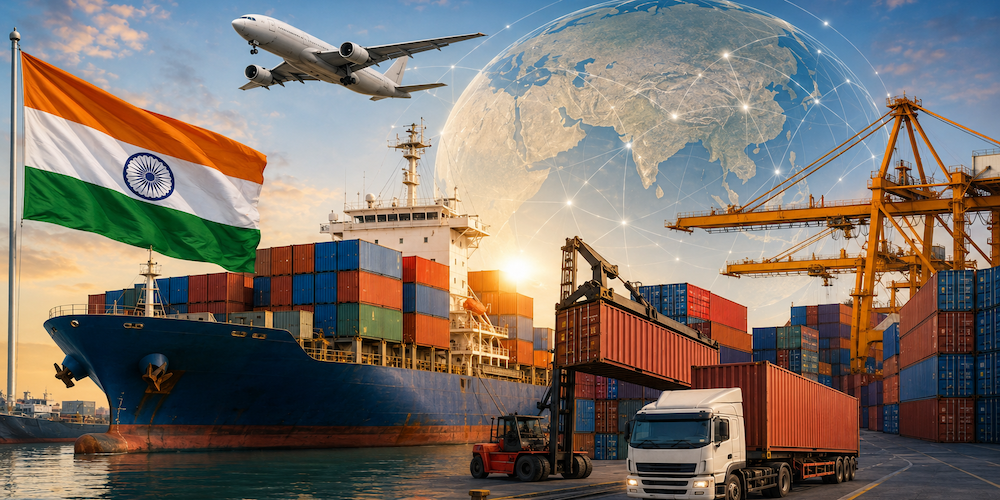
India’s Export Growth in FY 2026-27 has been marked by strong performance and new milestones
International trade serves as a vital engine for economic expansion, allowing domestic industries to scale beyond national borders while enhancing productivity and global competitiveness.
Following five consecutive years of record-breaking outbound trade that culminated in US$ 863.1 billion during FY 2025-26, India has carried this powerful momentum into FY 2026-27. Despite persistent geopolitical uncertainties and sluggish global demand, the Indian external sector has demonstrated remarkable resilience, setting fresh milestones across both goods and services.
During the first seven months of FY 2026-27 (April–October 2026), India’s total exports — comprising both merchandise and services — reached an estimated US$ 568.84 billion. According to data released by the Press Information Bureau, this represents a robust 16.66% year-on-year (YoY) increase compared to the US$ 487.59 billion recorded during the same period in the previous fiscal year.
Crucially, this upward trajectory has been consistent, with exports registering positive YoY growth in every single month of the current fiscal year. In October 2026 alone, total exports surged by 29.90% to reach US$ 89.99 billion, propelled by a dramatic 45.06% jump in merchandise shipments.
A defining feature of India’s trade performance in FY 2026-27 is the balanced expansion of its two primary pillars: merchandise and services. Between April and October 2026, merchandise exports grew by 21.96%, outpacing global trade averages and reflecting a maturing domestic manufacturing base. Even when excluding volatile petroleum products, non-petroleum exports rose by 18.01% to US$ 259.22 billion, underscoring broad-based industrial strength.
Meanwhile, the services sector remained a bedrock of external stability, growing at 10.93% and accounting for approximately 45.7% of India’s total export basket. Over the past decade, India’s services exports have expanded far faster than the global average, lifting its share of global services trade from 3.1% to 4.3%.
Sectoral data reveals that India’s export growth is no longer reliant on a handful of traditional commodities. Seven of the country’s ten leading merchandise export categories achieved double-digit growth during April–October FY 2026-27.
High-value manufacturing led the charge, particularly in electronic goods, which expanded by 46.92%.
Notably, non-smartphone electronics grew by 56.5% in the first half of the fiscal year, signaling deeper integration into global electronics supply chains.

Engineering goods — India’s largest industrial export category — rose by 22.00%, while organic and inorganic chemicals grew by 18.21%.
Agricultural and traditional sectors also posted impressive gains, with other cereals surging by 109.74%, meat, dairy, and poultry rising by 40.81%, and handicrafts expanding by 36.05%.
Alongside product diversification, India has successfully widened its geographic footprint.
Eight of India’s ten largest merchandise export destinations recorded double-digit growth in April–October FY 2026-27, with shipments to Singapore and Malaysia more than doubling. Exports to the Association of Southeast Asian Nations (ASEAN) jumped by 58%, highlighting the strengthening of regional supply chain linkages.
Furthermore, India’s targeted push into new territories yielded tangible results: between April and September 2026, Indian exporters established 1,985 new product-market combinations across 229 countries and territories, generating US$ 622.1 million in fresh export revenue.
Bilateral trade agreements also proved their worth, as shipments to recent free trade agreement (FTA) partners like Oman and Mauritius grew by 47% and 45%, respectively. With the India–EU FTA slated to take effect early next year, Indian exporters are poised to gain a major competitive edge in one of the world’s largest trading blocs.
This sustained export momentum is underpinned by comprehensive policy interventions and structural reforms. Initiatives such as the ₹25,060 crore Export Promotion Mission (EPM) are actively empowering micro, small, and medium enterprises (MSMEs) and first-time exporters with easier access to trade finance and compliance support.
Complementary schemes like RELIEF — allocating ₹497 crore to cushion exporters against rising international freight and insurance costs — have helped preserve price competitiveness amid global shipping disruptions.
At the grassroots level, the Districts as Export Hubs initiative has decentralised trade promotion, bringing local artisans and regional industries into the global marketplace. Coupled with duty neutralization frameworks like RoDTEP and digital logistics modernization, these measures have reduced transaction costs and turnaround times.
Ultimately, India’s stellar export performance in FY 2026-27 reinforces its broader macroeconomic trajectory, which includes 7.8% GDP growth in the first quarter and foreign exchange reserves standing at a healthy US$ 719.55 billion as of early November 2026.
While sustaining this pace will require continuous efforts to deepen domestic value addition, lower logistics expenses, and help smaller enterprises meet evolving international sustainability standards, the milestones achieved so far demonstrate a decisive shift. By combining high-tech manufacturing, resilient services, and proactive trade diplomacy, India is firmly cementing its position as a reliable, competitive powerhouse in global commerce.