Challenges and Opportunities of India’s Climate Programmes
As a mega-biodiverse nation balancing rapid economic development with climate resilience, India has positioned itself as an ambitious leader in the global sustainability arena. The country has achieved remarkable milestones under its climate architecture, notably crossing a 50% non-fossil fuel power capacity target ahead of its 2030 schedule.
However, the current landscape reveals a stark juxtaposition — a “green paradox.” While the Union Government rolls out cutting-edge, market-led environmental programs, groundbreaking reports like the State of India’s Environment highlight escalating climate vulnerabilities, ecological degradation, and localised infrastructure failures
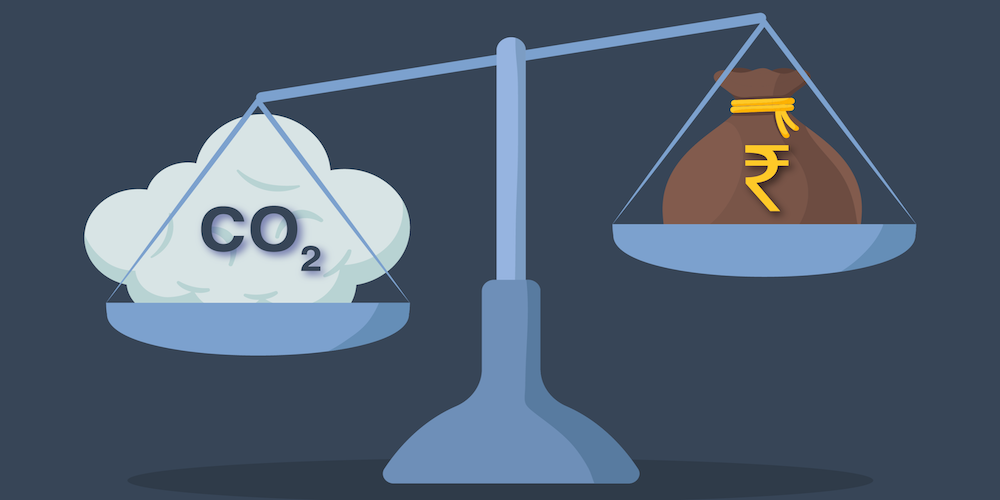
The most significant and modern pivot in India’s climate strategy is the operationalisation of the Carbon Credit Trading Scheme (CCTS). Initially enabled by the Energy Conservation (Amendment) Act of 2022, the scheme enters a critical phase as active institutional trading goes live.
This structural transformation establishes one of the world’s largest newly implemented compliance carbon markets, regulating hundreds of heavy industries across carbon-intensive sectors.
The programme forces a fundamental shift in corporate accountability. Emitters who exceed their facility-level intensity benchmarks must purchase Carbon Credit Certificates (CCCs), while entities utilising clean energy can monetise their savings.
On the global stage, this domestic framework acts as a vital economic shield. With the full implementation of the European Union’s Carbon Border Adjustment Mechanism (CBAM) and an upcoming UK carbon levy, Indian exporters face severe tariff risks on metal, engineering, and chemical goods. By pricing carbon domestically, India aims to retain fiscal revenues within its borders to fund internal green technologies, defending its economic interests while advancing toward its net-zero 2070 goal.
Parallel Ground-Level Programs
Alongside macroeconomic carbon instruments, India is expanding targeted ecological restoration and decentralised renewable programmes. The MISHTI (Mangrove Initiative for Shoreline Habitats & Tangible Incomes) scheme has intensified mangrove afforestation along the vast coastlines. This serves the dual purpose of creating potent carbon sinks and providing coastal defence against severe cyclonic activities.
Simultaneously, the energy transition has trickled down to rural and residential sectors. Schemes like PM-KUSUM are decoupling agriculture from the traditional electricity grid by deploying millions of solar-powered irrigation pumps.
For urban landscapes, the government continues to rely on the National Clean Air Programme (NCAP) to combat chronic PM2.5 concentrations, demanding stricter emissions tracking across non-attainment cities.

The Implementation Gap and Ecological Realities
Despite these sophisticated legislative and market frameworks, deep cracks exist between high-level macro programs and ground-level environmental realities. This divergence is illuminated by India’s low standing in the global Environmental Performance Index (EPI), which flags severe shortcomings in air quality, urban wastewater management, and biodiversity protection.
1. The Monitoring Blindspot: While the NCAP mandates cleaner urban air, environmental assessments reveal that approximately 85% of India’s population lives outside active 10-kilometer ambient air monitoring zones. This leaves over a billion citizens completely unrepresented in the data, masking the true severity of the public health crisis in semi-urban and rural areas.
2. Extreme Climate Whiplash: Macro-level carbon tracking cannot immediately suppress the micro-level climate disruptions pounding the subcontinent. Recent statistics prove that extreme weather events—such as unprecedented heatwaves, cloudbursts, and flash floods—occur on almost a daily basis across varying regions, causing widespread destruction to millions of hectares of arable cropland and threatening immediate food security.
3. Biodiversity and Habitat Fragmentation: While flagship programmes praise wildlife conservation numbers, the physical integrity of ecosystems is fraying. Planetary boundary frameworks indicate that biosphere integrity and freshwater changes have crossed safe operational thresholds. Habitat fragmentation, driven by mining and infrastructure development, has oversaturated existing wildlife reserves. Consequently, nearly 40% of wild tiger territories overlap with human settlements, resulting in a spike in human-wildlife conflicts.
The Path Forward
To bridge this green paradox, India’s environmental programmes must undergo a strategic realignment. The Carbon Credit Trading Scheme requires rigorous verification and price discovery mechanisms to ensure industries do not merely use credits as low-cost permissions to pollute.
Crucially, the power sector — which generates roughly 40% of national emissions — must be seamlessly integrated into the compliance boundary without triggering retail electricity tariff inflation for vulnerable populations.
More fundamentally, India must shift from centralised, bureaucratic governance to localised, community-centric climate resilience. Expanding the air-monitoring network to rural corridors, investing heavily in municipal solid-waste recycling, and protecting natural wetlands are non-negotiable prerequisites.
Market mechanisms are essential tools for a modernising economy. Still, they must be backed by strict local enforcement, scientific data collection, and an unwavering commitment to conserving the physical ecosystems upon which human survival ultimately depends.