WHEN EURASIANS HOLD HANDS
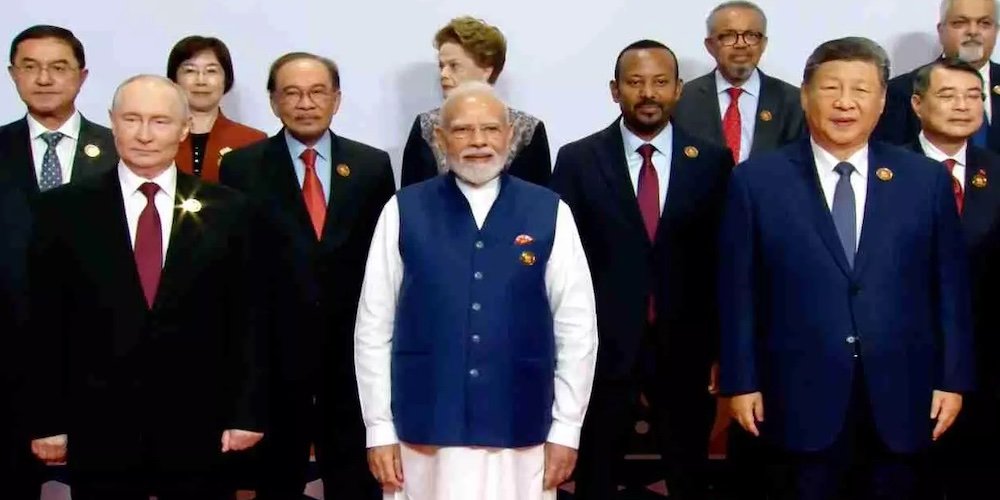
Proving the doubters wrong, the BRICS nations have urged ‘restraint’ in the Gulf War and a smooth flow of global trade. The joint declaration at the two-day summit has also expressed ‘firm opposition’ to the forced displacement of Palestinians by Israel.
India has moved along with the Global South. Its two allies, the United States and Israel, cannot but take note. Not surprisingly, the Western media played it down this morning as a group that has been seen as “falling like a ton of bricks”.
It was an achievement to have reached consensus on many issues, if not all. The two-day New Delhi meet sidestepped Ukraine (with Vladimir Putin attending), struck a balance between Iran and the UAE (heads of both shaking hands), and took a big swipe at the US-imposed tariffs, while flagging Gaza.
The participants included some of the actors shaping global events, deliberating in the shadow of President Donald Trump, who was not invited.
Prime Minister Narendra Modi hosted a ‘baraat’ with many ‘baraatis’, of the diplomatic kind. His critics at home fell silent as photographs adorned New Delhi, decked out in BRICS-themed signs and illuminated buildings and roundabouts.
Photographs of him exchanging pleasantries with Putin and China’s Xi Jinping are not new, though important since Xi visited after seven years of ups and downs on the Sino-Indian borders and in the economic arena.
But Modi holding hands with Iran’s Masoud Pezeshkian grabbed attention for its diplomatic significance. Xi and Putin may approve, but Trump could not have missed it amidst the Gulf War. Nor, for that matter, the caricature in The Indian Express newspaper by E P Unny, where Trump’s MAGA gets translated as “Make Asia Great Again.”
It was a summit where parleys taking place on the sidelines proved more important. One big takeaway was Modi and Xi declaring that they were “Partners not rivals, committed to resolution of boundary question”. India emphasised that “both sides must be guided by three mutuals: mutual respect, mutual sensitivity and mutual interest”.
BRICS strives to grow as a “non-Western”, not an “anti-Western” alliance, promoting trade in the currencies of its members. The US insists that BRICS is working to weaken the dollar’s predominance in world trade.
Trump has made no secret of his antipathy to the group and has actively imposed tariffs against India, China and Brazil, while sanctions, and more, continue against Russia. Far from ‘containing’ it, he may end up uniting its 11 members, who otherwise have numerous political and economic differences.
Money, as they say, makes the mare go. BRICS countries have gone beyond experimenting. India and Russia settle roughly 96% of their bilateral trade in currency mechanisms involving Indian rupees and Russian rubles.
South Africa has connected to China’s Cross-Border Interbank Payment System, allowing transactions with China to be settled directly in renminbi. Brazil and China are increasingly using their own currencies in bilateral trade, while India and the UAE have settled transactions in rupees and dirhams. China and Russia have shifted much of their bilateral trade into their national currencies.
Yet, the International Monetary Fund (IMF) says the US dollar accounts for 57% of global trade and the Chinese currency, only two%.

These are volatile times. Conceived as a group to promote economic cooperation among larger developing nations, the 20-year-young BRICS often encounters overlapping political issues. The two ongoing major conflicts currently threaten global trade, access to key waterways, devastation of food baskets and even deliberate destruction of oil and gas.
Friction is inevitable when the West is also suspicious of the Shanghai Cooperation Organisation (SCO), obviously a China-led group with Russia and the Central Asian Republics that met in Bishkek last month. Xi, Putin, and Modi, among others, attended. They stirred the Asian Teapot, as it were. Incidentally, ‘Chai’ in India is ‘Chay’ in Russian and ‘Cha’ in Mandarin!
Unsurprisingly, the SCO and BRICS summits have seen ‘established’ analysts in ‘established’ Indian media struggling to strike a ‘balance’ between “non-Western” and what is “anti-Western”. Perplexed by the talk of a US-China rapprochement, they are wary of India’s moves to firm up ties with China.
Economic ties, even if heavily in China’s favour, could prompt both sides to resolve their border management issues, with a sense of urgency. The Corps Commanders of the two armies met last month.
Here, one is reminded of the defining core of former Prime Minister P. V. Narasimha Rao’s reorientation of India’s foreign policy: The strategy of promoting economic ties to build better political relations. Taking office during the historic global shifts of 1991 — marked by the collapse of the Soviet Union and India’s own severe balance-of-payments crisis — Rao pioneered a pragmatic transition from Cold War-era ideological posturing to active economic diplomacy.
His signal contribution was the “Look East Policy”, to work with Southeast Asia, later renamed “Act East Policy” when the late Sushma Swaraj was the External Affairs Minister.
The two-day leaders’ summit represents the culmination of India’s massive year-long diplomatic campaign. Under India’s presidency, more than 350 ministerial, working-group, and track-two engagements took place across 25 cities nationwide.
Modi proudly announced that the 20-year-old BRICS has evolved into a formidable intergovernmental coalition representing over 45 per cent of the world’s population and nearly 30% of global gross domestic product (GDP). More and more nations want to join it, without saying so, hoping to gain some space from the Trumpian tariffs’ terror.
Long term, if New Delhi succeeds in steering the bloc toward a cohesive final declaration anchored in economic cooperation, digital innovation, and institutional reform, it will solidify its standing further as a primary voice for the Global South and an indispensable global balancer.
But if deep internal divides over currency, trade, and West Asian conflicts overshadow the proceedings, it will highlight the inherent structural limits of an expanding bloc attempting to reconcile vastly different national interests.
India’s simultaneous engagement with Washington and the West on one hand and with Moscow and Beijing on the other reflects a broader approach: maintaining strategic autonomy rather than choosing exclusive geopolitical camps. With this achieved, even if partially, India has carried the day.