Geothermal Energy: India’s Clean Energy Journey
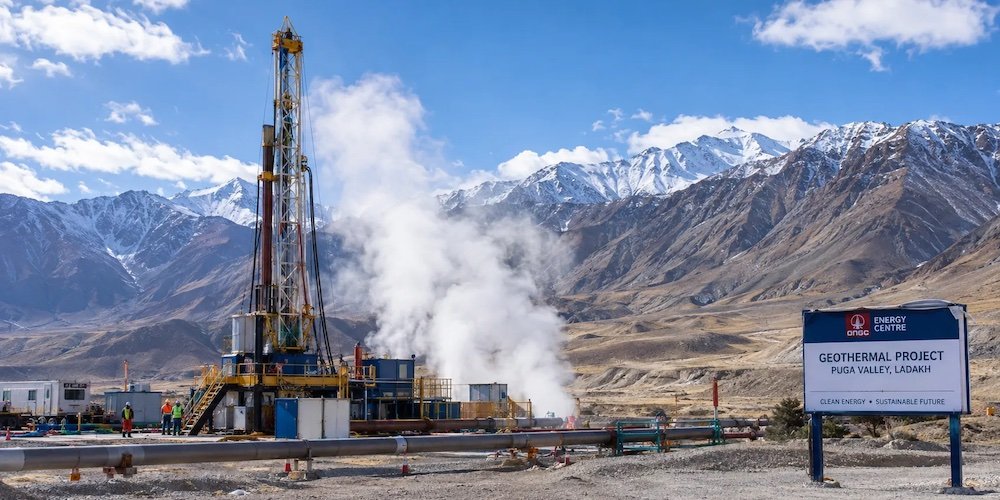
The intense heat in the Earth’s interior is a powerful source of clean energy called geothermal energy. Given India’s rich geothermal resources, this form of energy holds immense promise as a round-the-clock available source of power. The National Policy on Geothermal Energy aims to harness this potential. It seeks to make geothermal energy a key part of the nation’s renewable energy story as India drives towards Net Zero by 2070. The recent commissioning of the first two geothermal wells in Ladakh marks the beginning of this journey
As India navigates an ambitious transition toward green energy, its renewable portfolio has long been dominated by solar and wind power. However, these resources are inherently intermittent, fluctuating with weather patterns and seasonal shifts. To achieve its target of Net Zero emissions by 2070, India requires a stable, weather-independent source of renewable energy capable of providing reliable, round-the-clock base load power. Geothermal energy — the clean heat extracted from the Earth’s crust — has emerged as a critical pillar in fulfilling this requirement.
With a theoretical potential estimated at 10.6 Gigawatts (GW) across hundreds of thermal anomalies, India is actively transitioning this subterranean wealth from a scientific curiosity into a tangible component of its energy matrix.
Geological Landscape and Key Provinces
India’s geothermal landscape is diverse, shaped by complex tectonic activities and deep-seated structural fractures. The Geological Survey of India (GSI) has identified approximately 340 hot spring localities across the country. These thermal fields are categorised into distinct geographic and geological provinces, each possessing unique thermal gradients and commercial possibilities.
The Himalayan Province stands out as the most promising high-temperature zone. Located along the collision boundary of the Indian and Eurasian tectonic plates, this region includes fields like Manikaran in Himachal Pradesh and the Puga and Chhumathang valleys in Ladakh.
Beyond the mountains, the Son-Narmada-Tapi (SONATA) Lineament Belt cuts across central India, offering significant thermal prospective zones.
Additional major regions include the Cambay Graben in Gujarat, the West Coast geothermal province, and the deep sedimentary basins of the Godavari and Mahanadi rivers.
Together, these provinces provide an expansive geographic footprint for potential geothermal development.

The Breakthrough at Puga Valley
For decades, utilising geothermal energy remained restricted to small-scale direct applications, such as space heating or greenhouse farming. The turning point arrived with the commissioning of India’s first operational geothermal exploration wells in Ladakh’s Puga Valley.
Led by the ONGC Energy Centre, this milestone project operates in one of the most hostile, high-altitude environments in the world, sitting at over 14,000 feet above sea level.
Exploratory drilling at Puga has successfully reached depths of 1,000 metres, revealing a highly active hydrothermal system. Shallow testing registered temperatures as high as 135°C at a depth of just 400 metres, indicating a potent reservoir below. These wells serve as the foundational infrastructure for a 1-Megawatt (MW) pilot power plant. This initial project aims to supply continuous, clean electricity to isolated Himalayan communities that currently depend heavily on expensive, polluting diesel generators during extreme winters. Success at Puga provides a technical blueprint for scaling up deep-drilling operations across other high-enthalpy zones in India.
Policy Impetus and the 2025 Framework
Recognising the massive upfront capital investment and risk associated with deep drilling, the government introduced the National Policy on Geothermal Energy in 2025. This policy provides a comprehensive regulatory framework designed to de-risk investments and attract public-private partnerships.
A core component of the policy is the strategic integration and reuse of existing infrastructure. By leveraging data and wells from abandoned or idle oil and gas exploration sites, developers can cut exploration costs significantly.
Furthermore, the policy outlines financial incentives, streamlined environmental clearances, and clear grid-integration guidelines.
Beyond power generation, the 2025 framework heavily emphasizes direct-use applications. Projects like the Tapri Geothermal Cold Storage facility in Himachal Pradesh demonstrate how geothermal heat can be diverted to preserve agricultural yields, cutting regular fuel use by up to 80% and shielding farmers from climate vulnerabilities.
Challenges, Socio-Economic Impact, and the Path Forward
Despite clear progress, scaling geothermal energy in India presents distinct hurdles. The initial exploration phase carries high fiscal risk, as drilling exploratory wells offers no guarantee of finding viable steam reservoirs.
Additionally, drilling in remote terrains like Ladakh demands specialised logistics to prevent equipment damage from sub-zero temperatures.
However, the long-term rewards far outweigh these early obstacles. Geothermal plants require minimal land compared to sprawling solar farms and emit up to 99% less carbon dioxide than traditional coal plants.
Economically, expanding this sector is projected to generate between 350,000 and 700,000 jobs, stretching from specialised drilling engineering to localised plant maintenance.
In sum, India’s geothermal journey is transitioning from early exploration to active, grid-connected power generation. Driven by the technological milestones in the Puga Valley and supported by the 2025 National Policy, the country is unlocking a vital asset. By successfully capturing the earth’s natural heat, India diversifies its clean energy infrastructure, strengthens local grids, and moves closer to its long-term sustainable energy goals.