Mohan Bhagwat’s Successful Visit a Huge Embarrassment for Mamdani
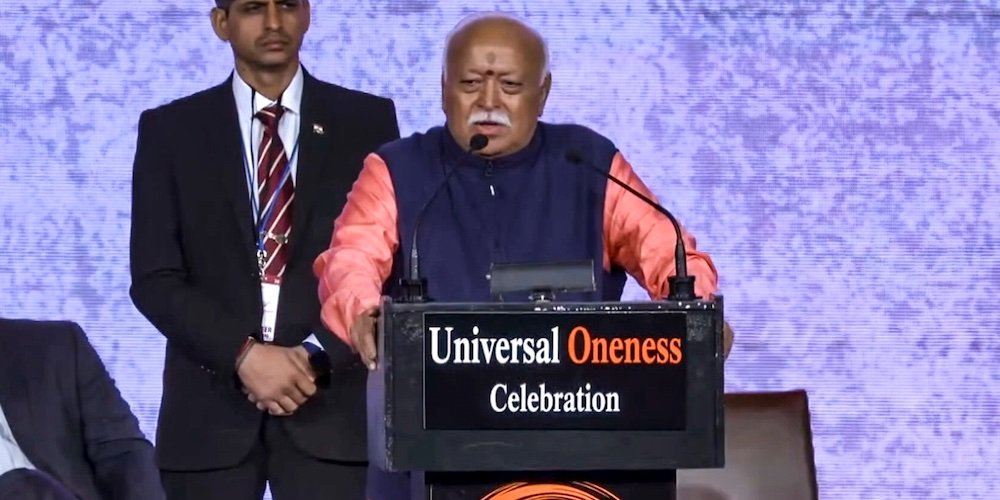
The recent visit of Rashtriya Swayamsevak Sangh (RSS) Sarsanghchalak Mohan Bhagwat to New York City for the “Universal Oneness Celebration” at Madison Square Garden unfolded against a backdrop of intense international debate and public scrutiny. Marking a notable moment in the global outreach surrounding the RSS centenary year, the event drew thousands of attendees from the Indian diaspora alongside significant political opposition from local and international figures, including New York City Mayor Zohran Mamdani
Long before Mohan Bhagwat arrived in New York, the planned gathering at Madison Square Garden on August 29 became a focal point for intersecting domestic and international politics.
Civil-rights coalitions, interfaith groups, and human-rights organisations voiced strong opposition to the platform provided for the leader of the Hindu nationalist organisation. Concurrently, bodies such as the US Commission on International Religious Freedom raised systemic concerns regarding minority rights in India.
The political friction escalated when New York City Mayor Zohran Mamdani publicly declared his opposition to the event. Labeling the ideological framework of the RSS as exclusionary, the Mayor’s office navigated the boundaries of municipal authority, acknowledging that the city lacked the legal jurisdiction to cancel a lawfully organised private assembly on private property.
For supporters of the organisation, this public stance by municipal leadership served to amplify the visibility of the tour. Pro-RSS commentators and diaspora groups argued that attempting to delegitimise a private cultural gathering infringed upon foundational principles of freedom of expression and assembly protected under the First Amendment of the U.S. Constitution.
Rather than dampening enthusiasm, the pre-event controversy galvanised mobilisation efforts, turning an anticipated diaspora convention into a high-profile test of free speech and community presence in Manhattan.
The Madison Square Garden Gathering and Interfaith Messaging
The “Universal Oneness Celebration” convened thousands of participants representing various regional associations and partner organizations. The atmosphere inside the arena featured traditional attire, cultural displays, and speeches centered around civil responsibility, diaspora heritage, and global harmony.
Addressing the assembly, Mohan Bhagwat focused heavily on philosophical concepts of unity in diversity. In an address that drew considerable international attention, Bhagwat articulated a direct stance on communal coexistence, stating that any individual identifying as Hindu who believes that Muslims have no place in India ceases to act in accordance with true Hindu principles.
This framing was positioned by organisers as an explicit reaffirmation of social harmony and shared heritage, serving to address external criticisms regarding the long-term vision of India as a Hindu nationalist state.
In addition to the main arena address, Bhagwat’s itinerary included community outreach events, meetings with enterprise executives and venture capitalists, and a visit to the historic birthplace of the International Society for Krishna Consciousness (ISKCON) at Second Avenue, where he participated in community food distribution initiatives. These engagements were utilised to project an image of cultural continuity, spiritual diplomacy, and grassroots community service.
Assessing the Outcome
Determining whether the visit was a “success” depends heavily on the evaluative framework applied. From the perspective of the RSS leadership and the organising bodies such as the American Hindus for Engagement and Dialogue (AHEAD), the event achieved its primary objectives. It successfully mobilised a large segment of the North American diaspora, provided a high-visibility platform to articulate organisational narratives directly to Western audiences, and countered prevailing international caricatures with an emphasis on interfaith dialogue and universal consciousness.
Conversely, critics and human-rights advocates maintained that philosophical declarations of inclusivity made abroad do not reconcile with documented communal tensions and policy realities in domestic Indian politics. For these coalitions, the protests outside the venue and the explicit pushback from municipal leaders like Mayor Mamdani may have registered international dissent against the mainstreaming of majoritarian ideologies.

But the fact remains that such expression of dissent was confined to a tiny section of the Americans and non-resident Indians who champion exclusivist identity politics in the name of caste and religion. In fact, most of them are non-Hindus and critics of Indian prime Minister Narendra Modi.
Viewed thus, the New York visit of Bhagwat demonstrated the increasing transnational integration of Indian domestic politics into Western civic spaces. By navigating intense local opposition, legal neutrality under U.S. constitutional protections, and high-volume media coverage, the event underscored the complex realities of diaspora mobilisation in contemporary global politics.
Economic and Diplomatic Implications of Transnational Diaspora Mobilisation
The high-profile gathering of RSS leadership in New York underscores a broader structural shift: the Indian diaspora is no longer just a source of passive remittances, but a highly organised, politically potent, and economically influential force in Western civic spaces.
When organisations deeply embedded in India’s governing ecosystem engage directly with overseas communities, it triggers a complex web of economic and diplomatic ripples across both Washington and New Delhi.
The financial footprint of the Indian diaspora in North America is unparalleled. As one of the highest-earning ethnic demographics in the United States, their mobilisation directly shapes bilateral economic corridors.
Events that bring together diaspora enterprise executives and venture capitalists serve as informal networking hubs. These interactions strengthen the bilateral tech pipeline, facilitating cross-border investments in critical sectors like artificial intelligence, semiconductor manufacturing, and renewable energy.
Philanthropic Redirects and Soft Power Funding
Transnational cultural movements heavily rely on diaspora philanthropy. Millions of dollars flow annually into specialised non-profits, think tanks, and cultural preservation trusts. This capital acts as a form of non-governmental economic diplomacy, funding grassroots initiatives in India that align with specific cultural and social visions.
High-visibility diaspora events signal political stability and cultural continuity to major institutional investors. When Wall Street executives and tech leaders witness deep, organised community support for narratives aligned with New Delhi’s leadership, it can lower the perceived “political risk” of long-term capital deployment in the Indian market.
Diplomatically, Bhagwat’s event highlighted the friction between local municipal politics and federal foreign policy, while showcasing the strategic leverage of a well-integrated immigrant community.
The pushback from local municipal leaders, such as New York’s mayoral office, exposed a clear systemic boundary. Because the United States strictly protects freedom of speech and assembly under the First Amendment, federal diplomatic channels remained uncompromised by local political protests.
So, Washington can maintain its strategic partnership with New Delhi, citing constitutional protections to neutralise demands from domestic pressure groups seeking to block foreign ideological leaders.
Here, the diaspora turns out to be a Domestic Lobbying Force. The ability to mobilise thousands of voters in critical economic hubs like New York transforms the diaspora into an essential domestic lobbying bloc.
U.S. lawmakers are acutely aware of the financial and electoral power of Indian-American constituents. Consequently, strong diaspora backing for organisations connected to New Delhi makes it politically costly for Washington to take overly critical diplomatic stances on India’s internal governance.
Viewed in terms of a broader geopolitical theatre, a highly organised, pro-India diaspora acts as a vital counterweight to adversarial lobbying efforts. By dominating the civic narrative in major Western cities, these communities actively challenge and dilute anti-India resolutions, media campaigns, and academic critiques, safeguarding India’s international reputation and diplomatic flexibility.