
CATASTROPHIC FLASH FLOOD IN NEPAL
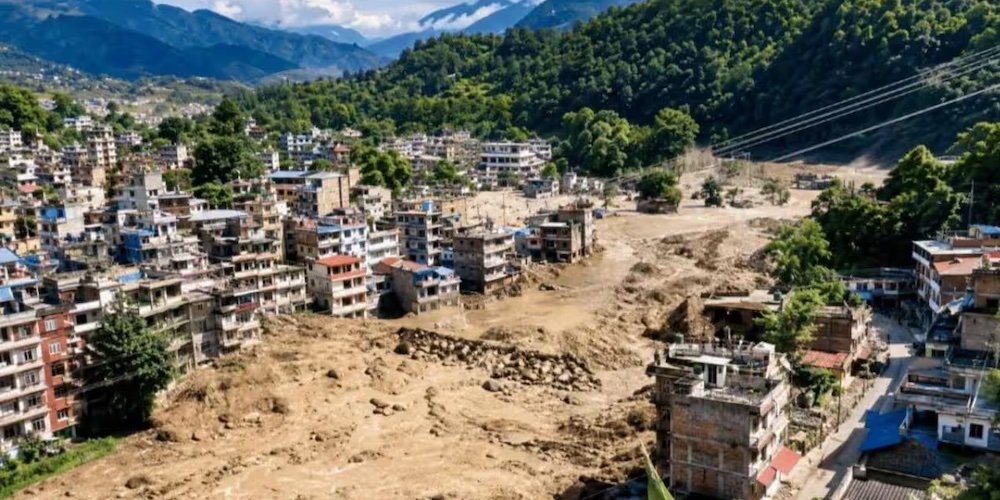
Himalayan country of Nepal has seen umpteen natural calamities in the past and has overcome several of them also.
In August 2025, a flash flood was caused along Tibet Nepal border when a glacial lake in Tibet over flowed due to rise in temperature. Nine people were killed and crucial infrastructure, including a bridge connecting Nepal with China was damaged.
But it appears, scale of devastation caused by the present massive flood due to outburst of another glacial lake along the same border may not have any parallel.
POSSIBLE CAUSES
According to a Scientist of Indian Institute of Science, collapse of a large chunk of snow and rocks from a hanging glacier may have temporarily blocked the river. It was the most likely cause. Thus somewhat weak seismic activity (4.4 or 5.5 on Richter scale), reported on the eve of the tragedy was ruled out as the triggering factor.
Collapse of a glacier mass may have accelerated the flow of Lhende Khola and Bhote Koshi rivers. Mass of ice may have generated immense energy, carrying water, sediments and large boulders, downstream.
It has been simultaneously gathered that Lhende Khola has got flooded twice in last fourteen months.Thus a sudden surge could have caused all the push downstream.
IMPACT OF FLASH FLOOD
According to preliminary reports, flash floods in Lhende Khola and Bhote Koshi river that began at 9 a.m., local time, on August 26, swept away innumerable houses, fields, shops and other establishments on both sides of sixty kms road from Gyirong in Tibet to Rasuwa and Dhading Districts in Nepal. Severe impact was felt right upto Nuwakot District.
VIEW OF EXPERTS OF ICIMOD
Experts are of the view that a large volume of ice and debris of rock may have entered Lhende Khola, a tributary of Bhote Koshi river. A sudden surge would have carried water, sediments and large boulders downstream.
It may be noted that Bhote Koshi river later joins Trishuli river which eventually flows into India (Bihar) as the Gandak river. Rightly alerts have been issued by Govt.of Bihar to move people to safer places.
FURTHER IMPACT
Scores of single unit, multi-storeyed buildings, shops, vehicles, furnitures etc were buried under mud within minutes in Nuwakot. Some people ran as fast and as high into nearby hills and thus survived. Swollen river took a large number of people, cattle and household goods.
POWER PROJECTS BEARING THE BRUNT
A dozen hydel power projects have been badly hit or destroyed.These are : Chilimi,Trisuli I, Upper Trisuli, Rasuwagadhi, Rasuwa, Bhotekashi, Sanjen khola,Upper Mailung, Mailung Khola and Laidang Khola.
As per latest inputs, one hundred workers were still trapped inside a tunnel of Upper Trishuli -I project.The tunnel is blocked by mud, debris and adverse weather conditions.
India was importing 963.4 MW of power from Nepal as on August 26. Not only India, electricity supply to Bangladesh has been also affected.
DAMAGES ELSEWHERE
Gorkha, Nawalparasi and Chitwan Districts were also reported to be affected by flood fury. Swollen Trishuli river has left a wide swathe of destruction on both sides of its course. Innumerable bridges were swept away, thus impacting or blocking traffic to popular tourist sites of Chitwan and Pokhara.
DAMAGE IN CHINA, THEIR OFFICIAL STAND
As far as Chinese side is concerned, it has been gathered that boulders, mud and strong current of water has destroyed several buildings and vehicles. As many as 265 persons were reported missing.
FEARS ABOUT SECOND OVERFLOW
The Chinese authorities have informed Nepal that around 2 million cubic metres of water had accumulated in a lake on border with another 3 million cubic metres assembling in three days. It could lead to a possible breach.
Subsequently risks from overflowing lake were found to be manageable. People of the area could heave a sigh of relief.

PEAK TOURIST SEASON
As it is trekking season for Gosalkunda and several other lakes in Rosuwa (108 in number) and it is also the main season for Mount Kailash-Mansarovar Yatra, the area is choked with foreign tourists. As such hectic search is on to locate hundreds of them hailing from 32 countries.
From India one of the largest groups of pilgrims to Mansarovar Lake was 80 member team from Isha Foundation. Others hail from T.N., Andhra, Keralam, Odisha, West Bengal, Gujarat etc.
DEAD & MISSING PERSONS
Upto 11 p.m. on August 29, 675 persons were declared dead and over 2400 were missing. In addition, about 4451
were rescued, including 517 by air. Over 15,000 security personnel have been deployed in search and rescue operations with 6755 from Nepal Army alone.189 dead bodies were recovered from Bhote Koshi river as its level was rising.
As per MEA, number of missing Indians had come down to 275 on August 29. This excluded 21 from Tamil Nadu and another group from Maharashtra which had returned. Further, 900 Indians were reported safe in China and that 598 of them had crossed over to Nepal.
They fought death, but managed to come out.
Incidently a Chinese Immigration Check post was also swept away.
In a relieving news, 63 Indians working in two power plants of Nepal have, at last been rescued.
Apart from Indians, 642 people from 32 countries are still missing. Break up being : USA 90, Ukraine 55, Malaysia 51, Australia 39, U.K. 33, Canada 25, Others 83. Several may have been rescued by now.
PATHETIC SCENE
Many towns & roadside villages appear Ghost towns.In all 50 bridges have been swept or destroyed and 40 kms of roads no longer exist. Rice & maize fields, Banana & Apple orchards, poultry sheds, all have been destroyed. Digging slushy land to pull out dead is becoming a herculean task. Among 8 affected Districts,worst hit continues to be Rosuwa District.
INDIAN HUMANITARIAN AID TO NEPAL
First plane containing ten tons of urgently needed assistance was sent by India in two aircrafts on 26th August evening.Second Plane carrying 37.5 tons of materials was despatched on August 27. Bailey bridges too were sent to restore communication. Third Plane with ten tons of materials was sent on 28th August. An 11 member medical team & a team to assess tunnel rescue operations also has accompanied. Fourth plane with 11 tons of aid material was leaving on August 30.With this a total of 68.5 tons of humanitarian aid has been sent to Nepal.
This is in the background of Nepal earlier saying NO to rescue teams from India & many countries that had offered help. Now it has been clarified that aid from India, China, Australia and South Korea was welcomed in the areas of rescue from tunnels, DNA testing and Forensic tests. India’s solidarity with Nepal should not be mis understood.
INDIA’s EXPERIENCE WITH MAJOR FLASH FLOOD EPISODES
India has faced major flash flood incidents in recent years : Kedarnath Mega Cloud burst in June, 2013 leading to over four thousand deaths, Chamoli disaster of February, 2021 resulting into death of two hundred persons, Sikkim-South Lhonak lake burst in October, 2023, which took lives of approximately two hundred people and Dharali heavy quantum of rainfall in August, 2025, which led to loss of about 70 persons.
One may note that these mega cloud bursts not only claimed hundreds of lives, disruption of communication took place and large scale damages also happened. Full force of muddy water not only carried away personal belongings but also family members. Affected lots had unimaginable fears for days owing to overflow situation.
EARLY WARNING SYSTEMS
Following Chamoli disaster, NDMA has initiated an effort to mitigate the risks from such events through installation of early warning systems on glacial lakes, considered vulnerable to breaches.
It is also proposed to strengthen the boundaries of these glacial lakes in four states of Arunachal Pradesh, Sikkim, Uttarakhand & H.P.
Programme covers J&K and Ladakh as well.
As per ISRO, of 2431 glacial lakes larger than ten hectares, 676 had expanded notably between 1984 and 2023. It may be considered a warning for future.
CONCLUSION
Nepal may consider learning from Indian experiences. Considering the scale of ongoing disaster, heightened vigilance is called for not only in Nepal but also on possible repercussions on river systems of Bihar. Areas, such as, Bagaha, Valmikinagar & Koshi Barrage need to be closely observed.Level of water in Gandak has begun rising and ten dead bodies swept from Nepal have been recovered.

(The author is former Chief Secretary, Sikkim. Views are strictly personal)


Well researched analysis and excellent narration 👍