Global Prominence of Indian Coconuts
India is a global leader in coconut production, accounting for over 31% of the world’s total output. The sector serves as a massive economic driver, supporting the livelihoods of nearly 30 million people, including 10 million farmers. According to the Ministry of Agriculture (DA&FW), India produces over 20,300 million nuts annually across 2.19 million hectares, with states like Tamil Nadu, Karnataka, and Kerala dominating the landscape
Across the sweeping coastlines and lush interiors of India, the coconut palm stands as an enduring symbol of ecological resilience and cultural heritage. Fondly revered as the ‘Kalpavriksha’ — the divine tree that fulfills all life’s necessities — the coconut is far more than a cultural staple; it is an economic powerhouse.
Today, India commands the global stage as the world’s leading coconut producer, accounting for an impressive 31.24 percent of the global output. Generating an annual yield exceeding 20,300 million nuts across 2.19 million hectares (third in the world in area under cultivation) , this vibrant agricultural sector forms the economic backbone for nearly 30 million people, including some 10 million smallholder farmers.
According to the DA&FW statistics, India produced about 20,301.22 million nuts of coconut during 2024-25 from 2.19 million hectares. Average productivity stood at 9,249 nuts per hectare.
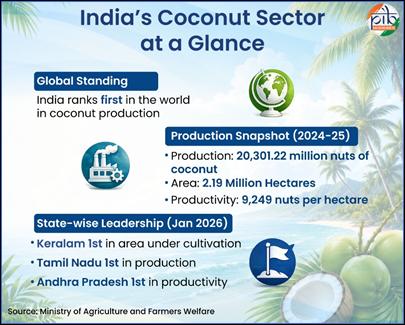
Within the country, Keralam has the largest area under coconut cultivation, covering nearly 7.54 lakh hectares and producing about 5,149.87 million nuts. Tamil Nadu leads coconut production, while Andhra Pradesh records the highest productivity, followed by West Bengal and Tamil Nadu.
Beyond primary production, the coconut sector has emerged as an important contributor to agricultural exports, supporting India’s export ambitions. The Government aims to achieve USD 2 trillion in exports by 2030 and USD 21 trillion by 2047.
Supporting these export ambitions, India’s coconut exports have recorded sustained growth in recent years. Coconut product exports reached ₹7,038.35 crore (USD 794.70 million) in 2025-26. This marked a 62 percent increase over ₹4,349.03 crore recorded in the previous year. This underscores the growing global demand for coconut products from India. The growth also highlights the significant progress made since 2001-02, when exports were only ₹25.3 crore. During that period, exports were largely restricted to traditional products such as coconut shell charcoal, coconut oil, coconut, desiccated coconut, etc.
Over time, India’s coconut export basket has evolved from traditional commodities to a diversified range of value-added products. The sector now caters to global demand for virgin coconut oil, coconut milk, and coconut water. It also supplies other application-oriented products, strengthening India’s competitiveness in international markets. Market outreach has expanded beyond the Middle East, once the primary destination. Exports now reach markets across Europe, the Americas, and Australia.
Over the past five years, the USA, UAE, Sri Lanka, Germany, Russia, Turkey, Belgium, UK, and Netherlands have emerged as major trading partners. Key export products include activated carbon, coconut oil, fresh/frozen/grated coconut, copra, and desiccated coconut. Among these, activated carbon has consistently dominated export volumes.
Yet, beneath the serene rustle of green fronds lies a complex landscape of more immense commercial opportunity and stark structural challenges that will determine the future of agrarian prosperity in rural India.
The contemporary landscape of coconut cultivation is undergoing a profound paradigm shift, transitioning from a traditional commodity market to a high-value industrial frontier. Historically, growers relied almost exclusively on raw nut sales or standard copra crushing — a market highly susceptible to volatile price fluctuations. Today, the horizon is illuminated by product diversification.
Advanced processing technologies have unlocked premium markets for items like Virgin Coconut Oil (VCO), coconut milk, and coconut water, driven by a surging global appetite for plant-based, wellness-oriented food products.
Beyond consumption, the industrial applications of the palm are expanding rapidly. Coconut shells, once treated as agricultural waste, are now converted into high-demand activated carbon used globally for advanced air and water purification processes. Similarly, coir and geo-textiles find vital applications in eco-friendly engineering, soil erosion control, and sustainable horticulture.

To maximize the commercial viability of these outputs, innovative growers are redefining land usage through multi-tier agroforestry systems. Because the vertical architecture of the coconut palm leaves ample sunlight and ground space under-utilized, farmers in pioneering regions like Karnataka, Tamil Nadu, and Kerala are successfully integrating shade-loving, high-value companion crops. Cultivating intercrops such as cocoa, coffee, black pepper, and high-yielding fruits beneath the palm canopy provides smallholders with continuous, diversified revenue streams. This progressive framework not only hedges against raw coconut price drops but also enhances local soil health.
Recognising these profound benefits, government frameworks like the Coconut Development Board’s newly expanded initiatives are actively funding plantation modernization, promoting regional exports, and driving geographical expansion into non-coastal frontiers like Bihar, Gujarat, and the Northeast.
The macroeconomic footprint across domestic boundaries further underscores these regional dynamics. While Tamil Nadu and Karnataka form the primary industrial processing hubs for oil and coir due to their massive production volumes, Kerala maintains the largest land footprint for cultivation, though it faces an urgent need for tree rejuvenation to combat declining productivity. Meanwhile, Andhra Pradesh sets the national benchmark for farming efficiency, leading the country in average nuts harvested per hectare. These regional strengths highlight the immense potential of the sector when modern agronomic practices are systematically scaled.
However, this golden horizon is shadowed by persistent structural bottlenecks that threaten to limit the sector’s long-term growth. Foremost among these is an acute labour crisis. Traditional harvesting relies heavily on highly skilled manual tree-climbers. As rural youth increasingly pivot toward urban employment opportunities, the industry faces severe labor shortages and soaring wage rates, leaving many growers unable to harvest their crops in a timely or cost-efficient manner.
This human resource deficit is compounded by the biological reality of aging plantations. In traditional cultivation belts, millions of palms have passed their peak productive years, leading to a natural decline in yields. Rejuvenating these senile tracts requires replacing them with modern, High-Yielding Varieties (HYVs) — a capital-intensive process that leaves smallholders facing a multi-year financial gap before the young palms bear fruit.
Compounding these structural challenges are the escalating realities of climate change and biological vulnerability. Coconut palms are highly sensitive to water stress and thermal extremes. Recent meteorological trends — marked by prolonged droughts, erratic monsoon cycles, severe groundwater depletion, and intense coastal cyclones — have directly contributed to reduced nut sizes and lower kernel quality across major producing belts.
Concurrently, changing weather patterns have intensified pest invasions and disease outbreaks. Farmers find themselves locked in an ongoing battle against destructive biological hazards, from the rhinoceros beetle and rugose spiraling whitefly to devastating conditions like root-wilt disease, which can decimate entire production clusters if left unmanaged.
Because over 90 percent of India’s coconut farms consist of fragmented, marginal smallholdings, individual cultivators frequently lack the financial leverage or technical resources to implement automated harvesting tools, set up advanced drip-irrigation networks, or negotiate favorable terms with large-scale corporate processors.
Ultimately, India’s coconut sector stands at a critical historical juncture. The opportunities presented by industrial diversification, sustainable agroforestry, and proactive policy support offer a clear roadmap toward unparalleled rural wealth creation. However, realizing this potential requires a synchronized, systemic response to address the crises of labor, climate, and fragmentation. By accelerating the adoption of mechanical climbing devices, scaling up community-based Farmer Producer Organizations (FPOs), and investing heavily in climate-resilient cultivars, stakeholders can safeguard this invaluable ecosystem.
Only through such modern interventions can India ensure that its beloved ‘tree of life’ continues to anchor the livelihoods of millions and drive agrarian economic growth for generations to come.