RIGHT ANGLE – GenZ in India Too Contradictory for a Street Revolution
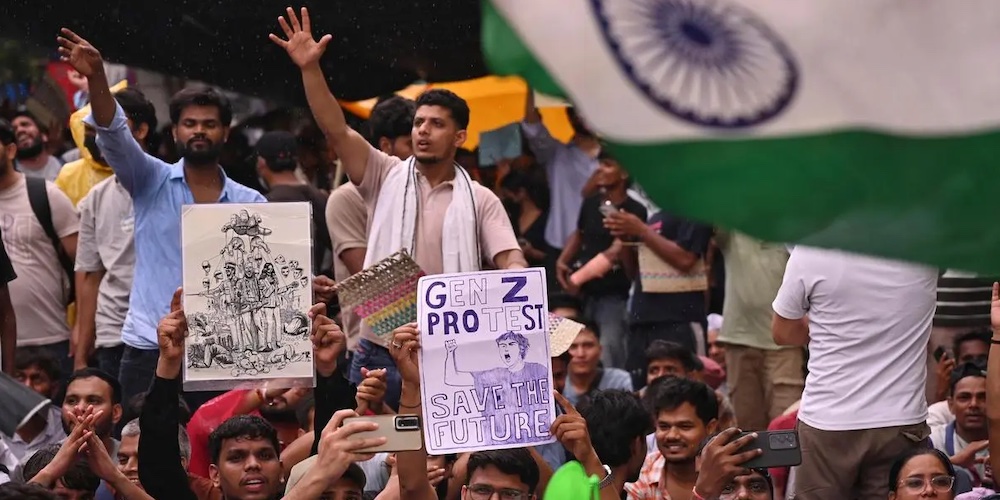
GenZ in India is 27 crore people. Born roughly between 1997 and 2012, they are the first generation to grow up with Jio data, UPI, Instagram Reels, and coaching apps.
In Nepal and Bangladesh in 2024, GenZ took to the streets and brought down governments. Social media called it “the GenZ revolution.” In India, the same energy gave us the “Cockroach Party” memes, AAP worker turncoats, and hashtag activism that dies in 48 hours.
Is India simply too large, too contradictory, and too diverse for one street protest to change the government? The answer is “YES”.
All told, Indian GenZ is not one block. 10 GenZs are living in one country. And there are mutual contradictions among them.
On one side, there is a group that is said to constitute 44 to 50 percent of the world’s Global Capability Centers (GCCs), employing over 2 million professionals.
While estimates vary depending on the exact metrics and year, it serves as the primary hub for multinational enterprise transformation, R&D, and digital operations. GenZ is building SaaS startups, making $10k/month on YouTube, cracking UPSC at 22.
On the other hand, 42% of graduates are unemployable as per Nasscom 2024. NEET, JEE, SSC aspirants spend 4 years in Kota hostels. The anxiety is real. And many of them depend on the pernicious system of caste-based reservations.
The second contradiction is between those who are hyper-nationalist and those who are hyper-global. A GenZ in Delhi will trend “BoycottChina” and, in the next reel, do a “GRWM (Get Ready with Me” in Shein” (unboxing or trying on budget-friendly fashion pieces, styling a complete outfit, and often pairing it with SHEGLAM cosmetics). A GenZ in Bengaluru wants a US H1B but also wants India to be a Vishwaguru. They are both proud and impatient.
The third contradiction is Political vs Apolitical. Some in GenZ fact-check on X, donate to crowdfunding, and roast politicians. But party membership? Door-to-door campaigning? That feels “cringe” to many. Politics for them is not a career.
This is not hypocrisy. It is survival in a country where your Instagram bio and your parents’ expectations pull you in opposite directions.
And that brings me to take a serious look at the “Cockroach Party”. Many consider it to reflect GenZ, but in reality, that is not the case. Let me explain.
Many cockroaches may have said it recently at Jantar Mantar, satirical, though: “ We survive everything, we are everywhere, and nobody likes us, but we can’t be killed.” But the fact remains that almost all of their leaders are ex-AAP (Aam Aadmi Party) workers and student activists belonging to left groups such as SFI and AISA that are present only in some select universities.
They do not represent GenZ for the following reasons:
One, the real GenZ movements in India that one has seen were through anti-CAA protests, farmers’ social media, #MeToo – started on WhatsApp groups and college campuses. But none of them were driven by people sitting in a party office. In any case, the Cockroach Party was formed “after” the meme, not before the anger.
Two, most of their supporters and social content came from JNU, DU, and AAP’s old volunteer network in Delhi. A GenZ in Assam, Tamil Nadu, or Bihar didn’t see themselves in it. Language, issue, and tone were North Indian and English-medium.
Three, it is wrong to compare them with what one saw in Bangladesh or Nepal. Bangladesh’s GenZ protested quota in jobs. Nepal’s GenZ protested corruption and a social media ban. But here in India, the Cockroach Party had sarcasm, but no 3-point charter. Memes don’t fill stomachs.
In sum, GenZ in India is skeptical of parties made by “former” activists. They’ve seen too many student leaders become MLAs. Authenticity matters, and ex-AAP workers running a “new” party felt like recycling.

Besides, there is a structural point as to why India is not Nepal or Bangladesh. First, there is the size of the population. Nepal’s population is 3 (three) crore. Bangladesh’s population is 17 crore. But India’s population is 144 crore.
A 5 lakh crowd in Kathmandu paralyzes the city. A 5 lakh crowd in Delhi is 3 metro lines. To change Delhi, you need 20 state capitals moving together. That coordination is nearly impossible without party machinery.
Secondly, India is too federal and too diversified. In Bangladesh, the issue was one of quota reform. In Nepal, it was one of corruption. But in India, the situation is complicated. GenZ in Kerala is protesting NEET. In Maharashtra, it is a Maratha reservation. In UP, it is paper leaks. In Karnataka, it is language policy.
In other words, in India there is no “one” GenZ issue. The country is too diversified for one slogan to work in Gujarat and Manipur at the same time.
Thirdly, Bangladesh and Nepal had blocked institutions. In India, there is still churn. GenZ can start a startup, get a remote US job, crack CAT, become an influencer, and migrate to Germany. The street is one option, not the only option. When you have an exit, you don’t burn the building.
Fourthly, while it is true that the support base and mobilisation of GenZ is digital, it is too fragmented in India. The Indian internet is in 22 languages. A viral reel in Hindi doesn’t reach a Tamil voter. WhatsApp is in 1000 groups, not 1 square. Algorithms create echo chambers, not mass squares. Nepal and Bangladesh had smaller, denser digital publics.
In fact, one may argue that for the Indian Gen Z, street protests are just one medium. After all, GenZ is the biggest cohort in UPI, mutual funds, and gig work. They punish brands, not just parties. A tone-deaf ad gets cancelled in 6 hours.
Secondly, the fact that 8.6 lakh Indians went abroad to study in 2024 and 2.5 lakh surrendered Indian passports was also a quiet protest against the establishment. “If you won’t fix it, I’ll leave” seems to be the warning to the rulers who do not provide jobs, which is further worsened by the ongoing political attempts to reserve jobs on the basis of the caste even if one is simply not employable.
Thirdly, not all the protests are necessarily anti-government. Many of them have been issue-based campaigns. From paper leaks in Bihar to mental health in Kota, GenZ organizes on Telegram, not on roads.
To conclude, GenZ is issue-specific, not anti-government. This is not a revolution. It is reform by a thousand cuts.
And, it is contradictory. It wants a Tesla and a temple. It wants global pay and local roots. It memes about politics but votes for stability.
The “Cockroach Party” is bound to fail because it mistook virality for representation. A few ex-AAP workers cannot speak for 27 crore people who don’t even speak the same language.
And India, as pointed out above, is not Nepal or Bangladesh. It is the union of 28 states, 8 union territories, and 1000 mini-Nepals inside it. A street protest can topple a city. To change India, you need an election, not just an occupation.
The GenZ revolution in India will not look like Dhaka 2024. It will look like 1 crore individual choices: what job to take, what country to move to, what to buy, what to vote for.
Viewed thus, blindly backing the “Cockroach Party” won’t help Rahul Gandhi or other opposition leaders.
Congress and other parties have more than 70 years of identity. Aligning with a sarcastic, meme-first party dilutes that.
Voters above 30, who still vote in the highest numbers, ask: “Is this serious or a joke?” It gives the ruling BJP a way to paint the entire opposition as unserious.