Defeating Left-Wing Extremism
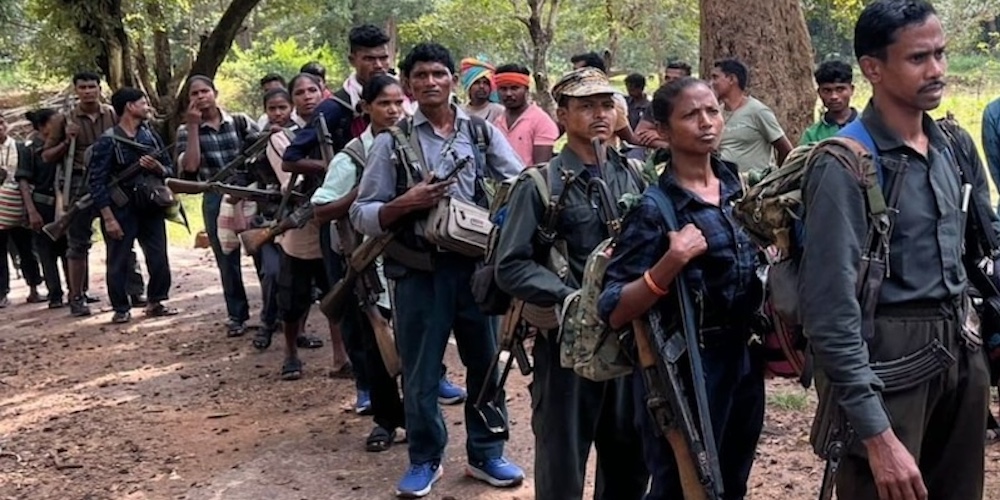
For nearly six decades, India grappled with Left-Wing Extremism (LWE). It was not a distant or abstract challenge, but a lived reality for millions of tribal families, villages cut off from roads, schools, and the broader promise of inclusive development. Violence was persistent, and uncertainty defined everyday life.
On 31 March 2026, this changed, marking a historic milestone in India’s internal security journey as the country became effectively free from Naxalism
The internal security framework of India has faced numerous challenges since independence, but none have been as enduring or ideologically entrenched as the Left-Wing Extremism (LWE) movement, commonly known as Naxalism.
Originating in 1967 from a peasant uprising in the small village of Naxalbari in West Bengal, the movement initially claimed to champion the rights of marginalized tribals, landless laborers, and peasants against oppressive landlords.
Over the decades, however, this movement evolved into a sophisticated, armed insurgency led by the Communist Party of India (Maoist), aimed at overthrowing the democratic state through violent means. At its peak in the late 2000s, Prime Minister Manmohan Singh famously termed Naxalism the “single biggest internal security challenge” facing the country.
Yet, over the last decade, a concerted, multidimensional strategy by the Government of India has systematically dismantled the movement’s infrastructure, bringing the nation closer than ever to the realization of a “Naxal-free India.”
To understand the trajectory toward a Naxal-free India, one must analyze the comprehensive blueprint adopted by the state, which balances hard security measures with proactive developmental initiatives. Historically, the state’s response was fractured, with individual states treating Naxalism as a localized law-and-order problem.
The turning point came with the formulation of a unified National Policy and Action Plan in 2015. This policy acknowledged that military force alone could not eradicate an ideology rooted in socio-economic alienation. Instead, it deployed a synchronized, four-pronged approach: security-related interventions, development measures, ensuring the rights and entitlements of local communities, and public perception management.
When the current government assumed office in May 2014, the Red Corridor remained one of the most serious internal security challenges. Earlier approaches were largely fragmented and incident-driven, managing symptoms rather than addressing the structural roots of the problem. A more comprehensive and integrated strategy was subsequently pursued to resolve it.
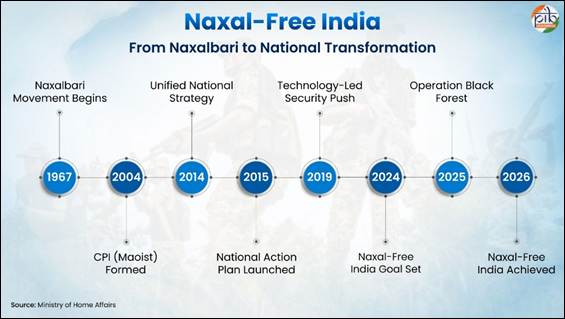
Over the last twelve years, the transformation was guided by three mutually reinforcing strands of action. Restoring trust and faith involved strengthened security operations, improved inter-agency coordination, structured surrender and rehabilitation frameworks, and sustained community outreach.
Expanding infrastructure meant improving physical and digital connectivity, extending governance presence into remote areas, and creating durable economic opportunities.
Delivering welfare focused on dignity, inclusive service delivery, cultural inclusion, and the mainstreaming of affected communities into the national development process.
Each of these strands reinforced the other. Security created space for development. Development deepened trust. Trust accelerated welfare delivery. It was not a sequence; it was an inseparable chain of progress.
On the security front, the transformation has been stark. The deployment of specialized, highly trained elite forces has fundamentally altered the operational dynamics in LWE-affected zones. Units such as the Central Reserve Police Force’s (CRPF) CoBRA (Commando Battalion for Resolute Action), Andhra Pradesh’s Greyhounds, Odisha’s Special Operation Group, and Chhattisgarh’s Bastar Fighters have successfully penetrated deep inside erstwhile insurgent strongholds like the Abujhmad forest. By establishing forward operational bases in these cut-off regions, security forces have choked the operational space of the Maoists, disrupted their logistics networks, and neutralized senior leadership cadres.
Simultaneously, the state recognized that the oxygen feeding the Naxal movement was the development deficit in remote tribal belts. Insurgents thrived in areas lacking roads, schools, electricity, and healthcare, using this neglect to fuel anti-state narratives. To counter this, the government launched targeted infrastructure schemes. Under the Road Requirement Plan (RRP) and the LWE Road Connectivity Project, thousands of kilometers of all-weather roads and hundreds of bridges have been constructed in formerly inaccessible terrains. Roads do not merely transport security forces; they bring economic integration, allowing tribal farmers access to broader markets, emergency healthcare, and education. Furthermore, the installation of thousands of mobile towers in deep forested pockets has bridged the digital divide, empowering local populations with financial inclusion through banking services and direct benefit transfers.

Socio-economic empowerment has been further bolstered through education and institutional visibility. The establishment of Eklavya Model Residential Schools in LWE-affected districts has provided high-quality education to tribal children, insulating them from radicalization and offering pathways into mainstream economic sectors. Additionally, the opening of new bank branches, post offices, and skill-development centers has restored public faith in democratic governance. When individuals witness tangible improvements in their quality of life, the ideological appeal of a violent overthrow of the state naturally erodes.
The success of this holistic strategy is clearly reflected in empirical data. Over the past decade, LWE-related violence has plummeted by over seventy percent, and civilian and security force casualties have reached historic lows. The geographical spread of the movement—once famously referred to as the “Red Corridor,” stretching from Pashupati in Nepal to Tirupati in southern India—has shrunk dramatically. The number of districts officially classified as LWE-affected has dropped from over one hundred to a mere handful of highly concentrated pockets, primarily along the tri-junction of Chhattisgarh, Odisha, and Maharashtra.
However, achieving a completely Naxal-free India requires navigating residual challenges with precision and empathy. As the Maoists lose territorial control, they frequently resort to desperate, asymmetrical tactics, such as the use of Improvised Explosive Devices (IEDs), which pose a continuous threat to security personnel and local villagers alike. Inter-state coordination remains an ongoing challenge; as pressure mounts in one state, insurgents tend to slip across porous state borders into neighboring jurisdictions. Maintaining seamless intelligence-sharing and operational synergy between state police forces and central agencies is critical to preventing the rebirth of these networks.
Furthermore, the final phase of eliminating Naxalism must prioritize the psychological and social rehabilitation of surrendered cadres. Lucrative surrender and rehabilitation policies have already motivated hundreds of active insurgents to lay down their weapons and reintegrate into society. The state must ensure that these individuals receive long-term vocational training, financial security, and protection from insurgent retribution. Showing the remaining active cadres that a dignified, peaceful life is achievable within the framework of the Indian Constitution is the most potent weapon against the survival of the movement.
Ultimately, the transition toward a Naxal-free India is not merely a victory of state might over an armed insurgency; it is a triumph of democratic inclusion over violent extremism. The eradication of Naxalism represents the fulfillment of the constitutional promise to the country’s most vulnerable citizens — ensuring that the tribal populations of central and eastern India are no longer hostages to a violent ideological war. By continuing to fortify internal security, rapidly expanding infrastructure, safeguarding tribal land rights, and fostering trust between local communities and the state, India is firmly on track to permanently close this turbulent chapter of its internal security history. A Naxal-free India will emerge not when the last insurgent is neutralized, but when every village in the heart of India is seamlessly connected to the nation’s democratic and economic progress.