India’s Solar Journey

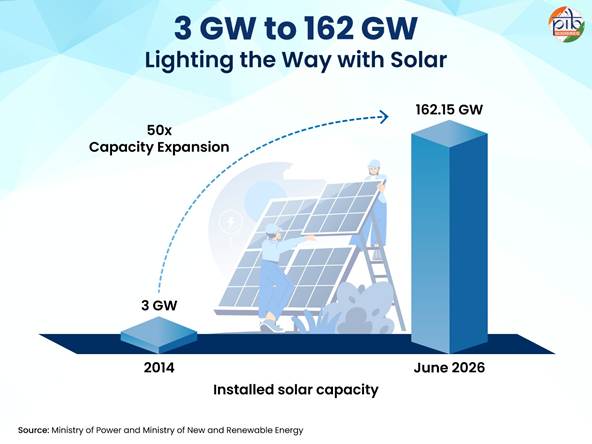
India’s solar march, which began from a modest niche initiative, has transformed into a world-leading clean energy revolution. Reaching an installed capacity of 162.15 GW by June 2026 — up exponentially from roughly 3 GW in 2014 — India now proudly stands as the third-largest solar producer globally
India sits in a privileged geographical belt, receiving an abundance of clean, tropical sunlight across most of its territory for 300 days a year. Recognizing this natural endowment, early steps were taken in the 1980s with the creation of dedicated non-conventional energy departments.
A decade ago, solar power occupied only a small place in India’s electricity mix. Today, it forms the largest share of the country’s renewable energy capacity. From an installed capacity of approximately 3 GW in 2014, the sector has expanded more than fiftyfold, reaching 162.15 GW till 30 June 2026.
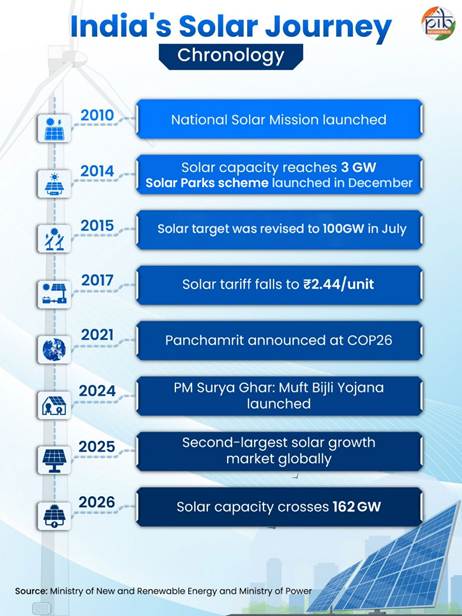
The real transformation began with the launch of the Ministry of New and Renewable Energy (MNRE) framework and the historic National Solar Mission in 2010. Initially targeting a modest 20 GW, the nation quickly recalibrated its ambitions as costs fell and technology matured.
Scaling Heights: Utility-Scale Solar Parks
The defining feature of India’s mid-2010s acceleration was the conceptualization of ultra-mega solar parks. Vast tracts of arid and semi-arid land in states like Rajasthan and Karnataka were converted into global showcases of renewable dominance.
Projects like the Bhadla Solar Park in Rajasthan and the Pavagada Solar Park in Karnataka pushed the boundaries of engineering, bringing gigawatts of clean power online. By shifting from small setups to massive utility-scale installations, India drove solar tariffs down to historic lows, making clean energy cheaper than or competitive with fossil fuels. Consequently, India achieved 50% of its cumulative electric power capacity from non-fossil fuel sources nearly five years ahead of its 2030 Paris Agreement commitments.
The latest push for solar growth is the newly approved Pradhan Mantri Surya Sarovar Yojana (PM-SSY).
The coordinated momentum has translated into measurable outcomes. The country has added 37 GW of solar capacity in 2025, surpassing the United States in annual additions. India has also emerged as the world’s second-largest solar growth market, underlining its growing role in the global clean energy transition.
Beyond utility grids, India’s solar narrative democratized energy generation through targeted grassroots schemes. The PM Surya Ghar: Muft Bijli Yojana catalyzed residential rooftop adoption, bringing millions of households into the clean energy fold with substantial financial subsidies.
Concurrently, the PM-KUSUM initiative revolutionized Indian agriculture. By deploying hundreds of thousands of standalone solar water pumps and solarizing grid-connected agricultural pumps, the government decoupled rural farming communities from erratic diesel supplies and unreliable grid feeds, ensuring energy security directly at the farm gate.
Manufacturing Self-Reliance and the Next Frontier
To prevent clean energy transitions from relying heavily on foreign supply chains, India championed domestic manufacturing. Backed by the Production Linked Incentive (PLI) Scheme for high-efficiency solar photovoltaic modules and quality control protocols like the Approved List of Models and Manufacturers (ALMM), India’s domestic solar module manufacturing capacity skyrocketed from a mere 2.3 GW in 2014 to roughly 172 GW by early 2026.
Innovative developments, such as the push for floating solar photovoltaic installations via initiatives like the Pradhan Mantri Surya Sarovar Yojana (PM-SSY), further expand the country’s footprint without straining scarce land resources.
Solar Capacity Across India
Solar deployment spans diverse geographies and climatic zones. Rajasthan, Gujarat, Karnataka, Tamil Nadu, Andhra Pradesh, and Maharashtra account for a significant share of installed capacity.
Large solar projects contribute 118.79 GW of installed capacity. Some of the large solar projects include the Bhadla Solar Park (Rajasthan), Pavagada Solar Park (Karnataka), and Rewa Ultra Mega Solar Park (Madhya Pradesh). Rooftop solar systems connected to the electricity grid contribute another 27.88 GW. The remaining capacity comes from hybrid solar projects and off-grid solar systems. Hybrid projects combine solar power with battery storage or other power sources, while Off-grid systems provide electricity in areas not connected to the grid.
Record Growth in FY 2025–26
FY 2025–26 marked a milestone year for India’s RE sector, with record additions in both solar and non-fossil fuel capacity.
• India added 44.61 GW of solar capacity, nearly double the 23.83 GW added in FY 2024–25.
• Solar module manufacturing capacity increased from 2.3 GW in 2014 to about 172 GW as of 31 March 2026.
• Total non-fossil fuel capacity reached 283.46 GW, including 274.68 GW of renewable energy capacity.
• Highest-ever annual addition of non-fossil fuel capacity recorded at 55.29 GW.
• On 29 July 2025, renewable energy sources met 51.5% of India’s electricity demand, the highest monthly share recorded so far.
Conclusion
India’s solar journey is an inspiring blueprint of vision, policy execution, and scalable climate action. As the country marches steadily toward its broader target of 500 GW of non-fossil capacity by 2030 and net-zero emissions by 2070, solar power serves as the beating heart of its sustainable, self-reliant future.