Nanomedicine Can Fight Cancer

Next-generation nanomedicine represents a true turning point in the fight against cancer. By using tiny engineered particles, doctors can now silence the exact genes that fuel tumor growth. This breakthrough method targets only bad cells, sparing healthy tissue and bringing hope for safer, smarter, and much more effective cancer treatments
Think of traditional treatments like a heavy rainstorm. They wash over your entire body, wiping out both the bad cancer cells and many healthy, normal cells along the way. This causes harsh side effects like hair loss, nausea, and extreme fatigue.
Nanomedicine acts more like a high-tech tracking device. Nanoparticles are microscopic biological delivery trucks that measure between 1 – 100 nanometers (one-billionth of a meter). These tiny trucks carry special instructions right to the tumor while completely ignoring healthy tissue.
Against this background, it is a great news that that Indian scientists from Pune have reported a gene-silencing strategy that can drive effective tumor inhibition in breast cancer, highlighting its potential as next-generation precision nanomedicine.
Advances in cancer nanomedicine are increasingly shifting toward precision strategies that directly silence disease-driving genes while minimizing systemic toxicity.
Scientists from the Agharkar Research Institute (ARI), Pune, an autonomous institute under the Department of Science and Technology (DST), Government of India, have presemted an innovative biodegradable nanocarrier platform engineered for targeted gene therapy in breast cancer.
The research, recently published in Advanced Healthcare Materials, provides new insights into targeted gene silencing of key survival pathways in breast cancer, enabling efficient tumor targeting and suppression, and offering a promising strategy for developing more effective and safer nanomedicine-based therapies.
The system is built on biodegradable mesoporous silica nanoparticles — well known for their high loading capacity and tunable surface chemistry — which enable efficient delivery of small interfering RNA (siRNA) molecules. By functionalizing the nanocarrier with a protamine biopolymer and an MUC1-specific aptamer, the researchers achieved precise tumor targeting, leveraging the overexpression of MUC1 receptors on breast cancer cells.
This targeting strategy significantly enhances cellular uptake while reducing off-target effects, a key limitation in conventional therapies.
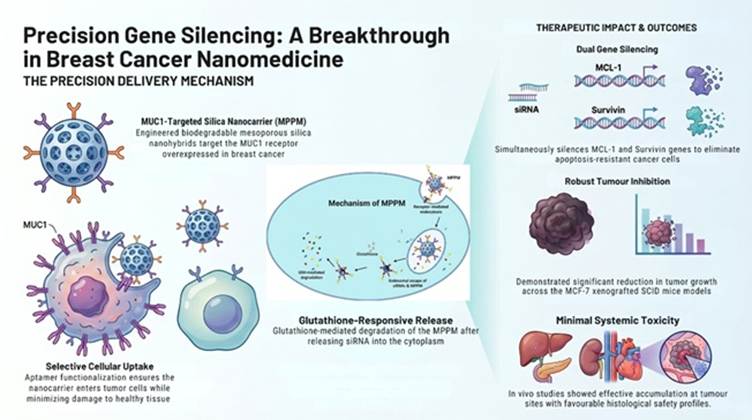
Fig: MUC1-Targeted Silica Nanocarrier (MPPM) Engineered biodegradable mesoporous silica nanohybrids target the MUC1 receptor overexpressed in breast cancer
A major highlight of the study by the team costsing of Niladri Haldar, Rajkumar Samanta, Surajit Patra, Devyani Sengar, Sachin Jadhav, and Virendra Gajbhiye is the dual gene-silencing approach. The nanocarrier simultaneously delivers siRNAs against two critical anti-apoptotic genes, MCL-1 and Survivin — both known to promote tumor survival and resistance to therapy. Once inside the tumor microenvironment, the glutathione-responsive design triggers controlled release of the therapeutic payload, ensuring efficient intracellular delivery and activity.
Biological evaluations in MCF-7 breast cancer models demonstrated robust gene knockdown, resulting in increased apoptosis and substantial tumor growth inhibition. Importantly, in vivo studies in Severe Combined Immunodeficiency (SCID) mice showed that the nanocarrier accumulates effectively at tumor sites and exhibits minimal systemic toxicity, as evidenced by favorable histological outcomes. These findings align with growing evidence that aptamer-guided nanocarriers can significantly improve tumor specificity and therapeutic efficacy.
Overall, this work highlights a powerful convergence of targeted delivery, stimuli-responsive release, and combinatorial gene silencing. By integrating these features into a single biodegradable platform, the study provides a compelling framework for next-generation RNAi-based cancer therapies. Such approaches could play a critical role in advancing precision oncology, offering more effective and safer alternatives to traditional chemotherapy.
The research was conducted by scientists from the Nanobioscience Group at the Agharkar Research Institute, Pune, India.