Health Sector under Modi
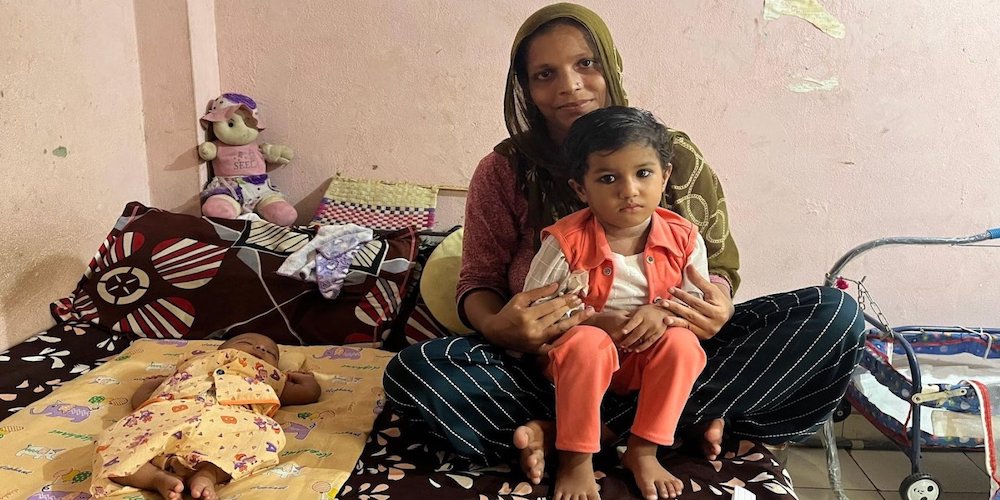
Under Prime Minister Narendra Modi, India’s health sector has undergone a massive transformation focused on making healthcare accessible, affordable, and high-quality for all citizens. Key initiatives include the massive Ayushman Bharat health insurance program, rapid expansion of medical infrastructure, and heavily subsidized medicines.
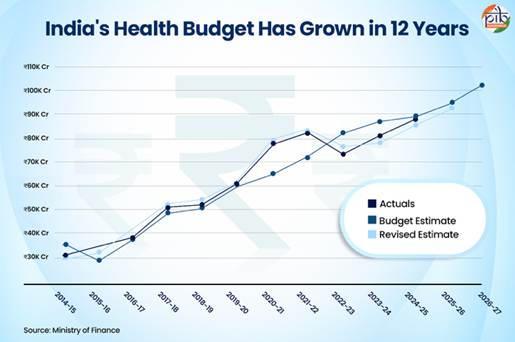
India has massively transformed its public health infrastructure in the past 12 years. It is now more accessible, affordable, and quality-driven. The impact is deeply visible even at the grassroots levels.
National Statistical Office 2025 survey of over 1.39 lakh households showcases more Indians than ever before are seeking medical care. Those visiting government hospitals and clinics for outpatient care — consultation, diagnosis, tests, prescription — are not having to pay anything. About half of the hospitalised patients are paying below Rs. 1,100 for their care. The poorest of households are benefitting from low or no out-of-pocket healthcare costs at such facilities. These are signs that people have renewed trust in the public healthcare system.
The National Health Mission, with its myriad disease control and care programmes, is making healthcare delivery more targeted. A new and robust digital health infrastructure, along with budding artificial intelligence integrations, is taking healthcare delivery to the next level. To meet rising demand, the government has more than doubled its capacity to train doctors and nurses the system needs. At the centre of these changes is the world’s most ambitious universal health coverage programme – the Ayushman Bharat scheme, launched in 2018.
Ayushman Bharat — meaning Long Life India — provides affordable, quality healthcare to people from all walks and all stages of life. It has emerged as a critical lifeline for socio-economically weaker sections and senior citizens above 70 years. The Ayushman Bharat architecture rests on four key pillars that collectively strengthen preventive, promotive, curative, and digital healthcare systems across the country.
Pillar 1: Public Health Insurance Through Ayushman Bharat – Pradhan Mantri Jan Aarogya Yojana (AB-PMJAY)
In continuation of the National Health Mission, the government introduced the National Health Policy (NHP), 2017. It outlines a transformative vision for India’s healthcare system. The policy recognised emerging healthcare challenges, including the rise of non-communicable diseases and escalating treatment costs. To tackle these issues, the government in 2018 launched Ayushman Bharat – Pradhan Mantri Jan Aarogya Yojana (AB-PMJAY). It has now emerged as the world’s largest publicly funded health assurance scheme.
AB-PMJAY provides free public health insurance up to Rs. 5 lakh per family per year to socio-economically deprived families. Such families make up about 40 per cent of the population, or about 12 crore families. The insurance saves these families from catastrophic healthcare bills.
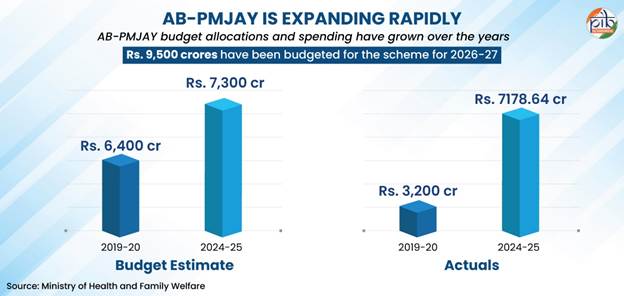
In a landmark expansion of the scheme in October 2024, the government introduced the Ayushman Bharat Vay Vandana, extending the insurance coverage to all senior citizens above 70 years.
The insurance covers consultations, hospitalisations and specialised treatment for a wide range of conditions, including cancer and heart diseases.
Empanelled public and private hospitals offer this insurance scheme. About 40,000 claims are processed daily for more than 1,900 treatment packages.
AB-PMJAY is available across the country, and has become a cornerstone of healthcare equity for lower-income people and senior citizens:
• 44.14 crore Ayushman Cards were created
• 12.03 crore hospitalisations were covered
• Treatment worth Rs.1,80,435 crore was provided
• 36,218 hospitals were empanelled — 19,659 public and 16,559 private
• 1.20 crore senior citizens were enrolled under the Ayushman Bharat Vay Vandana scheme, who availed over 13.84 lakh treatments worth Rs. 3,000 crore (as on June 5, 2026)
Ayushman App
One-stop hub for PM-JAY beneficiaries – Available on both Android and iOS in 19 regional languages. Beneficiaries can:
• Verify eligibility
• Download Ayushman e-cards
• Monitor wallet balances
• Locate empanelled hospitals
• Raise grievances
Pillar 2: Primary Care Through Ayushman Arogya Mandirs (AAM)
The government is scaling primary healthcare infrastructure for less specialised treatment of minor ailments and for public outreach health programmes. Ayushman Arogya Mandirs (AAMs) are being established to provide primary healthcare at every neighbourhood.
These AAMs are the cornerstone of community health in India, expanding universal health coverage. They provide comprehensive care spanning preventive, promotive, curative, rehabilitative and palliative care.
Each AAM offers 12 free services, going well beyond maternal and child healthcare. These include the screening and management of diseases, oral, eye and ear-nose-throat care, and mental health support. Teleconsultations, first-level emergency and trauma care, and free essential medicines and diagnostics are also provided at these centres. The AAMs have recorded a cumulative footfall of over 540 crores as on date.
The government is rapidly building this infrastructure. There are now:
• 1.86+ lakh Ayushman Arogya Mandirs are functional, including:
– 1.34 lakh Sub Health Centres
– 24,483 Primary Health Centres
– 5,474 Urban Primary Health Centres
– 12,259 AYUSH centres
– 9,758 Urban Health and Wellness Centres (as of June 5, 2026)
AAMs are also centres for community health outreach for Community Health Workers and Accredited Social Health Activists (ASHAs). At these centres, they spread awareness of health programmes, check in on patients, and keep track of community health.
Pillar 3: Pandemic Preparedness Through PM-ABHIM
Primary healthcare centres also play a pivotal role during public health emergencies, as seen during COVID-19. They become centres for disease surveillance, screening and treatment. The government has been significantly expanding the primary healthcare infrastructure to ensure pandemic preparedness.
Launched on October 25, 2021, the Pradhan Mantri Ayushman Bharat Health Infrastructure Mission (PM-ABHIM) is one of India’s largest pan-national programmes aimed at developing a resilient, accessible, and self-reliant public health system. Its total financial outlay is Rs. 64,180 crores, spanning from financial years 2021–22 to 2025–26.
The mission is building capacity at every tier of the health system and is:
• Providing support for 23,224 rural health and wellness centres in 10 high-focus states.
• Establishing:
– 13,736 urban health and wellness centres in all states.
– 3,389 block public health units in 11 high-focus states.
• Setting up 744 integrated public health labs in all districts
• Establishing 631 critical care hospital blocks in all districts with a population of more than 5 lakh.

Beyond physical infrastructure, PM-ABHIM is also building India’s pandemic defence architecture. This includes:
• Dedicated investments in bio-security preparedness, pandemic research, and disease surveillance
• Outbreak response and preparedness at 50 points of entry into the country
• Critical Care Blocks with 150 beds being established across 12 central institutions.
Pillar 4: Digital Health Ecosystem Through Ayushman Bharat Digital Mission (ABDM)
A robust digital health infrastructure is as crucial for improving healthcare accessibility as brick-and-mortar infrastructure. At its core, it gives citizens ownership of their own health data — making it portable, accessible, and usable across any provider in the country. It creates a single source of truth for health facilities, professionals, and pharmacies, enabling better clinical decisions and continuity of care. It also creates a national database that the government can use to analyse public health trends, support medical research, and take a more targeted approach to interventions.
The fourth pillar, the Ayushman Bharat Digital Mission (ABDM), is focused on building a comprehensive, citizen-centric digital infrastructure. It was launched in September 2021. At the heart of ABDM is the Ayushman Bharat Health Account (ABHA) — a unique 14-digit health identity number to which a citizen’s complete health records are linked. With the citizen’s consent, these records can be accessed by any healthcare professional across the ABDM network, enabling paperless, seamless care. ABDM also facilitates evidence-based decision-making for more effective health interventions at a population level.
The ABHA app, run by the National Health Authority, has a QR-based appointment registration service, which helps with long queues at hospitals or clinics. It also helps verify patient data. The app is leading the expansion of ABDM:
• 20.49 crore registrations were recorded on the app
• 27,328 facilities spanning 36 states and union territories were connected to the platform (as of March 31, 2026)
National Health Mission: Targeting Myriad Ailments and Diseases
The NHM with its two sub-missions — National Rural Health Mission and National Urban Health Mission — delivers targeted programmes that address specific diseases, populations, and health challenges.
NHM has improved public health outcomes across maternal and child health, disease elimination and immunisation.
Central to the NHM are community health workers operating from the primary healthcare centres. Due to the rapid expansion and upgradation of the primary healthcare infrastructure through Ayushman Bharat, these health workers are more capable than ever. They deliver healthcare services to more people, in more places, with better tools and data than before. Their work spans several targeted programme areas — beginning with maternal and child healthcare.
Maternal and Child Healthcare under National Health Mission
Pradhan Mantri Surakshit Matritva Abhiyan (PMSMA): Launched in 2016, this scheme provides free and quality antenatal check-ups at government health facilities. Crores of women have benefitted from this scheme:
• Over 7.47 crore pregnant women were examined
• 22,349 facilities provided PMSMA services nationwide (as of June 5, 2026).
Janani Suraksha Yojana (JSY): This scheme supports women through childbirth. It encourages facility-based deliveries among poor pregnant women, particularly those from below-poverty-line households, and the scheduled caste and scheduled tribe communities.
Janani Shishu Suraksha Karyakram (JSSK): This scheme entitles every pregnant woman at a public facility to government-funded free delivery, drugs, diagnostics, diet, and transport. There is no out-of-pocket cost. In 2014, the JSSK was extended to all antenatal & post-natal complications of pregnancy.
These programmes together have significantly reduced maternal mortality rates.
Eliminating Communicable Diseases
The government has reduced the prevalence of communicable diseases over the past 12 years. NHM’s targeted programmes for disease elimination and treatment have delivered measurable outcomes across tuberculosis, malaria, and leprosy.
Tuberculosis
India has reduced tuberculosis (TB) incidence through the National Tuberculosis Elimination Programme (NTEP). The goal of the programme is to eliminate tuberculosis. This programme is multifaceted and includes screening and treatment of TB through government facilities.
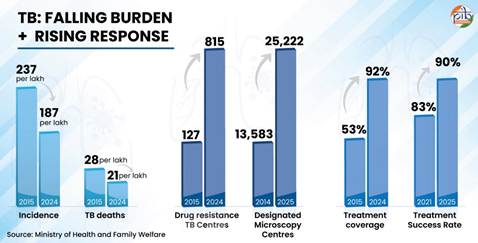
Due to the programme, TB cases and fatalities have declined faster than the global rate of decline. A strong community support network established through the programme also helped in combating TB.
• Over 3.78 lakh Nik-shay Mitras — volunteers who provide TB patients with nutritional, vocational and diagnostic support — supported over 20 lakh patients.
• These volunteers provided over 45 lakh food baskets (as of December 2025). This support helped patients stay committed to their treatment over the full course of care.
Pradhan Mantri TB Mukt Bharat Abhiyaan: Launched in September 2022, the Pradhan Mantri TB Mukt Bharat Abhiyaan is the community-led component of the National TB Elimination Programme (NTEP). It transformed TB elimination into a Jan Andolan — a people’s movement.
• Through awareness drives and community mobilisation, over 20 crore individuals have been screened for TB and more than 28 lakh patients diagnosed since December 7, 2024.
This large-scale screening helped identify previously undetected TB cases circulating silently within communities.
Malaria
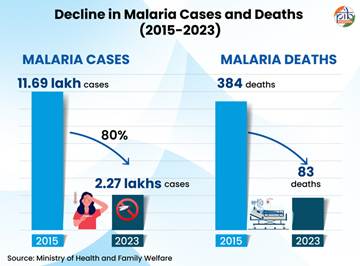
India, once among the highest malaria-burden countries globally, has significantly reduced cases and deaths since 2017 through sustained and targeted government interventions via the NHM.
In 2016, the government launched the National Framework for Malaria Elimination, which provides a roadmap for eliminating malaria by 2027. Building on this framework, the National Strategic Plan for Malaria Elimination (2023–2027) introduced enhanced surveillance and a “test, treat, and track” approach to case management. It also developed real-time data tracking. These interventions have contributed to a sustained decline in both malaria cases and deaths across India.
Other Communicable Diseases
NHM’s targeted programmes have driven measurable progress even beyond TB and malaria — reducing transmission, cutting fatality rates, and pushing several diseases towards elimination.
• HIV-AIDS: The mother-to-child transmission rate has declined by about 74.5% between 2010 and 2024. This has outpaced the global decline of around 56.5% in the same period.
• Kala-Azar: 633 endemic blocks in 54 districts have shown less than one case per 10,000 population.
• Japanese Encephalitis: Case Fatality Rate has reduced from 17.6% (2014) to 7.1% (2024)
• Dengue: Case Fatality Rate has reduced to 0.13% in 2024.
• Lymphatic Filariasis:
– 143 of 348 endemic districts (41%) have stopped Mass Drug Administration and cleared Transmission Assessment Survey, up from 15% in 2014 (MDA is the administration of drugs to whole populations irrespective of disease status).
– MDA coverage improved from 75% (2014) to 85% (2025) against total population.
• Leprosy:
– Districts achieving elimination (<1 case per 10,000) went up from 542 (2014-15) to 638 (2024-25).
– The new case detection rate has dropped from 9.73 per 100,000 in 2014-15 to 7.0 per 100,000 in 2024-25.
Prevention and Treatment of Non-Communicable Diseases
Non-communicable diseases (NCDs) — heart disease, diabetes, cancer, stroke — account for 60% of all deaths in India. To address this growing burden, NHM’s National Programme for Prevention and Control of NCDs (NP-NCD) has been strengthening infrastructure for early detection, diagnosis, and treatment.
Early Detection and Screening
Ayushman Arogya Mandirs (AAMs) function as the cornerstone for community screenings of NCDs, including cancer. The government also runs various clinics and care centres for cancer screenings, diagnosis and management of the diseases.
• Over 60 crore screenings have been conducted for oral, breast and cervical cancers at AAMs.
– 35.3 crore people have been screened for oral cancer out of which:
• 2.3 lakh people have been detected with the cancer
• About 2 lakh people are being treated
– Over 16.5 crore have been screened for breast cancer
– 8.73 crore screenings have been done for cervical cancer, out of which:
§ 1.1 lakh women have been diagnosed
§ About 97,000 are being treated
• Since 2017, 41.5 crore people have been screened for hypertension, out of which:
– 7.1 crore have been diagnosed, and
– 5.7 crore people are notified.
• 41.3 crore people have been screened for diabetes, out of which:
– 4.7 crore people have been found diabetic
– 3.4 crore people are being treated.
Treatment and Care
The government has made cancer treatment a priority over the past 12 years. It is expanding cancer care from district to tertiary levels.
• The Strengthening of Tertiary Cancer Care Centres Facilities Scheme established 19 State Cancer Institutes and 20 Tertiary Cancer Care centres.
• Cancer treatment facilities were approved in all 22 new All India Institutes of Medical Sciences (AIIMS). These facilities are equipped with diagnostic, medical, and surgical capabilities.
• The national cancer surveillance was expanded through over 600 cancer registry sites and over 100 stroke registry sites. This enhanced the government’s ability to track and respond to non-communicable diseases at scale.