RIGHT ANGLE – The Dangerous “Revdi Culture”
Soon after forming the first BJP government in West Bengal, Chief Minister Suvendu Adhikari, announced a list of freebies that includes the “Annapurna Bhandar Scheme” under which eligible women receive ₹3,000 monthly through Direct Benefit Transfer, and completely free travel for women in all state-run buses.
Likewise, the newly elected Congress-led United Democratic Front (UDF) government in Kerala, led by Chief Minister V.D. Satheesan, has officially approved a series of “Indira Guarantees”. The major freebies and welfare measures include free bus travel for women, a monthly honorarium increase of ₹3,000 for ASHA workers to boost frontline healthcare support, and a monthly hike of ₹1,000 for Anganwadi workers and helpers, school cooking staff, and pre-primary teachers/ayahs.
The other new government in Tamil Nadu led by Tamilaga Vettri Kazhagam (TVK) chief Vijay has gone the farthest, announcing a massive array of freebies that include a monthly assistance of ₹2,500 for women and six free LPG cylinders annually, a ₹3,000 monthly pension for widows and the elderly, and ₹15,000 a year for mothers of students in classes I to XII to prevent dropouts, 200 units of free electricity for all households, free bus travel for women, a ₹5 lakh interest-free loan for Women’s Self-Help Groups, and a sovereign of gold along with a silk saree for the marriage of poor women, free residential schools in all districts, 20 lakh collateral-free education loans, paid internships, and ₹25 lakh health insurance per family, total waiver of cooperative agricultural loans for farmers owning less than 5 acres, 5 lakh free solar pump sets, and guaranteed Minimum Support Price (MSP) for crops and fish.
It is estimated that Vijay’s freebies would exceed ₹1 trillion — roughly one-third of Tamil Nadu’s total revenue receipts. While the announcements garnered massive public support, they also triggered intense debates regarding long-term fiscal sustainability, state debt, and how the massive financial bill will be funded without compromising infrastructure.
But then, these new governments have followed what other state governments have done in some way or another. In Madhya Pradesh and Maharashtra, freebies, particularly to women, helped the BJP form the governments.
Incidentally, the Comptroller and Auditor General (CAG) warned not long ago that Karnataka’s “five guarantees” are straining state finances. The diversion of funds has squeezed capital expenditure for infrastructure, forcing a drop in capital spending and causing a spike in incomplete public works, including much-needed road repairs. The five guarantee schemes (comprising Gruha Lakshmi, Gruha Jyothi, Anna Bhagya, Shakthi, and Yuva Nidhi) account for roughly ₹50,000 to ₹60,000 crore annually, driving up the state’s subsidy burden and leading to a significant revenue deficit.
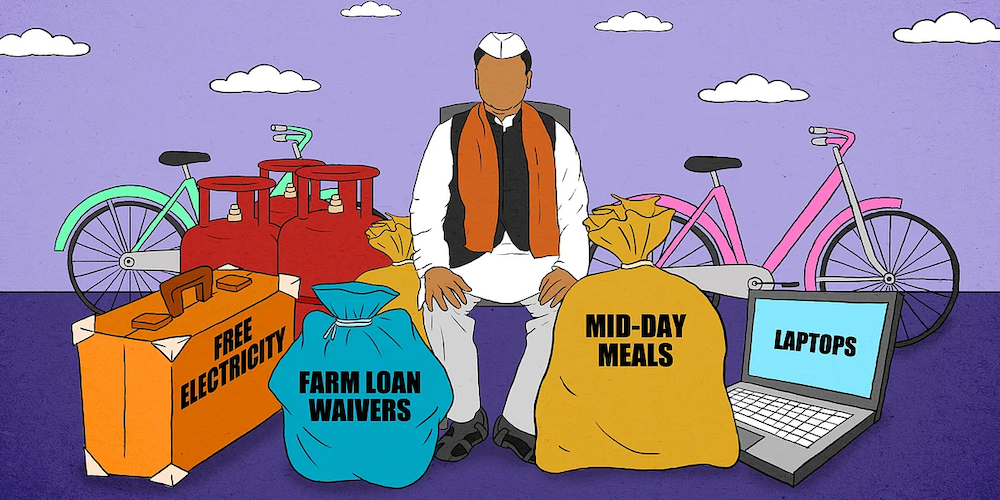
It may be noted that “Freebies” in India refer to welfare schemes that give goods, cash, or services at zero or heavily subsidised cost: free electricity, free buses, farm loan waivers, free smartphones, cash transfers to women, etc. They are popular with voters and often reduce short-term hardship. But when they expand rapidly and become untargeted, they create fiscal and economic problems that hit growth over the long run.
When a state spends 20-30% of its budget on subsidies and cash handouts, there’s less money for capital expenditure: roads, irrigation, power grids, schools, and hospitals. The RBI and CAG have repeatedly flagged that states offering large pre-election freebies cut capital spending, which is what creates jobs and raises productivity. Over time, poor infrastructure and low public investment lower potential GDP growth.
Freebies weaken the tax-subsidy balance. If states can’t raise taxes easily, they borrow more. High state debt means higher interest payments later, which eat up an even larger share of revenue. That leaves even less for development spending. It also raises the risk of a state debt crisis, which would force the Centre to bail out the state and spread the fiscal damage nationwide.
Freebies distort “Markets and Work Incentives”. For instance, free electricity for farmers encourages overuse of groundwater and inefficient crops. This we are seeing in Punjab and Haryana. Free bus travel sounds good, but when state transport corporations lose money, bus quality drops and routes get cut. Farm loan waivers reduce banks’ willingness to lend to farmers in the future.
Cash handouts not tied to work or skill-building can lower labour force participation, especially for women who might otherwise enter the job market. An economy that grows needs people producing, not just consuming.

In this context, let me point out especially the suicidal practice of the ever-increasing subsidies to the farmers, which, in reality, only cater to the interests of the upper segments of the farming community, not 70 percent of mostly landless or owners of tiny holdings.
India spends over Rs 3.5 lakh crore a year on farm subsidies, mainly through urea sold far below cost, free or near-free electricity for pumps, and repeated loan waivers. They help farmers in the short term, but their rapid expansion creates fiscal, environmental, and productivity problems that damage long-term growth.
Urea costs Rs 3,500-4,000 per bag to produce and import, but is sold to farmers for about Rs 266. The difference is the fertiliser subsidy, which alone was Rs 1.6 lakh crore in 2022-23. Add free power, irrigation subsidies, and loan waivers by the states and the Centre. All this loses huge revenue. That money comes from the same budget that builds roads, cold storage, research labs, and rural health centres. When subsidies crowd out capital spending, India’s farm productivity and rural infrastructure actually lower future growth.
Cheap urea encourages overuse. Farmers apply more than crops need because the price signal is broken. Excess nitrogen runs into rivers, depletes soil health, and creates stubble burning to clear fields quickly. Free electricity for pump sets leads to groundwater over-extraction in Punjab, Haryana, and Maharashtra. Aquifers fall, borewells go deeper, and energy demand rises. The subsidy that boosts output today undermines water and soil for the next decade.
Besides, persistent loan waivers tell farmers and banks that repayment is optional if political pressure builds. After the 2017 UP and 2018 Maharashtra waivers, banks tightened lending to farmers in those states. Fresh credit became costlier and harder to get. That pushes small farmers to informal moneylenders at 3-5% per month. A broken credit system thus reduces investment in better seeds, machinery, and drip irrigation, keeping yields low.
Another dangerous aspect is that subsidies are tied to urea, rice, and wheat. That makes it profitable to grow water-intensive crops even in dry regions. Farmers avoid pulses, oilseeds, fruits, and vegetables that need less water and fetch higher prices, but don’t get the same subsidy support. India, thus, ends up importing edible oil while exporting subsidised rice and wheat. The cropping pattern gets stuck, and farm incomes grow more slowly than they could.
When input costs are artificially low, India overproduces wheat and rice and stockpiles them. Export bans follow to keep domestic prices down. Trading partners see this as unpredictable, and India loses share in high-value farm exports like processed foods. Meanwhile, input subsidies keep Indian farm costs opaque, making it harder to negotiate fair trade deals.
The most alarming aspect of the freebies is that these are easy to announce but hard to withdraw. Once voters get used to free electricity or monthly cash, any government that tries to roll it back faces political backlash. That creates a “ratchet effect”: subsidies only go up, never down. Over 10-15 years, this locks states into a high-spending, low-investment path, making it harder to respond to future shocks like a pandemic or recession.
Ultimately, freebies hurt fiscal credibility and investment. Investors, both domestic and foreign, watch state finances. A state known for large unfunded freebies is seen as riskier. That raises borrowing costs for the state and for companies operating there. It also makes the Central government hesitant to give extra funds, reducing flexibility during crises.
If freebies keep rising faster than state revenues, India faces a long-term hit: weaker infrastructure, lower productivity, higher debt, and slower job creation. The economy doesn’t collapse overnight, but the growth rate slips by 0.5-1% per year. Over a decade, that’s the difference between India becoming a $5 trillion economy by 2027 vs. 2030.
Of course, not all welfare measures are a freebie. Spending on health, nutrition, education, and skill training raises human capital and future earnings. But untargeted freebies often crowd out this productive spending. For example, spending Rs 10,000 crore on free smartphones yields short-term goodwill. Spending the same amount on teacher training or vocational centres yields higher wages for the next generation.
Of course, though in practice he allows the BJP governments in states to distribute freebies, and that is because of the political compulsion of winning elections, Prime Minister Narendra Modi does realise that distribution of “irrational freebies” for votes, which he famously termed the “revdi culture” (after a popular North Indian sweet), is economically dangerous.
But then, if Modi cannot stop freebies, to expect the non-BJP governments to stop the practice is unrealistic.
In my considered opinion, this is one area where the judiciary should step in. No political parties will agree to stop the freebies. Only the Supreme Court can, by drawing a line between “irrational freebies” and “legitimate welfare”.