
PRESENCE OF RAILWAYS : MADRAS, THANE TO KASHMIR TO HIMALAYAN HEIGHTS
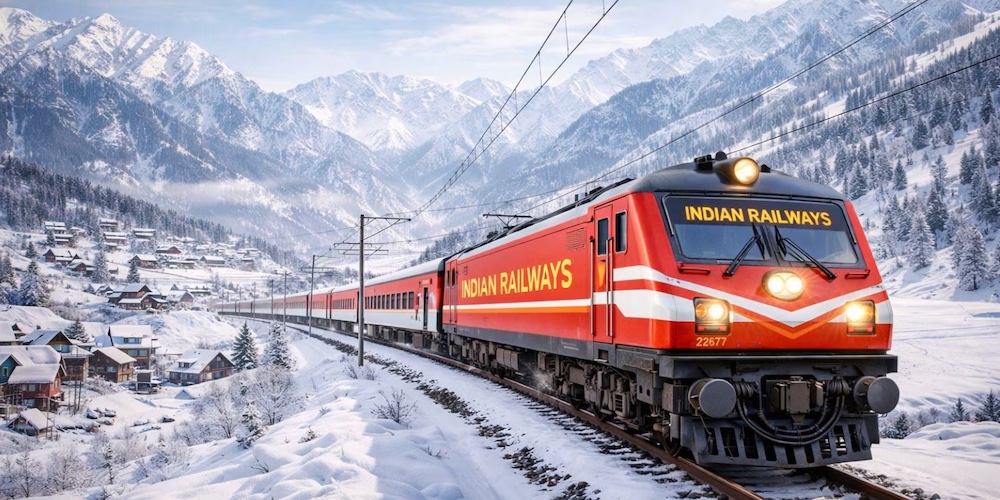
One aspires to travel with a view to have a change of mind, to refresh, visit scenic spots, places of interest etc. Various destinations also figure in an itinerary to pursue trade, business, education and health care in mind.
In good old days, though plenty of time was at the disposal of mankind, means of travel were limited. These were confined to horses, bullock cart, tyre carts, tonga, short distance vehicles, trucks and mini buses.
BEGINNING OF RAIL
Travel by train proved a pathbreaking beginning in England. It revolutionized the way people travelled. Process of convenient and fast travel began from 1830 with setting up of first Railway station at Liverpool, Manchester. In 1913, Grand Central Terminal at New York ,U.S.A. came up. Having 44 platforms, it is still the largest station in the world.
1837, TURNING POINT IN INDIA
In India, Railway operation began in1837 in the then Madras province when selected cargo was ferried. But passenger train could be introduced only on April 16, 1853 when a 34 kms long journey was performed from Bori Bunder in Mumbai to Thane. Under the Great Indian Peninsular Railway, three locomotives pulled a train having four hundred passengers in fourteen carriages.
First Railway Terminal of India
The first Railway terminal at the then Bombay city was named Victoria Terminus. Now called Chhatrapati Shivaji Terminal, it is a World Heritage Site due to its towering Gothic structure and breathtaking design.
Unfortunately, scores of innocent persons were killed mercilessly by Pak terrorists over here during the infamous 26/11 episode in 2008.
Other two very old stations of the country are : Howrah in West Bengal functioning since 1854 and Royapuram, Chennai, commissioned in 1856.
From having six Divisions in 1961, Indian Railways, the fourth largest rail system in world, has 18 zones now. Having a track length of 1,35,207 kms, it employs 1.25 million employees and whopping 99.1% of its lines are now electrified. Width of track is in terms of Broad gauge, Metre Gauge, Gauge having width of two feet 6 inches and two feet wide Gauge.
Tremendous Load
13,198 trains pulled by 13,569 electric locomotives, 4169 Diesel Engines and sixteen Steam Engines carried 6.9 Billion passengers in 2023-24. Its simply mind boggling and unbelievable. Railway personnel deserve all kudos for their dedicated work, round the clock.
Headed by an autonomous Board, Indian Railways is a state owned enterprise having fifteen subsidiaries and twelve undertakings. One dealing with ticketing & catering has not only brought relief to the passengers but also element of hygiene & variety is possible when it comes to food served in trains. But menace of middlemen is still having a sizeable say, especially in Northern India. South, fortunately has better performance in all respects.
ERA OF HIGH SPEED TRAINS
Maximum operational speed achieved by three trains in India ,viz, Vande Bharat Express, Gatiman Express and Shatabdi Express, so far, is 160 kmphs (99 miles).
Proposal for introducing a BULLET TRAIN, based on technology and long period loan from JICA (of Japan) was mooted in 2013-14.
After initial swift action on 508 kms (352 kms in Gujarat and 156 kms in Maharastra) project, work between Ahmedabad and Mumbai slowed down during 2016-17. Having a speed of 320 kmph, total time to be taken by new train will be 2 hours and seven minutes.
JUSTIFICATION ?
One may, however, ask- Is such a supersonic speed needed in our country ?
Vande Bharat Express at present is taking only 5 hours and forty minutes in covering the distance between two mega cities. That should suffice. Higher than normal speed is bound to be not only expensive, but it may lead to accidents as well.
One should not forget that land allotment/availability issues had emerged in a big way in the state of Maharastra. Tussle between state Government and Centre had come out in the open. Contractors, despite being given all ‘favours’, too did not perform on the expected lines.
Time & Cost Over Run
All this has led to unbelievable time and cost over run. A high speed train of this nature, in addition, could not have run on existing old ,over used and weak tracks. There were convincing matters of signalling also. It appears , there may be light at the end of the tunnel at last. But the new train, to begin with, will run only between Surat and Vapi and same is expected to be inaugurated on 15th August 2027(?).
Opening of entire stretch of 508 kms will not be easy / possible prior to August 2029. And that is going to be a long time affair.
However, partial opening too may be at a very exorbitant cost : of close to Rs One Thousand Lakh Crores !. It is something our economy can not afford due to obvious Geo Economic implications of ongoing Middle East War or imbroglio at Strait of Hormuz. Even if President Trump and President Xi Jinping reach some ‘understanding’ ,it may not make a dent so easily on Indian economy and that of others.
ARE VANDE BHARAT TRAINS SUCCESSFUL ?
Awfully expensive Vande Bharat trains going to Kashmir or elsewhere are adding to the burden of the existing tracks and apart from being under utilised, passengers therein donot always show expected civic sense. Rather than introducing new trains like this, stress should be on building 3rd railway track between Delhi & Kolkata AND between Delhi & Mumbai.
RAILWAYS IN TOUGH HILL TERRAIN
Taking up construction of 760 kms long Konkan Railway project in the toughest terrain of Western Ghats was not easy. It was completed due to indomitable spirit of E. Sridharan, the Engineer in charge and firm commitment of George Fernandes, the former Railway Minister.
DELHI METRO
Not only this, Sreedharan was later assigned to take up the work of the second Metro rail of the country-Delhi Metro in 1998. Working in congested and politically sensitive areas of national capital was not a cake walk. He saw to it that brand new Japanese Metro coaches aided by their latest tecnology begin running by Mid-2001.
Today DMRC is synonymous with efficiency, dedication and hard work. They have never compromised on the crucial issues of quality and environment.

Financial Viability Aspects
While many new cities have been added to Metro network in the last decade, there are several major towns of importance that have not been short listed as yet, forget about figuring them in the consideration zone.This needs to be addressed at an early date.
Moreover, the 4 kms long Patna Metro is a major disaster as , as against the reported daily running expenditure of Rs.18 Lakhs, revenue generated is just Rs.17,000 at present. What a colossal loss due to an extreme political decision !
In the same way, it has been learnt that most of the Bande Bharat trains are undergoing losses due to their under utilisation to the extent of 50 %. Some places being covered on non operational reasons, donot actually require these trains.
Outreach Of Railways In NORTH EAST
Among all eight states of N.E., Assam was covered by the Indian Railways right from British days. Gradually states of Manipur, Tripura and Nagaland were also linked. Next came the turn of Arunachal Pradesh and Mizoram.
In the state of Meghalaya however, it had to face stiff opposition when despite all efforts for years, 110 kms Burnyhat- Shillong rail link Project could not take off/ make any headway. Vague, strange and unconvincing reasons were given by the so called social cum political activists. What this writer has gathered is that the project area fell in a very stable zone which would not have invited any environmental or stability issue.
If the terrain concerned happens to be hard plateau kind , such as, in Meghalaya or young Geological formation of the Eastern Himalayas in West Bengal & Sikkim, apart from taking care of Bio diversity and protection of thick vegetation to withhold the slopes , umpteen care has to be taken for regulating drainage downwards. Any kind of hill cutting should not lead to occurrence of landslips or land slides or aggravation, thereof.
Bairabi Sairang Project, Mizoram
This project of the length of 51.38 kms has been commissioned at last in May 2025. One of the most picturesque projects, it was sanctioned at a cost of Rs.8071 Crores way back in May 2008.
It has 55 major and 88 minor bridges. 45 Tunnels are in an area of 16 kms. It has four stations built in beautiful locations.People and tourists alike are making good use of this much awaited facility. Its videos and photos figuring in Social media frequently will be an added advantage.
SEVOKE-RANGPO RAIL LINK PROJECT (SRRP)
Though like 125.2 kms long Dehradun-Tehri-Pauri- Chamoli Railway line, 44.56 kms long Sevoke-Rangpo Rail Project (SRRP) is underground to the extent of 85%, it has taken a very long time since its sanctioning as a national project in 2008.One should not undermine the fact that even after final green signal was given by the NITI AAYOG in September 2019, various Ministries and Forest Department of West Bengal took their own time in clearing the path for IRCON.
As actual work began in the end of 2021, IRCON head office should have co-ordinated with all concerned in view of past bad experiences with the Gurkhaland activists on the one hand and Forest Department of West Bengal state, on the other.
It is heartening to note that in such a short distance, the tough project will have fourteen tunnels and thirteen bridges. Ten out of 13 bridges and Twelve out of 14 tunnels have been completed already. Mining and lining works too have been completed in twelve tunnels.
Foundations and sub structures of other bridges too are being taken up on priority, informs Project Director of SRPP. Track lining works and BLT works too have been completed in ten out of fourteen tunnels, adds the P.D. In the same way, track on five bridges has been also completed. Yard work of five stations has been simultaneously taken up. One is complete, two are getting completed. Overall,90 % of works, reportedly, have been completed.
RANGPO STATION
However, work on Rangpo Station building and yard, needs special attention ,as it will be the first one in Sikkim, therefore, the most prestigious one. Its design has to be in tune with local architectural traditions to suit the mindset of people of the state.
The current work on huge R.C.C. bridge at Teesta Bazar too being slow, needs to be expedited. Sufficient clearance may have to be ensured in view of massive floods in Teesta river in 2024 and 2025.
During my three visits to the sites in the last four years, unusual hard work, sincerity and dedication was seen among the qualified and experienced Engineers and their assistants.The apprehensions expressed by vested and genuine people during and pre Monsoon periods in last three to four years has not only been noted BUT requisite action has been / is being taken by the Project officers.
CONCLUSION
All said and done, SRPP is going to be a certain Game Changer for the sparkling jewel of Asta Laxmi, that Sikkim is. It is bound to bolster culture, tourism and trade. Now that final locational survey of the second and third phase of this link, going right upto Nathula, has been completed, it is high time that construction work between Rangpo and Gangtok is also taken up on top priority. It may lessen the burden on existing tourist friendly highway as it has to be used for defence and business purposes also.
SHALL WE HOPE FOR THE BEST ?

(The author is former Chief Secretary, Sikkim. Views are strictly personal)


Very nice analysis on railway by giving historical perspective as well as current developmental projects. 👍