
Chhakada to Tesla
The world we inhabit today feels like a fever dream of acceleration. A person born in the eighteen hundreds might see the arrival of the steam engine and the lightbulb, but the fundamental rhythm of life remained recognizable. However, post 2000, the clock of evolution broke its own gears. The revolution just exploded. We moved from the stuttering, fragile connection of 2G to the near-telepathic speeds of 6G in a span of time that is historically insignificant. This jump is not just about how fast a video loads on a screen. It is about the fundamental restructuring of the human experience. We are living through a temporal compression where five years of modern time holds the weight of fifty years of ancestral experience.
This swift change has been driven by a total digitization of our reality. In the beginning, we were a species of physical tools. Our ancestors used rocks and etching tools to mark their existence on the walls of caves. For thousands of years, the hand was the primary interface with the world. We gripped, we carved, we pushed, and we pulled. Now, those physical anchors have disappeared into the ether. The etching tool has been replaced by buttons under our fingers, and even those buttons are now just haptic vibrations on a glass surface. The physical world is receding, replaced by a digital layer that promises total control with zero effort. We started with basic online things like banking, shopping, and documentation. These were seen as conveniences at first. Within a year or two, the entire phenomenon was knitted into a single web that caught every aspect of our lives.
The scope of this web is staggering. It has moved from the office desk into the most intimate corners of our existence. Right from the kitchen to the drawing room, into the bedroom and even the washroom, anything and everything is available through a single button. We do not even have to stand up to change the climate of our homes or the lighting of our rooms. We are living in a domestic command center where we are the immobile commanders. Yes, this saves an immense amount of time and energy. We can argue that it helps control traffic because fewer people are on the roads. Perhaps it even aids in pollution control because the logistics of a single delivery truck are more efficient than twenty individual cars going to a mall. But we must ask ourselves what we are losing in this trade. What it leads to is a total collapse of human interaction.
Before 2010, a family would often go shopping together once a week. It was a ritual. It involved walking, talking, navigating a physical space, and interacting with strangers. Now, the entire day’s meal comes from a single button. The ritual has been replaced by a transaction.
The whole globe is now one village. The urban and the rural are connected in a way that was once the stuff of science fiction. A farmer in a remote village can see the same trends as a teenager in a skyscraper in a metro city. This connectivity is the hallmark of our era, but it is a village where no one actually talks to their neighbors.
When we talk about the advantages of this digital age, the list is long and impressive. We have democratization of information. A child with a cheap smartphone has access to more knowledge than the President of a country had forty years ago. Education is no longer a privilege of the elite who can afford expensive libraries. Healthcare has been transformed through telemedicine, allowing specialists to diagnose patients across oceans. The economy has shifted to allow for a global marketplace where a small artisan can sell their wares to someone halfway across the world.
These are the miracles of the modern age. We have eliminated the friction of distance and the barrier of cost for many essential services.
However, the disadvantages are beginning to pile up like a heavy fog that we cannot seem to shake. The primary casualty is the human spirit of community. We have traded the messy, unpredictable beauty of physical interaction for the sterile efficiency of a screen.The mental health crisis that is currently sweeping the globe is the direct result of a species that evolved for social bonding suddenly being plunged into a world of digital isolation. We are more connected than ever, yet we feel more alone than any generation before us.
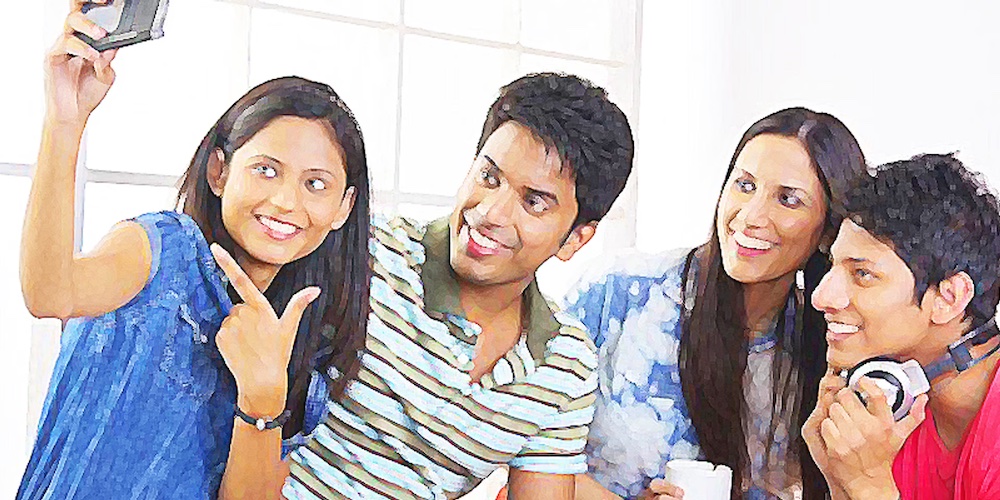
Consider a typical middle class family today. They might comprise four or six members living in a three BHK apartment in a busy metro. On paper, they live together. In reality, they are four separate islands sharing a common roof. They probably get a chance to be together once a week for a meal or a cup of tea, and even then, their phones are usually sitting next to their plates like uninvited guests. The silence in a modern home is different from the silence of the past. It is not the silence of peace; it is the silence of distraction. Each person is plugged into a different reality, watching different videos, talking to different strangers, and living in different algorithmic bubbles.
This is where the challenge of Gen Z becomes most apparent. This generation was born into the heart of this revolution. They do not remember a world without high speed internet. They do not know the patience required to wait for a television show to air at a specific time. For them, the world has always been on demand. Because their needs are being met without any physical interaction, they have developed a profound hesitation toward the physical world. This has reached a point where many Gen Z individuals hesitate to even receive a parcel from a delivery agent. They would rather have it dropped at the door or received by someone else. The simple act of opening a door and saying thank you to another human being has become a source of anxiety.
The days of bargaining are gone. That entire social art form, which required reading body language and understanding human psychology, has been deleted. Selections are now done based entirely on screen appearance. We choose our food, our clothes, and even our partners by swiping on a two dimensional image. We have lost the tactile sense of quality. We no longer touch the fabric or smell the produce. We trust the image, and unfortunately, this trust has led to an explosion of scams and fraud cases. The digital world is a playground for predators who know how to manipulate the screen to hide their true intentions.

The biggest worry is that this same generation interacts more with online people who are unseen and unknown than they do with their own flesh and blood. They find solace in the comments section of a stranger’s post while ignoring the person sitting across from them at the dinner table. They share their deepest secrets with digital avatars but cannot hold a conversation with their parents. The generation gap has become a huge chasm that is no longer just about different tastes in music or fashion. It is a fundamental difference in how we perceive reality itself.
In this landscape, Artificial Intelligence is emerging as an enemy more than a friend. We were promised that AI would be the ultimate assistant, freeing us from mundane tasks so we could focus on being human. Instead, AI is beginning to replace the human element entirely. The disadvantages of AI are manifold and touch every level of our existence.
Environmentally, the cost is staggering. The data centers required to train and run these models consume vast amounts of electricity and water for cooling. We are burning the planet to create a machine that can write poems for us.
Economically, AI is hollowing out the middle class. Jobs that once required years of study and human intuition are being automated in an instant. This is not just about factory workers anymore. It is about writers, artists, coders, and analysts. We are moving toward a world where human labor is becoming an optional luxury. Individually, the impact is even more insidious. We are outsourcing our thinking to an algorithm. We no longer have to struggle with a difficult problem or find a creative solution. We just ask the AI. This leads to a cognitive atrophy. Our brains are muscles, and if we do not use them to think, they will weaken.
The reliance on technology has stripped us of basic survival skills. Consider the GPS. We have reached a point where we cannot navigate ourselves across our own cities without a blue dot telling us where to turn. We don’t ask people along the way anymore. We have lost the ability to read the sun, the landmarks, or the maps. If the satellite signal fails, we are effectively blind.
Even our memory is failing. Old people can still remember a hundred phone numbers from their youth. They remember birthdays, addresses, and directions. Today, children don’t remember even two numbers. Why bother remembering when the information is stored in the cloud? But what happens when the cloud is out of reach? We are becoming a species with a massive collective memory but zero individual recall.
The “single button” lifestyle is advertised as the ultimate freedom. But this freedom is a cage of dependency. Every time we press that button, we are surrendering a small piece of our autonomy. We are surrendering our need to move, to speak, to negotiate, and to remember.
We are seeing a rise in physical ailments that were once rare. Obesity, posture issues, and eye strain are the physical manifestations of our digital addiction. But the emotional ailments are deeper. There is a profound sense of purposelessness that comes from having everything handed to you. Humans are designed to overcome obstacles and to interact with our environment. When you remove the struggle, you remove the satisfaction of living.
The Gen Z isolation is a cry for help that we are misinterpreting as a preference. It is not that they do not want to interact; it is that they have forgotten how.
As we move more of our lives online, we become more vulnerable. The scams we see today are not just about money. they are about the theft of identity and the manipulation of truth. We are seeing a world where a person’s entire reputation can be destroyed by an anonymous post. We see young people being groomed and exploited by strangers who know exactly how to bypass their defenses.
The lack of physical interaction means we have lost our gut instincts. We cannot sense the danger in a person’s voice or the shiftiness in their gaze because we only see the curated version of them online.
The fraud cases are increasing because the digital world provides a perfect mask. It allows a predator to be anyone they want to be. For a generation that prefers online people to physical ones, this is a death trap. They are looking for connection in the most dangerous place possible, while the safety of their own family is being ignored.
We need to bridge the generation gap not by dragging the old into the digital, but by bringing the young back into the physical. Only then can we truly say that we have mastered the revolution, instead of being its victims.
The acceleration of the clock cannot be stopped. We will likely see 7G, 8G, and beyond. The buttons will become even more invisible, and the AI will become even more persuasive. But the human heart remains the same. It still needs connection. It still needs purpose. It still needs the earth beneath its feet. If we can hold onto that, if we can remember that we are more than just users and consumers, then we might just survive this digital storm. We might even find that the best things in life are the ones that can never be accessed with a single button. They are the things that require our time, our energy, and our full, undivided presence. That is the real progress. That is the real evolution. That is the task before us all.
(Yajin Bhatt is a Thinker, writer & social activist)


great one