Preparing for Multi-Domain Wars
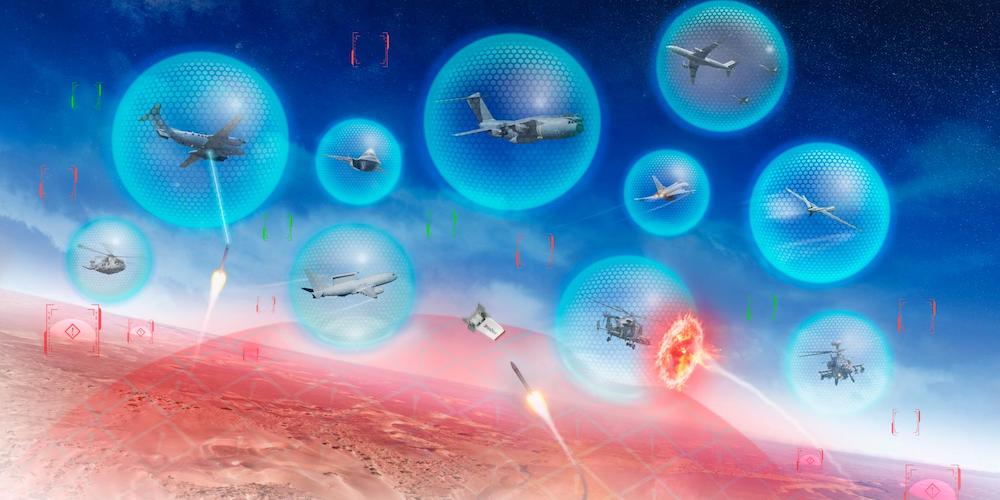
A national seminar Ran Samwad – 2026 concludes with “a Collaborative Road Map to Prepare the Indian Armed Forces for Multi Domain Conflict”
India is undergoing a fundamental military transformation to transition from traditional service-specific operations to Multi-Domain Operations (MDO). This shift, accelerated by lessons from recent joint operations like Operation Sindoor, aims to integrate combat power across land, sea, air, space, cyber, and cognitive domains.
Emerging concepts of such warfare were discussed in the just-concluded two-day (April 9-10) national seminar ‘Ran Samwad’ in Air Force Training Command, Bengaluru.
The MDO is in accordance with Defence Minister Rajnath Singh’s roadmap – “Defence Forces Vision 2047” so as to build a “world-class military” by India’s centenary.
Its three principal features are moving away from service silos to unified commands for faster decision-making; protecting critical space assets and conducting offensive/defensive cyber operations; and managing disinformation campaigns and psychological operations to shape strategic narratives.
The two-day seminar was inaugurated by Chief of Defence Staff General Anil Chauhan. The seminar was s anchored around the theme “Multi-Domain Operations (MDO): An Imperative for Addressing Conventional and Irregular Threats.” The MDO doctrine is intended to enable stakeholders across military and non-military entities to foster India’s joint warfighting capabilities across all six domains, i.e., land, sea, air, space, cyber and cognitive.
The Chief of Integrated Defence Staff to the Chairman, Chiefs of Staff Committee (CISC), Air Marshal Ashutosh Dixit, in his keynote address, outlined a transformative vision for India’s military future centred on Multi-Domain Operations (MDO). He said that the character of war has undergone a fundamental shift and noted that modern conflict is no longer sequential but unfolds simultaneously across space, cyberspace, the electromagnetic spectrum, and the cognitive domain. For India, Multi-Domain Operations is not a future idea but a present necessity, he added.
Characterising the modern era as a “dispersed, undeclared world war,” the Chief of Army Staff (COAS) General Upendra Dwivedi emphasized that the battlefield is no longer a map, but a layered, complex adaptive system. He highlighted the reality of a “permanent conflict” world, how a land force commander must read the battle across domains, how different domains interact in operations, and how the Army is transforming MDO from a concept into a capability. He said that MDO is not of six domains operating in parallel, but in constant dynamic interaction where the weight shifts and the lead changes. He further emphasised that the Army is accelerating Integration, Informatisation and Intelligentisation to ensure that the force moves beyond “Domain Purity” toward total Domain Fusion.
Talking on operational milestones, General Dwivedi shared that the Indian Army has operationalized Integrated Battle Groups (IBGs), Divyastra Drone Batteries, Command Cyber Operations Wings, among others. He called for a new command culture where leaders “command technology rather than merely operate it” to ensure decision advantage. He further noted that while Operation Sindoor proved India’s jointness, the ultimate goal remains a seamless “Whole of Nation” architecture where the seams between domains disappear entirely.

Chief of the Naval Staff (CNS) Admiral Dinesh K Tripathi presented a comprehensive maritime visualization of Multi-Domain Operations grounding modern naval strategy in both technological convergence and Kautilya’s wisdom. He defined the modern maritime domain as an interconnected grid extending from the seabed to space. He elaborated on how the maritime battlespace has changed into a dense, transparent, deeply interconnected grid shaped by speed, scale and simultaneity.
The CNS said that the Indian Navy is firmly on course towards being a 200-plus ship Navy by 2035 with each new induction increasingly focused on modularity and technological evolution. At the same time, the Navy is pursuing augmentation of fleet capabilities with uncrewed and autonomous solutions across the domains, in accordance with the Indian Navy Vision for Unmanned Systems 2022-30, he added.
Chief of Defence Staff (CDS) General Anil Chauhan delivered the closing address, emphasising that the multi-domain operations require convergence across physical, synthetic and cognitive realms.
In his address, the CDS highlighted the urgency of faster and smarter decision-making in an Artificial Intelligence (AI) driven battlespace. He underlined that warfare in the present era spans across multiple dimensions of time, cyber, Electro Magnetic (EM) spectrum and cognition, demanding seamless tri-service integration and innovative thinking. The focus, therefore, has now shifted from coordination to true integration among the Indian Defence Forces, he added.
Gen Chauhan announced that Ran Samwad 2027 would be organised on the theme “High-Intensity Operations in a Transparent and Expanded Battlespace: Challenges for Force Application and Force Preservation”. Post his address, he met with the members of the media fraternity and lauded their role in nation-building and nurturing the spirit of strategic culture.
Incidentally, the second day of Ran Samwad also witnessed profound discussions by senior officers from the tri-services on a broad spectrum of subjects, including Doctrinal Adaptation and Training for Multi Domain Operations (MDO) and Re-imagining Operational Art, ISR (Intelligence, Surveillances & Reconnaissance) Integration for Information Superiority in MDO, and joint planning.
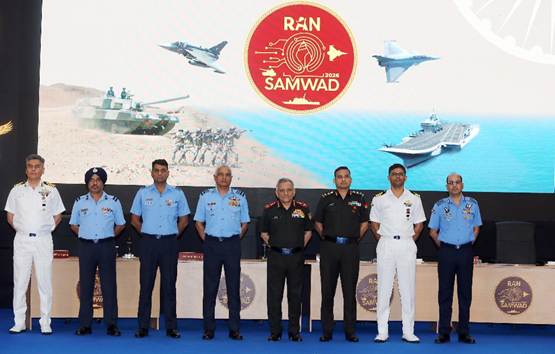
The seminar succeeded in fostering a shared understanding of the challenges posed by both conventional and irregular threats with a collaborative road map and meaningful discussions on the complexities of war, warfare and warfighting. The collaborative spirit demonstrated over the two days reaffirmed the Indian Defence Forces’ commitment towards achieving decision superiority and operational excellence in an increasingly contested multi-domain battlespace.
It may be noted that the flagship two-day national level seminar is conducted annually on rotational basis between the three services. It brings together senior officers from the three services, academicians, think-tank scholars, industry experts and Foreign Service Attaches from friendly foreign nations, to engage in brainstorming sessions on wide array of topics.