Augmenting Power
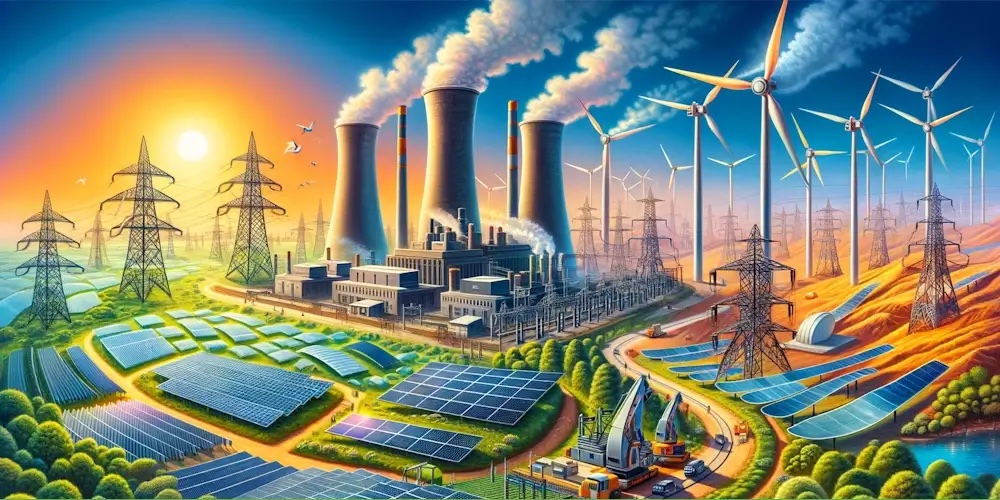
Electricity is among the most invisible yet indispensable elements of modern life. Lights switch on, irrigation pumps run, factories operate, hospitals function, and digital networks stay connected. For a country as large and diverse as India, ensuring reliable, affordable, and universal access to power is both a technical challenge and a governance achievement. Over the past decade, India’s power sector has undergone a period of major structural change, transitioning to a system defined by adequacy, expanded capacity, and improved reliability. It reflects years of consistent investment, institutional strengthening, regulatory discipline, and policy continuity.
India’s power sector is the third-largest producer and consumer of electricity globally, currently undergoing a historic structural shift toward sustainability while managing some of the fastest-growing energy demands in the world. As of early 2026, the sector has achieved critical milestones in universal electrification and renewable energy integration, positioning it as a central player in the global energy transition.
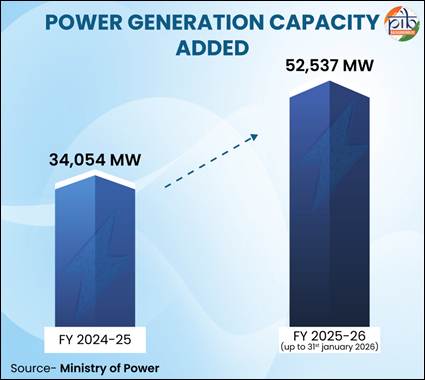
As India’s economy grows and living standards rise, electricity demand continues to expand across households, industry, agriculture, and services. Meeting this demand at scale requires not only more power generation but a system capable of delivering it across vast geographies. Focusing on building this scale, the generation capacity has expanded steadily across conventional and renewable sources.
Current Status and Milestones (2026)
• Installed Capacity: India’s total installed power capacity reached 520.51 GW as of January 2026.
• Renewable Energy Surge: Non-fossil fuel sources (renewables, hydro, and nuclear) now account for over 51% of total capacity, a target originally set for 2030 but achieved five years early.
• Supply Reliability: Power shortages have plummeted from 4.2% in FY14 to a minimal 0.03% by December 2025.
• Universal Access: Near-universal household electrification has been achieved through initiatives like the Saubhagya scheme, connecting over 2.86 crore households.
Key Drivers and Policy Framework
The transformation of the sector is guided by ambitious long-term goals and robust regulatory reforms:
• Draft National Electricity Policy 2026: Aims to raise per capita consumption from 1,460 kWh to 2,000 kWh by 2030 and over 4,000 kWh by 2047.
• Panchamrit Targets: India is working toward 500 GW of non-fossil fuel capacity by 2030 and net-zero emissions by 2070.
Flagship Schemes
• PM Surya Ghar: Muft Bijli Yojana: Targets rooftop solar for 1 crore households, providing up to 300 units of free electricity monthly.
• PM-KUSUM: Focuses on solarising the agricultural sector to reduce diesel dependence and provide energy security to farmers.
• Green Hydrogen Mission: Targets 5 MMT annual production by 2030 to decarbonize heavy industries.
Sectoral Challenges
Despite rapid progress, the sector faces persistent structural and financial hurdles:
• Distribution Health: State distribution companies (DISCOMs) still struggle with high Aggregate Technical & Commercial (AT&C) losses, though profits reached ₹2,701 crore in FY25 due to reforms like the Revamped Distribution Sector Scheme (RDSS).
• Grid Integration: The variability of solar and wind energy necessitates massive investments in Battery Energy Storage Systems (BESS) and pumped hydro storage to maintain grid stability.
• Transmission Bottlenecks: Renewable capacity additions often outpace transmission infrastructure expansion, leading to power curtailment in resource-rich states like Rajasthan.
• Supply Chain: Heavy reliance (75-80%) on imported lithium-ion cells for battery storage poses a risk to long-term energy security.
Future Outlook
The path toward Viksit Bharat @2047 involves a projected investment of $2.2 trillion over the next two decades. The Central Electricity Authority (CEA) expects total capacity to double to 1,121 GW by 2036, with solar emerging as the dominant backbone of the national grid. Future advancements will likely focus on Smart Grids, Small Modular Reactors (SMRs), and Green Hydrogen to ensure a reliable, affordable, and sustainable power supply for all.