Empowering Indian Agriculture

Kisan Credit Card is Strengthening Farmers’ access to capital
Agriculture is the backbone of the Indian economy, providing a livelihood to over 60% of the population. Despite its significance, Indian farmers have historically struggled with seasonal financial constraints and dependency on high-interest informal loans from moneylenders. To address these challenges, the Government of India, based on the recommendations of the R.V. Gupta Committee, introduced the Kisan Credit Card (KCC) Scheme in August 1998.
Implemented by NABARD (National Bank for Agriculture and Rural Development), this scheme was designed to provide timely and adequate institutional credit to farmers under a single window, transforming the agricultural credit landscape.
With nearly 46.1 per cent of the population dependent on agriculture and allied activities for their sustenance, ensuring financial security and improved access to institutional credit for farmers remains a central policy priority for the Government. In this context, the KCC and then the Revised Kisan Credit Card (2020) scheme seek to ensure that farmers have access to adequate and timely credit for a wide range of agricultural requirements, including short-term crop cultivation, post-harvest operations, marketing-related expenses, household consumption needs, working capital for farm maintenance, and investment credit for allied and non-farm activities.
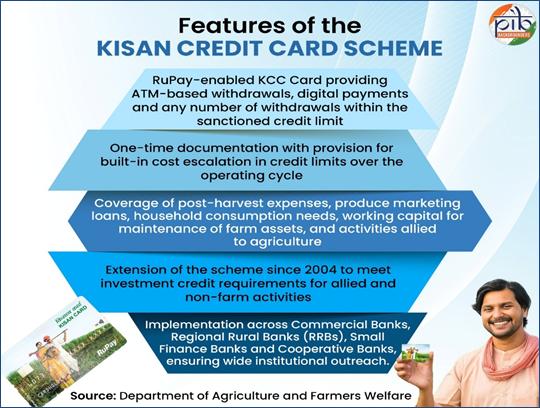
The revised KCC offers a RuPay-enabled card with flexible withdrawals, digital payments, and one-time documentation, making access to credit simple and efficient. It covers cultivation, post-harvest needs, allied, and non-farm activities, and is implemented through commercial, regional rural, and cooperative banks to ensure broad outreach.
Key Features and Benefits
1. Revolving Credit Facility: The KCC acts as a revolving cash credit facility, allowing multiple drawals and repayments within the sanctioned limit, which is usually valid for five years.
2. Affordable Interest Rates: The standard interest rate is 7% per annum. However, the government provides a 2% interest subvention and a 3% prompt repayment incentive, reducing the effective rate to as low as 4% for timely repayment.
3. Collateral-Free Loan: Farmers can avail of collateral-free loans up to Rs. 1.6 lakh (and up to Rs. 3 lakh in some cases) based on crop hypothecation.
4. Comprehensive Coverage: The credit limit covers short-term crop loans, post-harvest expenses, consumption requirements, and working capital for farm maintenance.
5. Insurance Cover: KCC holders are provided with personal accident insurance up to ₹50,000 for death or permanent disability, and ₹25,000 for other risks.
Eligibility and Application
The Kisan Credit Card (KCC) Scheme covers a wide range of farmer categories to promote inclusive and equitable access to institutional credit. It extends coverage to:
• individual farmers and joint borrowers who are owner-cultivators,
• tenant farmers, oral lessees, and sharecroppers.
• In addition, the scheme also includes Self Help Groups (SHGs) and Joint Liability Groups (JLGs), including groups formed by tenant farmers and sharecroppers, thereby ensuring broader financial inclusion across diverse farming communities.
In 2025–26, the Government of India enhanced the Kisan Credit Card (KCC) lending limit, which includes:
• the crop loan limit under MISS, which has been raised from Rs 3 lakh to Rs 5 lakh.
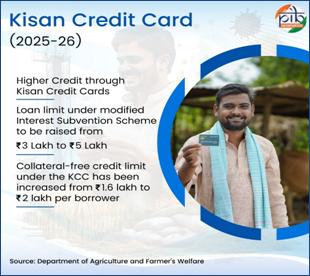
• the credit limit for fisheries and allied activities has been increased from Rs 2 lakh to Rs 5 lakh
• the collateral-free credit limit has increased from Rs 1.6 lakh to Rs 2 lakh per borrower, effective from 1 January 2025.
• Short-term agri-loans up to Rs 3 lakh are available at 7% interest, with an additional 3% subvention for timely repayment, reducing the effective rate to 4%.
Achievements and Impact
The KCC scheme has made significant strides in financial inclusion, particularly for small and marginal farmers, who make up over 86% of the farming community. As of 2024, the scheme has empowered millions of farmers, with over 7.72 crore active KCC accounts and outstanding loans exceeding ₹10 lakh crore. By facilitating easy access to quality inputs like seeds and fertilizers, the KCC has enhanced agricultural productivity.
Challenges and Misuse
Despite its success, the scheme faces challenges. In some instances, credit intended for agricultural purposes has been diverted to non-agricultural uses, such as vehicle purchases or real estate investment. Additionally, some farmers, particularly small holders, face difficulties in getting the full credit limit approved in rural areas, and documentation hurdles still exist in some regions.
Conclusion
The Kisan Credit Card has been a transformative tool in Indian agriculture, acting as a “lifeline” for farmers by replacing expensive informal credit with affordable, institutional credit. The integration of technology through RuPay cards and digital platforms like the Kisan Rin Portal has furthered its effectiveness. As the government continues to expand its coverage to allied sectors and improve accessibility, the KCC scheme remains crucial to promoting financial stability and boosting productivity in the rural economy.