Lessons from the AI Summit
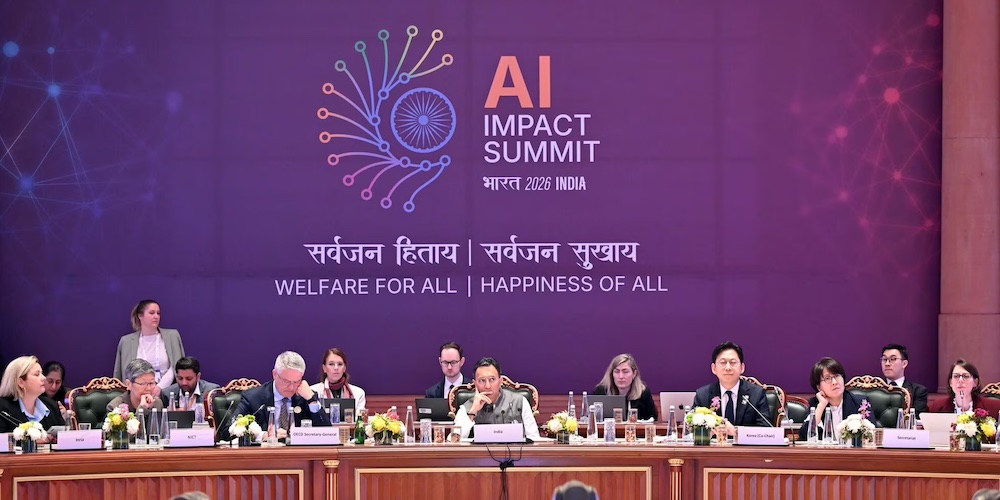
The recent AI Summit brought together policymakers, technology leaders, researchers, and industry pioneers to discuss the transformative power of artificial intelligence. With major players such as OpenAI, Google, Microsoft, and Meta participating in global AI conversations, the message was clear: AI is no longer a futuristic concept — it is a defining force shaping economies, governance, and societies
Artificial Intelligence (AI) is a key enabler of India’s development journey, strengthening governance and transforming public service delivery in alignment with the vision of Viksit Bharat@2047.
Underscoring India’s commitment to responsible and inclusive AI, Prime Minister Narendra Modi inaugurated the India AI Impact Expo on 16 February 2026 in New Delhi at Bharat Mandapam, New Delhi.
The Summit, the first global AI gathering to be hosted in the Global South, witnessed unprecedented participation, with over 20 Heads of State, 60 Ministers, and 500 global AI leaders.
Bringing together policymakers, technology companies, innovators, academia, and industry leaders, the Summit sought to translate global AI deliberations into actionable development outcomes under the IndiaAI Mission and the Digital India initiative.
For India, a nation with immense demographic and technological potential, the summit offered critical lessons.
1. Invest Aggressively in AI Infrastructure
One of the key takeaways from the summit was the centrality of compute power, data infrastructure, and semiconductor ecosystems. Countries leading in AI are investing heavily in high-performance computing clusters and domestic chip manufacturing.
India must accelerate its semiconductor mission, strengthen data centers, and encourage public-private partnerships in cloud and AI infrastructure. Without strong compute capacity, even the best AI talent cannot compete globally.
2. Prioritize AI Talent and Research
The summit emphasized that AI leadership depends not just on technology, but on talent. Institutions like Massachusetts Institute of Technology and Stanford University are driving foundational AI research through strong academic-industry collaboration.
India already produces a large number of STEM graduates, but needs:
• Greater funding for AI research in universities
• Incentives to retain top AI researchers
• Cross-disciplinary AI programs combining ethics, law, and technology
Strengthening institutions such as the IITs and IISc with world-class AI labs could help India transition from being a consumer of AI to a creator of foundational models.
3. Build Responsible AI Governance Early
A recurring theme at the summit was responsible AI — transparency, safety, and fairness. The rapid rise of generative AI tools like ChatGPT has sparked global discussions around misinformation, bias, and regulation.
India should avoid a reactive approach. Instead, it can:
• Develop clear AI accountability frameworks
• Encourage ethical AI standards
• Align with global best practices while preserving national interests
Proactive regulation can make India a trusted AI hub rather than a risk-heavy market.

4. Leverage AI for Public Good
Several summit sessions showcased AI applications in healthcare, agriculture, climate modeling, and education. For a country like India, AI can dramatically improve:
• Precision agriculture for small farmers
• Diagnostics in rural healthcare
• Personalized learning in public education
India’s digital public infrastructure — such as Aadhaar and UPI — provides a strong foundation to integrate AI-driven public services at scale.
5. Foster Startup Ecosystems
Global AI innovation is not driven by big tech alone. Startups play a pivotal role in experimentation and rapid deployment.
India must:
• Improve access to early-stage capital
• Simplify regulatory frameworks for AI startups
• Encourage sandboxes for AI experimentation
Cities like Bengaluru and Hyderabad already show promise, but a broader national innovation network is needed.
6. Ensure Strategic Autonomy
The summit also made it evident that AI is becoming central to geopolitical power. Countries are racing to control supply chains, data flows, and AI standards.
India must strike a balance:
• Collaborate globally
• Protect strategic interests
• Avoid overdependence on foreign AI infrastructure
Strategic autonomy in AI will be as critical in the 21st century as energy security was in the 20th.
7. Upskill the Workforce at Scale
AI will reshape employment patterns. Rather than focusing solely on job displacement, the summit emphasized augmentation — AI working alongside humans.
India should:
• Integrate AI literacy into school curricula
• Provide large-scale reskilling programs
• Support MSMEs in AI adoption
With the world’s largest youth population, India can turn AI disruption into a demographic advantage.
Conclusion
The AI Summit underscored a simple truth: nations that lead in AI will shape the global economic and political order of the coming decades.
For India, the opportunity is immense — but so is the urgency. By investing in infrastructure, nurturing talent, building responsible governance frameworks, and focusing on inclusive growth, India can move from being an AI adopter to an AI leader.
The summit was not just a gathering of technologists; it was a glimpse into the future. The lesson for India is clear: prepare boldly, act strategically, and innovate responsibly.