
POLITICS OF HATE
India Rising, Politics Sinking in the Face of AI Summit
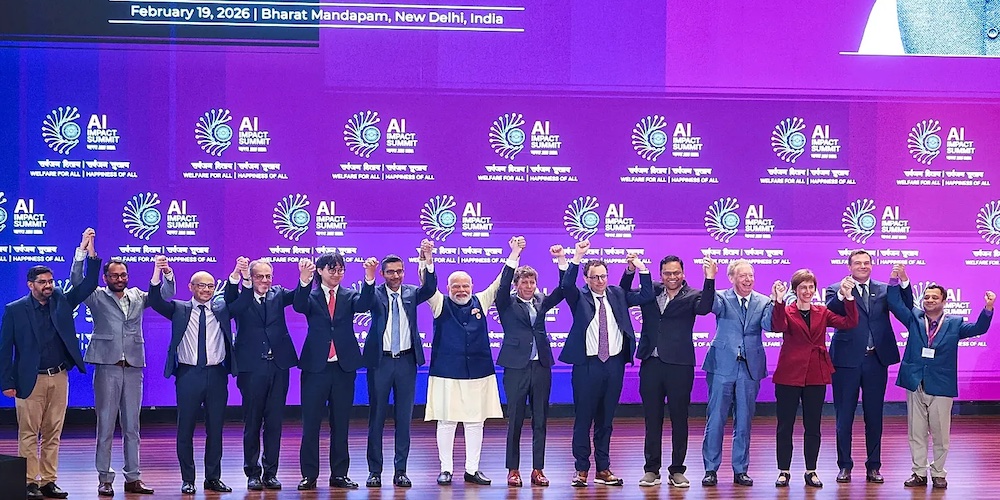
India stands today at a rare and historic juncture — rising with unprecedented confidence on the global stage while its principal opposition party sinks into theatrics, disruption, and a vocabulary of hostility that increasingly appears misaligned with the nation’s aspirations. This contrast was glaringly visible when a group of Youth Congress workers staged a bizarre half-naked protest on 20 February 2026 at the gates of Bharat Mandapam, the venue of the Global AI Summit in New Delhi. At an event attended by innovators, scholars, corporate leaders, and policymakers from across the world — an event meant to showcase India’s technological leadership — the spectacle of young party workers reducing dissent to indecency exposed a deep psychological frustration within the Congress ecosystem. Far from a democratic protest, it became an unfortunate demonstration of internal anger spilling out in a form unbecoming of a national political organisation.
The conduct and rhetoric of the Leader of the Opposition, Rahul Gandhi, have further amplified this troubling descent. Inside Parliament, debates have often been overshadowed by sloganeering and performative disruption. Outside Parliament, his preference for emotionally charged, sweeping denunciations—rather than fact-based critique—has contributed to a political culture of perpetual negativity. His unwillingness to acknowledge even a single achievement of the government underlines a mindset driven not by an alternative vision but by compulsive contrarianism. At times, he appears more invested in discrediting India than in challenging the government.
More disturbing is his tendency to address forums abroad — often populated by groups sympathetic to anti-India narratives — to criticise domestic developments, question democratic institutions, and amplify Western scepticism about India’s rise. This appears less like political dissent and more like political outsourcing. Even the recent US decision to ease tariffs on Indian goods became yet another pretext for him to attack the Prime Minister. Ironically, when former US President Donald Trump imposed tariffs on India, he held Modi responsible; and now, when tariffs are relaxed, he again holds Modi responsible! This political inconsistency signals a deeper problem: a reflexive opposition to Modi rather than a reflective understanding of governance.
It would have been one thing if this negativity impacted only domestic politics. But when India faces threats from China or provocations from Pakistan, the Congress narrative often appears strangely aligned with India’s critics, as though national setbacks offer them political ammunition. This is not opposition in the classical democratic sense. It borders on a form of adversarial politics that positions the political opponent not merely against a ruling party but against the nation itself.
Fortunately for India, national destiny is shaped not by the frustration of a few but by the collective will of millions. Under the stewardship of Narendra Modi, the nation has demonstrated remarkable resilience, confidence, and achievement — advancing in security, economy, diplomacy, technology, and governance at a pace unmatched in its contemporary history.
Terrorism crushed, Naxalism wiped out.
One of the most profound transformations in India over the past decade has been the restoration of national security. Terrorism has been crushed, and Naxalism wiped out. There was a time when terror attacks were frequent, unpredictable, and demoralising. Major urban centres lived under perpetual fear; security forces were overstretched, and responses remained defensive. The Kashmir Valley faced relentless infiltration. The Red Corridor witnessed continuous bloodshed under Left-Wing Extremist groups. This landscape has changed decisively.
Terrorism sponsored by Pakistan has been reduced to a fraction of its earlier scale. Advanced intelligence operations, coordinated counter-terror missions, improved border fencing, high-tech surveillance, and the reorientation of security doctrine have together restored deterrence. The Balakot airstrike in 2019 marked a turning point. For the first time, India demonstrated that terror attacks would invite not only defensive operations but punitive action across the border. It altered Pakistan’s calculus, exposing the limits of its proxy war strategy.
The equally historic achievement has been the virtual eradication of the Naxalite insurgency. Decades of neglect had allowed Left-Wing Extremism to control vast territories stretching across central and eastern India. Governments before Modi viewed the challenge primarily through the prism of policing. Modi’s approach combined security operations with governance, connectivity, welfare delivery, and developmental integration. Roads, telecom towers, schools, healthcare facilities, and banking access entered regions once inaccessible to state presence. Local confidence in the administration increased as governance replaced guerrilla rule. Today, only a handful of districts report sporadic incidents, and even these are fading.
The significance of this transformation cannot be overstated. A secure India is an economically confident India; a secure India is an investible India; a secure India is a socially cohesive India. The end of large-scale insurgency and terrorism has freed national resources, improved public morale, and strengthened India’s international image as a stable and responsible power.
But more importantly, it has delivered peace and dignity to millions of ordinary citizens who lived for decades under fear — families in Dantewada, Sukma, Latehar, Malkangiri, and Bastar, whose children can now attend school, whose markets can function safely, whose roads are no longer death traps. These people have gained the most from Modi’s quiet but committed leadership.
Poised to be the World’s Third Largest Economy
Political rhetoric may oscillate wildly, but economic performance is difficult to manipulate. Numbers tell a story of truth — and India’s numbers over the last decade narrate the saga of a nation entering a phase of unprecedented expansion. When the Modi government took office, India was the world’s tenth-largest economy. Today, it is the fourth largest, having surpassed Japan and racing to overtake Germany to become the third largest, well ahead of earlier projections and likely also to overtake Germany to become the world’s 3rd best performing economy even before the current term of Modi government ends in 2029. This leap is not a statistical artefact; it reflects structural strength, sustained reforms, and global trust.

India’s high-growth trajectory has occurred despite multiple global crises: a pandemic that crippled supply chains, wars that disrupted trade, inflationary shocks in advanced economies, and recessionary pressures worldwide. Yet India has remained the fastest-growing major economy — a unique phenomenon admired by institutions like the International Monetary Fund and the World Bank. Several pillars underpin this success:
1. Structural Reformism: GST created a unified national market. The Insolvency and Bankruptcy Code cleaned the financial ecosystem. Corporate tax rationalisation boosted competitiveness. Labour law consolidation simplified compliance.
2. Infrastructure Renaissance: Highways, expressways, new airports, modernised railways, logistic hubs, and inland waterways have drastically reduced transport friction. India is building more infrastructure annually than in entire decades previously.
3. Digital Revolution: The JAM trinity, UPI, Aadhaar-enabled services, and fintech innovation have democratised financial access. India leads the world in real-time digital transactions, surpassing the combined total of the next several countries.
4. Manufacturing Push: The PLI schemes have ignited fresh investment in electronics, semiconductors, pharmaceuticals, defence production, renewable energy, and mobility technologies.
5. Global Supply Chain Shifts: Multinational corporations seeking alternatives to China increasingly view India as a long-term destination. Apple’s growing investment in India is a visible indicator of this trend.
6. Innovation and Technology: The success of Chandrayaan-3, the Aditya-L1 mission, and India’s expanding startup ecosystem — including over 100 unicorns — highlights India’s move toward knowledge-driven growth.
In the global economic debate, India is now viewed not merely as an emerging market but as a civilisational power re-entering the top tier of the global economy. Its demographic strength, digital capacity, market size, and geopolitical credibility position it uniquely to shape the 21st century.
Against this backdrop, opposition leaders calling India a “dead economy” sound not merely uninformed but disconnected from reality.
Strategic Statecraft: Turning ‘Tariffs’ into Leverage
The recent political controversy surrounding US tariff policy is yet another example of how domestic criticism often misunderstands global diplomacy. When the US President Trump imposed tariffs on India, it was part of his broad economic protectionism that targeted not just emerging economies but traditional US allies as well. India responded firmly but without antagonism. It retaliated proportionately, protected national interests, and simultaneously kept diplomatic channels open. Under Modi, India’s foreign policy is neither timid nor aggressive— it is assertively composed.
What followed is instructive: the US recalibrated, and tariffs on certain Indian goods were later relaxed. This was not due to Indian pressure alone, but because Washington recognises India’s increasing indispensability in global strategic architecture — especially in the Indo-Pacific, where the balance of power is shifting rapidly due to China’s assertiveness.
And yet, even in this achievement, the opposition saw an opportunity to attack Modi. Their narrative alternates inconsistently: When tariffs were imposed, they said Modi failed! When tariffs were eased, they said Modi capitulated! Such inconsistency reflects political desperation rather than analysis.
India’s diplomacy today is multi-aligned, no longer non-aligned. It maintains a strategic partnership with the United States while preserving strong ties with Russia. It strengthens relationships with the United Arab Emirates, Saudi Arabia, and France — countries that value India’s stability and global standing. India leads the Global South dialogue and plays a central role in climate diplomacy, trade negotiations, and emerging technology governance. Even at multilateral forums, India’s voice is amplified not because of rhetoric, but because of respect for it.
Modi’s personal diplomacy — assertive, unpretentious, and purposeful — has turned India into a bridge-builder between competing global blocs. Few world leaders today enjoy cordial relations across such a diverse geopolitical spectrum. India’s ability to maintain autonomy while expanding influence is perhaps one of Modi’s most underappreciated achievements.
Conclusion: India in a Fast Forward Mode
India’s rise is not an illusion; it is an unfolding reality. It can be measured in secure borders, safer villages, confident markets, expanding infrastructure, growing global recognition, and the optimism of 1.4 billion citizens. It is visible in the confidence of young startups, in the aspirations of migrating workers, in the pride of professionals abroad, and in the relief of communities freed from decades of insurgency.
But paradoxically, while India moves upward, sections of its own political class seem stuck in cycles of cynicism. Their frustration manifests as indecent protests, intemperate speeches, contradictions, and attacks on India’s institutions, diplomacy, and achievements. They appear unable to digest that India under Modi is succeeding — globally admired, economically stable, and strategically respected. History, however, is indifferent to political bitterness. It judges through outcomes, not outrage.
Today, India is stronger than at any time in its modern history. Its future appears luminous, its leadership assured, and its people united in aspiration. Even as detractors attempt to paint a picture of despair, the world sees an India rising — confident, stable, purposeful, and ready to define its destiny.
(The author is retired Colonel of the Indian Army)


Very welldone. Correctly and boldly narrated.
Absolutely spot on!