RIGHT ANGLE – So Near and yet So Far are India and the US on the militarization of Space
It seems the signing of the interim Indo-US Trade Agreement early this month was also the beginning of efforts to restore the momentum that had been derailed in the otherwise growing security ties between New Delhi and Washington.
While India decided to buy last week Boeing made six P-8I Patrol Aircraft, the Commander of Indo-Pacific Command Admiral Samuel J Paparo, during his visit to the Indian capital on February 15, also became the first senior American official to “applaud the tactical execution” of the Indian military against Pakistan during Operation Sindoor.
Saying that the US would “learn” from the conflict, he asserted that the US-India defence relationship is now on a “steeply upward trajectory”.
In between, the U.S. Consulate General Chennai, with support from the U.S.-India Strategic Partnership Forum (USISPF), hosted the U.S.-India Space Business Forum in Bengaluru on February 10-11. The forum was the flagship event of the first U.S. Trade Mission to India focused on commercial space, which brought 23 Executives from 14 leading American space companies to India to engage with more than 200 government and industry participants from both countries.
As only the second space-focused trade mission ever organized by the U.S. Department of Commerce, and the first of its kind to India, the initiative reinforced U.S. leadership in commercial space innovation and underscored the growing momentum of the U.S.-India partnership in the global space economy.
Along with the developmental goals that the forum would strive to achieve through the cooperation and “cocreation” ( of technologies and assets), the Americans were reported to have also highlighted how “the space is underpinning national security,” and the two countries should move forward together in this regard.
Incidentally, any bilateral or even multilateral cooperation on space almost inherently involves security dimensions due to the dual-use nature of space technology. Even when cooperation is initially aimed at scientific exploration, it often evolves to include strategic, defense, and security aspects.
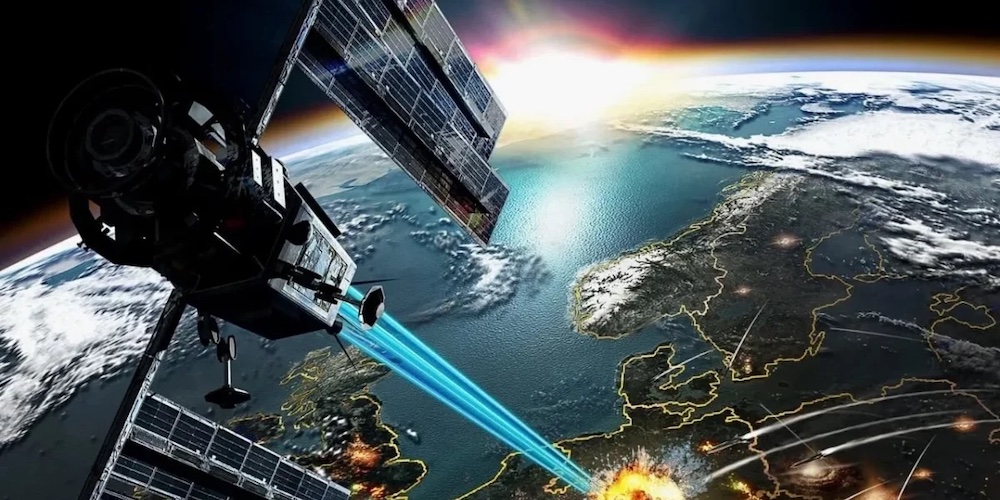
After all, space has transitioned from a tool for socio-economic development to what is said to be “a critical fifth domain of warfare”, alongside land, sea, air, and cyber world. So much so that experts now say that space is not only a physical domain – the ‘eighth continent’ to be controlled and exploited – but also an inescapable component of modern statecraft and overall power projection.
Spacepower already forms the backbone of contemporary warfare, enabling everything from weather forecasting to multi-domain Command, Control, Communications, Computers, Intelligence, Surveillance and Reconnaissance (C4ISR) and missile defense.
There are many reasons why space power is becoming indispensable for national security. A few of them are particularly noteworthy :
First, dedicated military satellites are now vital for military surveillance and intelligence. They work on 24/7 monitoring of borders, coastline, and maritime areas.
Secondly, they provide secure communication for the borders, coastline, and maritime areas. They offer day-and-night imagery even through thick cloud cover, which is vital for tracking troop movements and identifying targets.
Thirdly, they provide the high-resolution imagery necessary for precision strikes and situational awareness. And they secure military communications, so essential for the command and control of distributed forces of the Army, Navy, and Air Force, and integrated warfare.
Fourthly, satellites support missile launch detection, secure communications, navigation, and intelligence — all functions critical to avoiding miscalculation and unintended escalation.
Equipped with multi-sensor technologies and electro-optic capabilities, thermal sensors, high-resolution cameras, communication sensors, and high-precision radars (like synthetic aperture and inverse synthetic aperture radars), satellites can provide much better image clarity and definition.
In other words, space-based assets provide the “eyes and ears” for modern armed forces, enabling capabilities that were previously impossible. They are now the force multipliers. As a result, space is getting increasingly militarized, leading to the following :
More satellites have been launched by governments and commercial companies in the last five years than in the previous six decades combined. More than 100 nations and multilateral organizations now have at least one satellite in orbit, compared to just 14 at the turn of the century.
There are now more than 10,000 active satellites, including for critical defense and national security functions, with more than 40,000 objects, including debris, currently in orbit — a serious challenge for ad hoc space traffic management.
Secondly, major powers are developing “ counterspace weapons” such as Anti-Satellite (ASAT) missiles to physically destroy the targets of their adversaries. Although the global Outer Space Treaty(OST) of 1967 prohibits the placement of nuclear or other weapons of mass destruction in orbit, it does not ban the transit of nuclear weapons or the use of conventional or ASAT weapons.
Thirdly, there are now instances of high-altitude jamming, spoofing of GPS signals, and cyberattacks on ground stations so as to “blind” an enemy nation without creating physical debris.
Fourthly, the proliferation of debris from collisions or ASAT tests poses a “cascading” threat that could make critical orbits unusable for all nations.
Fifthly, many nations have now created their respective “Space Forces” to augment their space power on the one hand and defend or protect it on the other. We now have the U.S. Space Force, the Canadian Space Division, the Australian Defence Force’s Space Command, Britain’s Royal Air Force U.K. Space Command, and France’s Air and Space Force.

India has a dedicated military space agency called the Defence Space Agency (DSA). Fully operational since 2019, the DSA is a tri-service agency that commands space-based assets, manages military satellites, and handles space warfare strategy, including anti-satellite (ASAT) capabilities.
In other words, as space has become more congested, contested, and militarized, safeguarding the space environment has become highly imperative.
It is not surprising, therefore, that on February 13, the Euro-Atlantic Security Leadership Group (EASLG), which operates as an independent and informal initiative, with participants from the United States, Canada, Russia, and fifteen European countries, has issued a significant statement.
It says, “Without practical steps to prevent conflict in space, the danger of nuclear catastrophe — by design or by blunder — grows significantly. The risk is further exacerbated by uncertainty over the future of nuclear arms control, allegations of plans to place nuclear weapons in space, and the possibility that one or more nuclear-armed states may resume explosive nuclear weapon tests”.
The EASLG has appealed to all the major militaries, including those of India, China, Japan, Germany, and Russia, to start a dialogue among themselves on how to avoid a space war and utilize space peacefully for developmental activities.
Simultaneously, there is another school of thought (that argues that it is time for democratic countries to join hands together against authoritarian Russia and China that are intent on dominating space. It advocated the democratic powers and their private sectors to work in cooperation, “promoting the asteroid belt, moon, and Mars as places for natural resources extraction, determining whether to use crewed or uncrewed vehicles to achieve democratic space objectives”.
It says that there is “the need to conduct Freedom of Navigation Operations (FONOPS) in space by these democracies, winning the information narrative against authoritarian powers, and bluntly telling public opinion in these democratic countries that space is no longer an idyllic venue for scientific exploration, but an arena of geoeconomic, geopolitical, and strategic competition”.
It is against this background that one may see the present state of Indo-US cooperation in space, particularly in the security sphere. Some of the important features of this cooperation are :
One, India’s Defense Space Agency (DSA) and the U.S. Space Command are collaborating to monitor space assets and track threats. India participated in the U.S. Space Command’s Global Sentinel exercise in 2025, focusing on shared surveillance capabilities. In fact, India has now transitioned from observer to participant in this US Space Command exercise.
Two, India and the United States have expanded cooperation in human spaceflight, with Indian astronauts training at NASA, and an Indian astronaut, Group Captain Shubhanshu Shukla, participating in Axiom Space’s Ax-4 private mission to the International Space Station in July last year.
Three, the India-US Defense Acceleration Ecosystem (INDUS-X) funds joint challenges to foster startups in developing technologies for satellite reconnaissance and secure communications. In 2025, seven Indian startups were selected for mentorship and potential US defence contracts in areas like satellite tracking and space-grade semiconductors.
Four, there has been cooperation on geospatial intelligence, aided by agreements like BECA (Basic Exchange and Cooperation Agreement, which, finalised in 2020, allows the sharing of high-end satellite imagery and classified geospatial data, enhancing the accuracy of India’s missile systems and military navigation); COMCASA (Communications Compatibility and Security Agreement, which, signed in 2018, provides India access to secure, encrypted US communication systems for real-time intelligence sharing between military assets; and Space Situational Awareness (SSA) Agreement (signed in 2022, this allows both nations to share data to monitor space debris and detect artificial threats to their satellites).
Five, there is the NASA-ISRO Synthetic Aperture Radar (NISAR) project that facilitates advanced Earth observation data for both civilian and security applications.
Six, in 2023, India signed with the US the “Artemis Accords” that set out nonbinding principles for lunar exploration, transparency, interoperability, and resource utilization. This move is said to have departed from India’s traditional preference for a multilateral, legally binding framework negotiated through the United Nations, especially considering it is one of the few countries to have ratified the 1979 Moon Agreement.
Seven, in the same year of 2023, the partnership gained further strategic depth with the launch of the U.S.-India Initiative on Critical and Emerging Technology (iCET), which included civil, commercial, and defense space cooperation. Accordingly, the U.S. Space Force has partnered with Indian startups Bharat Semi and 3rdiTech, with support from the India Semiconductor Mission, to establish India’s first national ecurity–focused semiconductor fabrication facility at Kolkata.
Incidentally, during Prime Minister Narendra Modi’s February 2025 visit to Washington, iCET was rebranded as the U.S.-India TRUST (Transforming the Relationship Utilizing Strategic Technology) initiative. TRUST builds on iCET’s cross-sectoral framework while placing greater emphasis on artificial intelligence, semiconductors, and critical minerals.
During this visit, Prime Minister Modi and U.S. President Donald Trump also reaffirmed the centrality of space cooperation under this new initiative, including in civil, commercial, and human spaceflight activities. They launched the INDUS Innovation Bridge, modeled after INDUS-X, to facilitate joint ventures and investment in emerging technologies, including space.
However, despite the increasing convergence in space cooperation between New Delhi and Washington as noted above, there remain some areas where the two partners agree to disagree.
India may have obtained in 2018 the Strategic Trade Authorisation-1 (STA-1) status, moving from Tier-2 to Tier-1 of the U.S. Commerce Department’s license exception list, a status that places it on par with NATO allies, and allows for license-free, expedited access to advanced, dual-use, and sensitive U.S. technologies in the defense, space, and high-tech sectors. But India continues to face hurdles from the US International Traffic in Arms Regulations (ITAR) and Export Administration Regulations (EAR).
And on its part, India has not supported the U.S. in some international forums on some matters relating to Space. It abstained from voting on the 2022 U.S.-led UN resolution calling for a ban on debris-generating direct-ascent ASAT missile testing.
It also abstained on the 2024 resolution on reducing space threats through norms, rules, and principles of responsible behaviors, a measure that received overwhelming support from the United States and its European allies.
India’s rationale is said to be its uneasiness with norm-making processes it perceives as “exclusionary or insufficiently representative”. And this has been seen as a manifestation of its policy of maintaining “ Strategic Autonomy”.
Viewed thus, one may conclude with the remarks of Dimitrios Stroikos, Head of the Space Policy Programme, LSE IDEAS, London School of Economics and Political Science, that “ while India is increasingly aligning with U.S. initiatives on operational and technological fronts, its approach to space governance remains cautious, characterized by selective engagement, normative ambivalence, and reticent behavior”.