OF ‘DOST’, ‘HAPPINESS’ & INDIANS IN U.S.
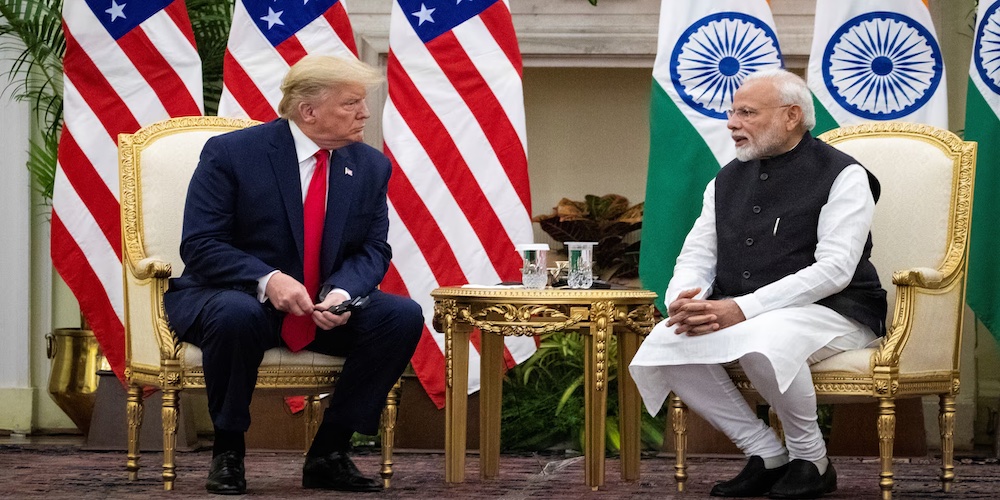
With the United States-forced regime change in Venezuela and the fear of much more that jeopardises peace, India cannot remain unaffected or unconcerned. More so, when President Donald Trump, determined to bring the entire world under America’s sway, specifically and repeatedly mentions India and Prime Minister Modi. He has declared that India “does not like me”, that he is ‘unhappy’ that Modi must “make him happy.”
Who in the world can be happy with such obvious arm-twisting when his “tariff terror” has persisted for the past nine months, that he wants to escalate with a 500 per cent hike? There is some talk that the ‘deal’ – Mr Trump’s favourite word – may come through next week. But unlike the hike and the threat of it, the reduction may only be calibrated.
Asked about this at the launch of his book on “New Age Foreign Policy for India,” former External Affairs Minister Salman Khurshid quipped: “Dost Dost Na Raha….”
For India, equally worrying is the well-being of the 5.4 million people who maintain their Indian roots living in America. They are facing their worries in silence, whether or not they admit this.
What had been coming for some time is clearly visible in the last year. It began with the handcuffing and deportation of illegal migrants. Nobody can complain. But what is happening to those who are legally there and those who are chasing the American dream of studying and working?
Has the dream run of Indians in America come to a halt after six decades? The New York Times confirms and laments that this has happened to “one of America’s most successful experiments in modern history”.
Noting that the Trump administration’s migration policy has caused a wave of antipathy against Indians, columnist Lydia Polgreen warns that “the US has been profoundly changed by Indians coming to the country. It stands to reason that it will be changed by their not coming, too.”
The commentary quotes Srinivasan Tamirisa, a successful doctor, who built a temple on Sugar Island (Texas), thinking it was the symbol of his lifetime’s achievement, dedicated to the Indian community. But erecting a tall statue of Hanuman earned him hostile comments from the neighbours. Having lived in the US for half a century, now old, he asks: Why am I here?
The signs are clear. Indian students topped the list of those entering American universities in 2024. Last year, this fell by 44 per cent. This is one of the planks of his “America First” policy. The “Make America Great Again (MAGA), a report from Washington says, has unleashed ‘cowboys’ to harangue the Indians.
The reports are both alarming and depressing. The current hostile mood has led to violence, both physical and verbal. They have become critical of the prosperous Gujarati, Punjabi or Telugu who have succeeded in their vocations, earning far above the average American.
Polgeen notes that key Republican officials and those in the Trump administration have been bad-mouthing Indians as a community, relying on what are not the normal, but exceptional events and issues concerning Indians. This has permeated social media and the mainstream media with Trump’s domestic support base, MAGA.
Indians are not singled out, though. Yet they are the worst-affected as they have topped the visa for work and education in recent years. They earned them on merit. But now, all of a sudden, meritocracy is sought to be redefined in nationalist terms. Trump’s National Strategic Security document explicitly says that by allowing foreigners on merit, “America’s historic advantages in science, technology, industry, defence and innovation will evaporate.”

To say the least, building on a narrow nationalist pride or caution betrays falling confidence in the world’s most powerful nation. The country that once projected itself as a “nation of immigrants” has, of late, turned inward-looking, wearing the ‘nationalist’ cap and has responsible opinion influencers saying, “we are a Christian nation.” Okay. But why trouble law-abiding people?
Not long ago, Raas Garba was celebrated in Times Square: today it seems an eyesore. Indians show their prosperity at cultural events and their religious devotion at temples. Today, erecting statues and temples that are boasted as “taller than the Statue of Liberty” is attracting disdain.
With some justification, Indians, in their anxiety to retain their identity, are accused of not mixing with the locals. Their race-conscious lack of mixing with other groups, especially the blacks, figures in Indian origin Mira Nair’s Mississippi Masala”, made in 1991.
The NYT commentary notes: “In its crudest form, mostly expressed on social media, this antipathy shows up as gutter racism and religious bigotry – declaring that Indians have low IQs, worship devils, cheat their way into the country and commit terrible crimes.”
She points to Indians who made America their home, bringing with them degrees and professional distinctions, and handsomely contributed to American society even as they prospered.
These are America’s “poster children” who include top corporate leaders heading multinational corporations. Indeed, six of them attended Trump’s oath-taking ceremony just a year ago.
Nobody seems to have an answer to the contrast between Trump-1 and Trump-2, in dealing with the same Indian Americans, and the same PM Modi, still called “a nice man”, continues to lead India. Have the days of “Howdy Modi” and “Namaste Trump” ended? Why?
The commentary takes a broader sweep with a measure of empathy amidst a hostile atmosphere. It is not the first and will only push forward the debate, which is unflattering.
It is not that all the Indians in America are in trouble. Yet, stories from their relatives back in India are causing worries. Not only citizenship aspirants and green card holders, but even those who have earned citizenship are uncertain about their future and that of their children.
Questions are being asked about the vocal silence of Indian Americans over the current phase, worsened by the Trump administration’s spat with Modi and India. But the reality is that neither can they forsake India and their families back there, nor can India, now led by Modi, who has assiduously wooed them, ignore their woes. But it is equally true that New Delhi can’t do much.
Some are returning home to uncertain prospects. While Canada and some European nations are welcoming meritorious students, work prospects in Europe, where they are employable, are also not bright. The anti-immigrant sentiment runs high. The ongoing conflict in Ukraine has hit European economies.
The larger reality is that this didn’t start with Trump. Indians “taking away” jobs from the locals was an issue in all American elections in the last 25 years. It has escalated today due to Trump’s exclusivist “America First” slogan. Any hope of a change, if and when it comes, is three years away. Unless Trump himself reverses it.