RIGHT ANGLE – Rahul Gandhi: India’s Tallest Communist Leader
Though Karl Marx always had many “bhakts” in India like M.N. Roy, Abani Mukherji, and others, officially it was on January 26, 1925 that the Communist Party of India (CPI) was officially established in the country at its first conference in Kanpur, with S.V. Ghate as its first General Secretary.
Over the last 100 years the Communists have risen as well as fallen. But it is to be admitted that Indian Communists have always had an influence on the country’s polity and foreign policy that is inversely proportional to their real strength. Though their pockets of strength have vastly eroded over the years, the Communists and their supporters still wield considerable influence in many walks of life. Until very recently, they dominated totally in the education sector. No wonder why India’s record has been so poor as far as fresh ideas, particularly in social sciences, are concerned, but that is a different matter.
Indian media, specifically the English media, is virtually dictated by the Leftist elements, notwithstanding the narratives of “Godi-media”. So is the case with non-government sectors.
In 1957, the CPI formed the world’s first democratically elected communist state government in Kerala under E.M.S. Namboodiripad. Subsequent disagreements within the party over the Sino-Indian War in 1962 and whether to support the Indian National Congress (INC) led to the formation of the Communist Party of India (Marxist) [CPI(M)].in 1964. This split, followed by the Naxalbari uprising in 1967 that led to the birth of the Maoist movement (CPI-ML), which advocated for armed revolution over parliamentary politics.
It so happened that after the splits, it was the CPM that did well electorally, particularly in three states of West Bengal, Tripura and Kerala over the years. But this “Red base” has declined,with CPM ruling now only in Kerala.
And it has also happened that both the CPI and CPM have decided to become tiny partners of dominant regional parties in Bihar, Tamil Nadu and the national Congress party for their very survival. They are happy to be accommodated with a few MLA seats and miniscule number of seats in the Lok Sabha and regional Sabha. So much so that In April 2023, the Election Commission of India revoked the CPI’s national party status due to poor electoral performance. The CPI and CPM are now mostly working together as parts of the so-called Left-Front.
There are many reasons that are often cited by the political commentators for the decline of Indian communists. These are :
• Failure to Adapt to Indian Realities: The communist ideology, largely based on Western industrial class struggles, struggled to adapt to India’s semi-feudal, agrarian society with deep-rooted caste and religious divisions. Party leaders were often from upper castes and failed to connect with the Dalit and backward classes who became the support base for caste-based regional parties led by figures like B.R. Ambedkar and Ram Manohar Lohia. Besides, the core tenet of communism, that is atheism, found little resonance in a deeply religious and god-fearing country with the towering influence of Mahatma Gandhi, who often mixed religion and politics.
• Rise of Identity Politics: The emergence of strong, charismatic leaders focusing on caste and religious identities (e.g., Mayawati, Mulayam Singh Yadav, Lalu Prasad Yadav) fragmented the potential support base that the communist parties might otherwise have attracted based on class.
• Economic Liberalisation and the Middle Class: The economic liberalisation policies initiated in the 1990s brought prosperity and new opportunities to a rising middle class, especially in the growing IT/BPO sectors. This new generation saw economic liberalism as a path to a better life and viewed the communist parties as “anti-industry” and “anti-development”.
• Internal Splits and Strategic Blunders: The communist movement in India suffered from various ideological splits (e.g., the 1964 split into CPI and CPI(M) following the Sino-Soviet war) and strategic errors. A major missed opportunity was the party’s decision to spurn the chance for their leader, Jyoti Basu, to become Prime Minister in the 1990s, a move he later called a “historic blunder.” Similarly, while part of the INDIA bloc since 2024, communists find themselves in direct conflict with their own alliance partners (like the TMC in Bengal or Congress in Kerala), creating voter confusion and weakening its distinct identity.

• Association with Trade Union Militancy: While effective in organizing labour in certain regions, the disruptive methods of some trade unions led to the shutdown of industries and created an anti-investment image, particularly in West Bengal and Kerala, hindering industrial growth.
• Perception of Being Anti-National or Pro-Foreign Powers: During historical conflicts, such as the 1962 war with China, sections of the communist parties were perceived as aligning with Chinese interests over India’s national interest, which significantly damaged their public image and credibility.
• Global Decline of Communism: The worldwide decline and eventual disintegration of the Soviet Union in 1991 made socialism seem an outdated and failed doctrine, which also impacted its appeal in India.
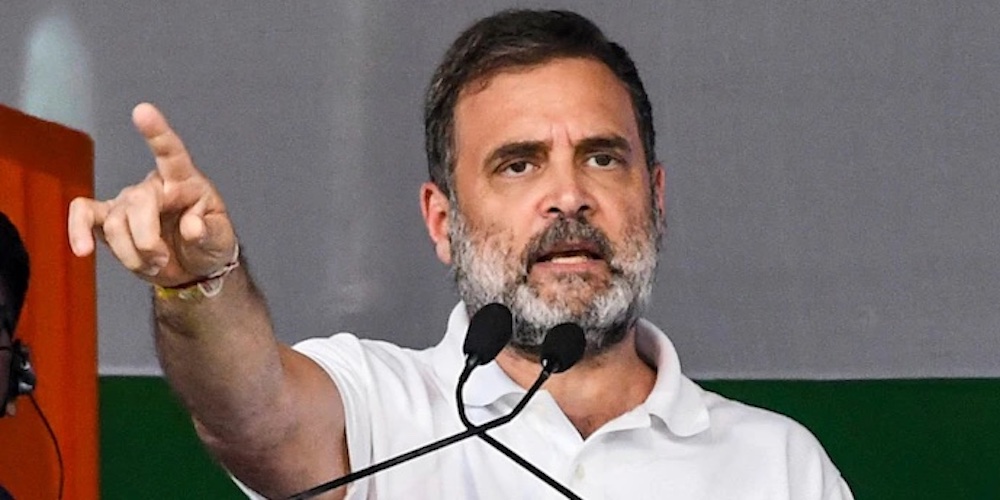
However, in my humble opinion, there is yet another reason why people do not miss the presence of the communists in India’s political landscape. Ironical it may sound, but it is a fact that the Congress Supremo Rahul Gandhi, who has literally reduced the Congress party to be his family property, is sounding like India’s tallest Communist leader. His political language does not reflect that of the traditional Congress party, which was an “umbrella” accommodating different shades of opinions within the party.
Rahul language, seen in a broad framework, is indistinguishable from that of veteran communist leaders of yesteryears like Namboodripad or S Dange ( though history tells us that Rahul’s grandmother Indira Gandhi as the Congress President pressurised his great grandfather, Prime Minister Jawaharlal Nehru, to dismiss the Nambudripad government) . In a way, he has gone a step further, something these veteran communists could not do.
Rahu is advocating for the redistribution of wealth and proposed a nationwide caste census to assess the participation of lower castes in various sectors of the economy and society. This, in fact, aligns with classic communist or Marxist economic philosophies.
Through initiatives like the Bharat Jodo Yatra, Rahul has focused on mass mobilisation and connecting with the poor and marginalized, a strategy often associated with Leftist and grassroots movements.
In fact, what Communist leaders failed in doing in the past is being done by Rahul these days when he often targets what he describes as the concentration of wealth among a few ultra-rich individuals like Ambani and Adani and the government’s alleged favoritism towards them, which resonates with anti-capitalist sentiments.
Like the ideologically rigid Communists, particularly of the CPM variety, Rahul Gandhi spares no opportunity to criticise the country’s foreign policy in maintaining strategic autonomy, wooing foreign investments and strengthening the Indian military. Remember what was the CPM’s role during the India-China war of 1962? And see how all these days Rahul and his “chamchas” are openly saying that Pakistan won over during the Operation Sindoor, which Islamabad fought with Chinese weapons. Or for that matter what he said during the 2017 Doklam Standoff in Bhutan and border clashes in Ladakh in 2020? After all, Rahu has consistently acted as a “mouthpiece” for the Chinese Communist Party (CCP), ever since a 2008 Memorandum of Understanding (MoU) signed between her then mother-led Congress Party and the CCP. Nobody, till today, knows its content.
But then all said and done, Rahul Gandhi has got his limitations, if electoral results in recent years are taken into account. And that is the problem with the Indian Communists. Their “tallest leader” is only making them further irrelevant in Indian politics.