IS TRUMP PUSHING ASIA CLOSER TO CHINA?
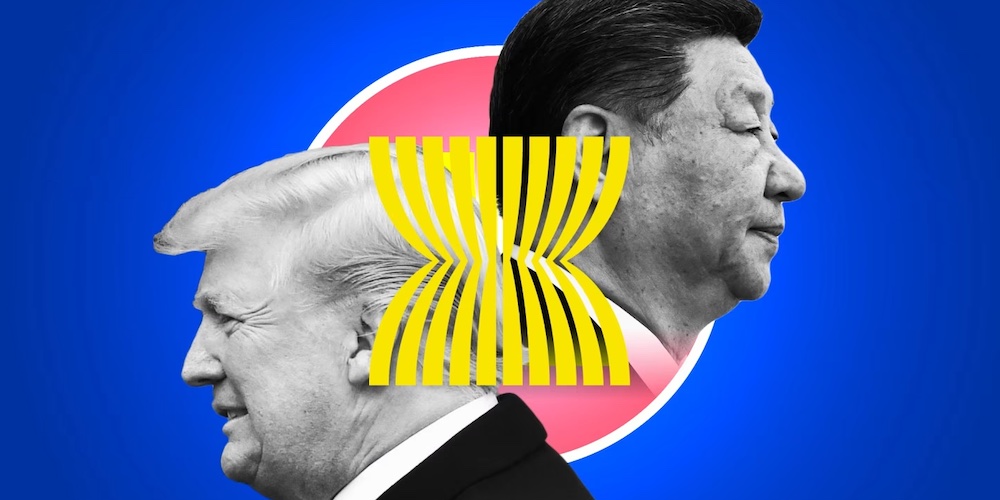
Is United States President Donald Trump, stuck in the snows of Europe in trying to bring peace to Ukraine, missing out in Asia, where his perceived principal adversary, China, is rising and consolidating?
Questions are being asked as he completes 11 months of his tumultuous second term. He seeks to extend America’s influence in Europe, to ‘save’ it from ‘extinction’ as per his new National Security Strategy. He also calls them ‘capricious’, “declining powers”, and wants to promote their only far-Right parties.
Critics are wondering if he has pushed more and more Asians closer to China by using threats of tariffs and trade, and ending many American programmes like the USAID that have benefited the poor across the world.
Perhaps the most glaring example is India, an ally on whom the highest tariffs have been imposed. No deal has been reached for over six months now. Trump was angry about the optics of the SCO at Tianjin, where Prime Minister Modi shook hands with China’s Xi Jinping and shared a car journey with Russia’s Vladimir Putin.
Indeed, the car-sharing was repeated when Putin visited India last week, and Modi received him at the tarmac, breaking protocol. The two smiled, hugged and patted. Analysts say that with these gestures, Modi has signalled that he has options beyond America and the European Union and that India is determined to exercise its “strategic autonomy” in a complex world, made more volatile by Trump’s policies.
In doing that, also facing the same US-EU phalanx that is worried about Ukraine, Putin played the perfect partner. Both subtly shifted the focus away from defence to a range of economic cooperation that have so far remained non-sanctioned areas. The message from the India-Russia summit is that whatever the US-EU nations may think and may have to sell to India, Russia shall remain a significant arms supplier, which will collaborate with India in technology transfers and co-production to help India become “atma-nirbhar” (self-reliant).
Read this with many countries reducing the dollar in their hard currency baskets. Led by India and Brazil, which have the highest Trump tariffs, and followed by China, countries of the BRICS alone, ignoring Trump’s threats, have withdrawn USD 29 billion in September from the American Treasuries. Of this, India’s share is USD 16.7 billion. America’s other allies, including Japan and Saudi Arabia, have also done this. The dollar is still the most powerful currency, but ‘de-dollarisation’ has begun.
The Monroe Doctrine, established by President James Monroe in 1823, helped create many “areas of influence” abroad for America and several “Tiger Economies”. One of them, the Philippines, America’s ally facing China’s heat, is worried. Interviewed by Ravi Velloor of The Straits Times, Singapore, Don MacLaine Gill, eminent Filipino expert, laments that the Monroe Doctrine is swiftly being replaced by the “Donroe Doctrine”, an allusion to Donald Trump’s Asia policies that hurt allies and benefit China.

Turn to Asia as a whole. Hong Kong-based think tank East Asia Forum, in its editorial on Trump’s policies in the region, concludes that Trump’s 11 months in office are “a period of significant disruption to traditional US foreign policy, characterised by unilateralism, transactional relationships, and a rejection of multilateral agreements.”
The EAF lists three broad reasons. “America First”: Foreign policy decisions were primarily guided by perceived US domestic interests, often at the expense of long-standing alliances or international consensus.
Unpredictability and Personal Diplomacy: Trump’s use of public statements, including tweets, and direct, personal negotiations with foreign leaders created a high degree of uncertainty for allies and rivals alike, often bypassing traditional diplomatic channels and the State Department.
Transactionalism: Relationships with other nations were often viewed through a transactional lens, with an emphasis on immediate economic or security concessions rather than shared values or long-term partnerships.
One notable action was the withdrawal of the US from the Trans-Pacific Partnership (TPP) trade deal, signalling a preference for bilateral trade agreements. Trump also announced his intention to withdraw from the Paris Climate Accord.
The Trump administration pursues a hardline position on Iran, with threats to leave the Joint Comprehensive Plan of Action (JCPOA), aligning the US with anti-Iran allies in the Middle East. Trump’s first foreign trip was to Saudi Arabia, which was seen as prioritising counter-Iranian influence and business interests.
The administration also issued an executive order to halt refugee admissions and bar entry to nationals from several Muslim-majority countries, which faced legal challenges.
Eleven months on, looking through the Asian prism, the EAF sees “a period of chaos, unpredictability, and a diminished U.S. standing as a reliable partner.
Allies expressed uncertainty and began developing strategies to mitigate the impact of sudden policy changes, while some authoritarian leaders saw opportunities to strengthen their positions.
The approach is perceived as being driven by the president’s personal interests and a desire to dismantle the previous administrations’ foreign policy legacies.
The Asians see difficult times ahead.