NEGATIVE U.S. POLICIES : IMPACT ON INDIA, CHINA & ELSEWHERE
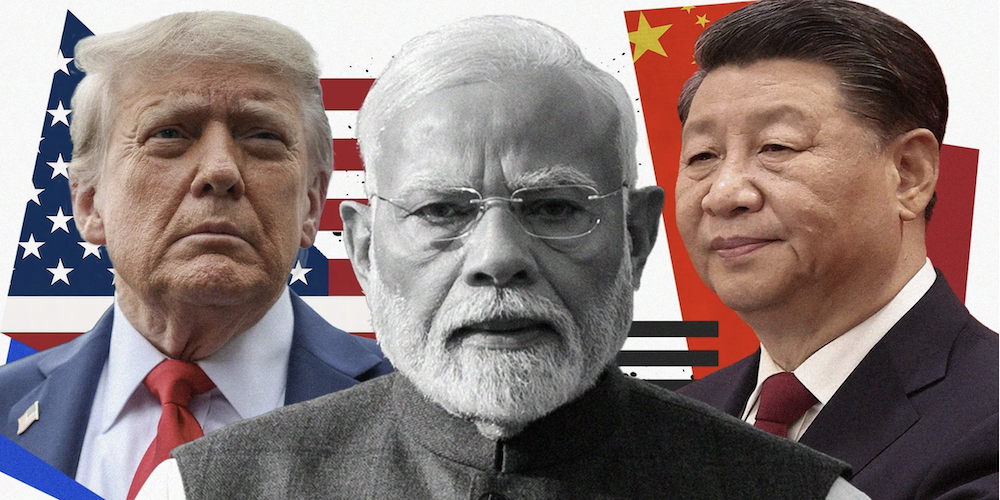
Being very old civilizations, having rich culture and heritage, both India and China had not only people to people contacts but also regular visits by travellers and scholars on a mutual understanding basis.
While one is aware about Confucius and HuenTsang in ancient times, names of Mao-tse-tung, Chou-en-Lai and Deng-Xiao-Ping have fired the shots in the post- 1954 Panchsheel Era, when Jawaharlal Nehru was our PM
PATH BREAKING CULTURAL REVOLUTION
If Mao-tse-tung was the most powerful Chinese Communist leader ever from 1949 to 1976, it was Deng-Xio-Ping who served as a paramount leader of China from 1978 to 1992. He is credited to have kept China ‘hidden’ from international glare for over a decade. At the end of it, however, China not only appeared stronger politically, diplomatically, scientifically and project management wise but also on art, culture and sports fronts. Performance of Chinese athletes and sportspersons became a force to reckon with, after what is widely known as Cultural Revolution.Chinese could occupy top positions in Olympics and World championships earlier held by U.S., U.K.and Russian sportspersons. The Chinese, being determined, never looked back.
ERA OF XI JINPING
President Xi Jinping, aged 72 years, has been at the helm of affairs both in administration and the ruling party since November 15, 2012. A man of few words, he began slowly to ultimately become the strongest ever President of the People’s Republic of China and that of the ruling Communist Party. He succeeded Hu JinTao. Incidentally, the latter was humiliated in an Annual Communist party conference just before his demise.
Close on the heels of Vladymir Putin, Xi declared himself as President for Life more than three years ago. He faced tough weather especially from youth during the Covid times in 2021-22 but being a capable administrator, he could suppress criticism and protest rallies which could have proved embarrassing if not counter productive.
DOKLAM TUSSLE & GALWAN WAR
On June 16, 2017 during a routine patrol close to tri-junction point (where Indian border touches that of Bhutan and China) at Doklam in East Sikkim, Indian soldiers discovered hectic road construction activity by Chinese soldiers. It was a clear violation of two Bhutan-China agreements of 1988 and 1998 on land claimed both by Bhutan and China.A few days of fist fight between the Army of India and China ultimately led to withdrawal of two armies to their original positions.
GALWAN, LADAKH BORDER
What happened on June 15, 2020 in Galwan at Line of Actual Control in East Ladakh was far more serious. In a major shift in its Border Road policy, the central government approved construction of feeder road to Patrol Point 14 in Galwan. Apart from providing improved access and support, it was to help civilian settlements and communication in the area. As the prospect of improved Indian connectivity appeared unpalatable to China, its soldiers began throwing stones & boulders. Same was responded to in a tit for tat manner by Indian troops.
When things went out of control, action by guns and artillery followed. While 20 Indian soldiers, including Col.Santosh Babu of Bihar Regiment, sacrificed their lives, on the Chinese side, the number was 35 to 45.
IT WAS THE DEADLIEST BORDER CLASH BETWEEN INDIA & CHINA SINCE 1967. Issue was resolved due to our deft diplomatic handling, sooner than expected. However, the fact remains that China continues to forcibly occupy thousands of hectares of Indian land in Ladakh as also Arunachal sectors.
Resumption of Mansarovar Yatra
However, there has been de tant (relaxation of strained relations) after several diplomatic and military level discussions. As a result, Kailash Mansarovar Yatra was resumed in the second week of June, 2025 after a gap of seven years through Nathula in Sikkim and Lipu lekh and Ship ki La in Uttarakhand and H.P. respectively.
LONG STANDOFF
It is well known that there has been a five year military stand off between India and China and that some attempts were made to relax things in October 2024. Ignoring it, P.M. Narendra Modi and President Xi Jinping have lately stressed that two countries were partners , not rivals. Looks like things may work towards gradual normalisation, which is the need of the hour, more so, in view of misuse of tariff policy and growing discrimination against the Indian diaspora in the U.S.A.
FIRST VISIT Of PM MODI TO CHINA IN 7 YEARS
Prior to the first visit of P.M. Modi to China in seven years, Modi visited Tokyo and Tanjin. Latter is a Port city which once served Imperial China. Having spent two days in Japan to consolidate mutual ties by signing of commercial, technological and security agreements, it appeared P.M.Modi was seeking re-engagement with China. In Beijing, prior to the SCO summit, when Modi and Xi Jinping finally met, it was being speculated that both will agree to end five year CHILL in Bi lateral ties.
They would keep the following three Pillars of SCO in mind – Security, Connectivity and Opportunity.
THREATENED WEAPON OF U.S. TARIFF
Talking of U.S. factor, due to the imposition of a 50% tariff on Indian goods as opposed to only 19% on Pakistani goods, is very unfair. As it is at random, it is bound to hit Diamond, Textile and similar high value sectors of India very adversely.
The trust deficit between both the countries not only has deepened over 50% tariff but imposition of additional 25% tariff on India over purchase of crude oil from Russia has led to additional complications. As regards China, no such additional tariff has been announced as yet.
Further, the Trump administration has asked European countries to impose sanctions and secondary tariffs against India. It has also asked them to stop buying crude oil and gas from India.
It could be said that personal anger of Donald Trump and his whims and fancies, his knack for playing with fire etc, are one day bound to go against him. Many allies of the USA fell into his line but INDIA DID NOT, AND RIGHTLY SO.
Trump’s open criticism by two of his powerful Mayors and murmuring going on within the Republican party are also going to be watched closely and with interest. From 50% in favour nine months ago, now 50% disfavour him. So much of a drastic slide in the public rating of any U.S. President has never been seen.
Not only has Trump minted millions of Dollars in Crypto currency, he has been found being erratic completely in taking decisions. His illogical desire to get the Nobel peace prize and rising softness towards Pakistan is bringing in an element of surprise in international circles. Invitations extended to Field Marshall Munir to visit the USA twice certainly raises the discomfort level of India.

EXPECTED OUTCOME OF TIANJIN S.C.O. SUMMIT
It is likely to go against Donald Trump, as apparent from the tone and tenor of the heads of Russia, China, Japan, India and North Korea during the Summit and whatever emerged from the sideline confabulations.
Russia, China, India, Japan and North Korea may remain united to show commitment for the time being to prevent any further U.S. attempt to use Tariff as a nasty international weapon.
In the meanwhile, India’s engagement and attempt to re-cement ties with Russia and China has already evoked strong criticism and concern from Peter Navarro, U.S.Trade Advisor.
Back to talks between PM Modi and President Xi Jinping, two leaders already met on the sidelines of SCO summit.They are reported to have agreed on a fair, reasonable and mutually acceptable resolution of the border issue and stressed the significance of a multipolar world and role to be played by two economies to stabilise world trade.This meeting, their second in ten months has materialised in the backdrop of deepening crisis between India and USA over 50 % tariff imposed by Trump Government.
But when asked if a raise in U.S.Tariff figured in the talks between two leaders, Indian Foreign Secretary, as expected, only minced words. He stated that focus was on the bilateral domain, but the international trade situation did come up.
BRICS SUMMIT OF OCT., 2024
Last meeting of Indian and Chinese leaders was during the BRICS summit in Kazan, in October 2024. P.M.Modi has optimistically felt that after long delayed disengagement at the border, an atmosphere of peace and stability should be in place.Further, he has disclosed that our Special Representatives have also reached an agreement on Border Management. He was perhaps referring to two meetings held between Ajit Doval, Indian NSA and Chinese Foreign Minister in December, 2024 and August, 2025.
PM Modi has described these meetings as fruitful.
S.C.O. MEET AT TIANJIN
Addressing the main summit of Shanghai Cooperation Organisation on September 1, P.M. Modi made it clear at the very outset that double standards on terror were unacceptable and that sovereignty and territorial integrity were the KEY factors. Purposely referring to the most brutal terror attack at Pahalgam, he said that it was not only an assault on the conscience of India but also an open challenge to every nation, every individual having faith in humanity. On the whole, Indian P.M.focussed on the need to oppose terrorism and those supporting it.
Ahead of Modi, President Xi Jinping of China laid stress on his vision for a new Global Security and Economic Order that gives priority to the Global South.
IT WAS A DIRECT CHALLENGE TO THE U.S.A. He went on to add that we must continue to take a clear stand against hegemonism and power politics and practice multilateralism.
LESSONS TO BE DRAWN FROM S.C.O. Summit
• In order to maintain the tempo that was set in motion on the side lines and apparently sustained during the summit proper, President Xi Jinping hosted a banquet in honour of S.C.O. leaders. P.M.Modi could meet the host and President Putin and reiterate commitment for improving bi-lateral ties based on mutual trust and respect,
• India became part and parcel of a big show of anti-West unity. It is a different issue that Putin-Xi Jinping bi-lateral talks also prompted Pakistan to have such talks with Russia,
• Though Putin, Kim Jong Un, P.M.of Pakistan and 24 other Heads stayed back to witness the Grand Chinese Parade on September 2, to mark the 80th anniversary of World War II, the decision of P.M.Modi to skip it was a wise one. The Trio of Xi Jinping, Putin and Kim Jong Un upset western leaders so much that parade was considered an anti-U.S.conspiracy by the U.S. President,
• Apart from his forceful arguments against tentacles of terrorism in the presence of facilitators,viz, President of Turkiye and P.M.of Pakistan, P.M.Modi also called for reforms in UNO on the occasion of 80th anniversary of the world body.He could sense that spirit during the summit appeared respectful and non-confrontational,
• When it comes to Sino- Indian ties , China is capable of changing colours like a chameleon. India shall have to move very carefully and cautiously while dealing with them,
• India’s very old ties with Russia shall have to take precedence over any dis-engagement with China or fresh trade treaty negotiations with the U.S.A.
The coming together of Russia, China, India, Japan and North Korea is going to be a disadvantage to the U.S.A. Though it may not pose an immediate threat, it is a sign of discomfort. It certainly weakens the QUAD ‘experiment’ of the U.S.A.

(The author is former Chief Secretary, Sikkim)