The New Era of IIT Expansions and Milestones
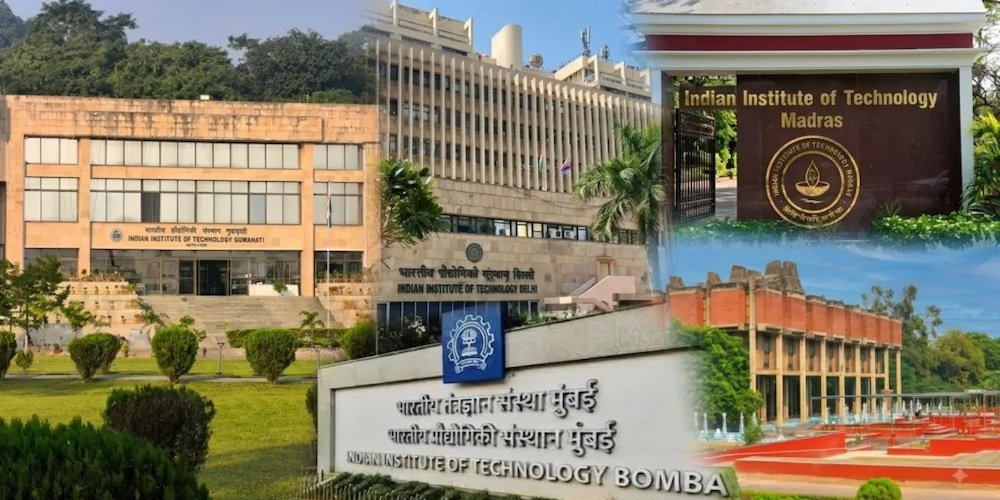
IIT Kharagpur recently celebrated its Platinum Jubilee (75 years) with a commemorative coin unveiled by Prime Minister Narendra Modi. Meanwhile, IIT Delhi-Abu Dhabi held its first convocation for 17 MTech graduates, IIT Kanpur signed a five-year MoU with BIT Mesra alongside launching a ₹281-crore Deep Tech U-Hub in Noida, and IIT Madras introduced 20 courses on AI, aerospace, and cybersecurity for school students
For more than seven decades, the Indian Institutes of Technology (IITs) have stood as the crown jewels of India’s technical education system. What began in 1951 as an ambitious post-independence experiment to build a self-reliant, industrialised nation has evolved into a globally recognised powerhouse of engineering, research, and entrepreneurship.
Today, the IIT ecosystem is undergoing its most dynamic transformation yet — celebrating historic anniversaries while aggressively expanding its domestic infrastructure, international footprint, deep-tech capabilities, and grassroots educational outreach.
Honoring 75 Years of Nation-Building
The foundation of the IIT legacy was recently spotlighted as IIT Kharagpur, the nation’s very first IIT, celebrated its Platinum Jubilee. Established on the historic grounds of the Hijli Detention Camp — where British authorities once imprisoned Indian freedom fighters — the campus has become a living symbol of India’s journey from colonial subjugation to technological self-reliance.
To commemorate 75 years of academic excellence, Prime Minister Narendra Modi unveiled a special commemorative coin at the campus, reflecting on how IIT graduates have powered every phase of modern Indian development — from foundational infrastructure, space exploration, and atomic energy to the global information technology revolution.
The milestone served not just as a tribute to a single institution, but as a recognition of the entire 23-institute IIT network and its more than half a million alumni worldwide.
Taking the IIT Brand Global
Perhaps the most visible shift in the IIT story is its expansion beyond India’s geographical borders. Driven by the internationalisation goals of the National Education Policy (NEP) 2020, IITs are establishing offshore campuses to export Indian academic rigor to the world. Following IIT Madras’s pioneering campus in Zanzibar, IIT Delhi-Abu Dhabi recently marked a major milestone by hosting its inaugural convocation.
Seventeen students graduated from the campus’s first Master of Technology (MTech) cohort in Energy Transition and Sustainability, achieving a remarkable 100 percent placement record across the UAE and the wider Gulf region, including key roles at the Abu Dhabi National Oil Company (ADNOC).
Rapidly growing to nearly 300 students representing 13 nationalities across undergraduate, postgraduate, and doctoral programs, the Abu Dhabi campus demonstrates how IITs are tailoring their curricula to solve pressing global challenges like green hydrogen, carbon capture, and clean energy.

Scaling Domestic Capacity and Deep-Tech Infrastructure
While venturing abroad, the IIT system is simultaneously scaling up at home to meet surging domestic demand and foster frontier innovation. Over the past decade, total student enrollment across the 23 IITs has doubled from 65,000 to 1.35 lakh. To sustain this momentum, the Union Cabinet approved a massive ₹11,828.79 crore Phase-B expansion plan for five newer IITs — Tirupati, Palakkad, Bhilai, Jammu, and Dharwad. Over a four-year period, this investment will add over 6,500 seats, create 130 new professorial posts, and establish five state-of-the-art research parks to tighten industry-academia linkages.
At the same time, established IITs are spearheading India’s push into high-stakes deep technology. In a landmark move, the Uttar Pradesh government approved a ₹281.03 crore Deep Tech U-Hub at IIT Kanpur’s Noida campus (alongside a sister center at IIIT Lucknow). Designed to translate specialised laboratory research into commercially viable startups, the Noida hub will focus on strategic sectors including physical AI, robotics, semiconductor design, quantum computing, and advanced biotechnology.
Complementing this infrastructure push, IIT Kanpur also signed a five-year Memorandum of Understanding (MoU) with the Birla Institute of Technology (BIT) Mesra to foster joint research supervision, shared laboratory access, and student exchanges — a model of collaborative growth increasingly common across premier Indian institutions.
Democratising Access at the Grassroots
Historically, the IIT experience was accessible only to the tiny fraction of students who cleared the fiercely competitive Joint Entrance Examination (JEE) Advanced. Today, however, IITs are actively dismantling these walls to democratise technical education at the school level.
A prime example is the IIT Madras School Connect Programme, which offers 20 specialised eight-week online certificate courses to students in Classes 9 through 12. Covering cutting-edge subjects like Data Science, Artificial Intelligence, Aerospace Engineering, Cybersecurity, and Forensic Sciences at a nominal fee of ₹500 per course, the initiative has already reached over 2.25 lakh students across more than 6,500 partner schools.
By introducing teenagers to emerging fields before they enter college, IIT Madras is helping young learners make informed career choices while cultivating a nationwide culture of scientific curiosity.
Looking Ahead
From commemorating 75 years of history in Kharagpur to graduating international cohorts in Abu Dhabi, building deep-tech hubs in Noida, and mentoring school students online, the IIT ecosystem is redefining its mandate. No longer just elite engineering colleges training graduates for global corporations, the IITs have matured into multi-dimensional engines of innovation — bridging classrooms, industries, and nations to architect India’s technological future.