WHEN “GEOPOLITICAL NEPOTISM” HIT U.S. TIES WITH INDIA
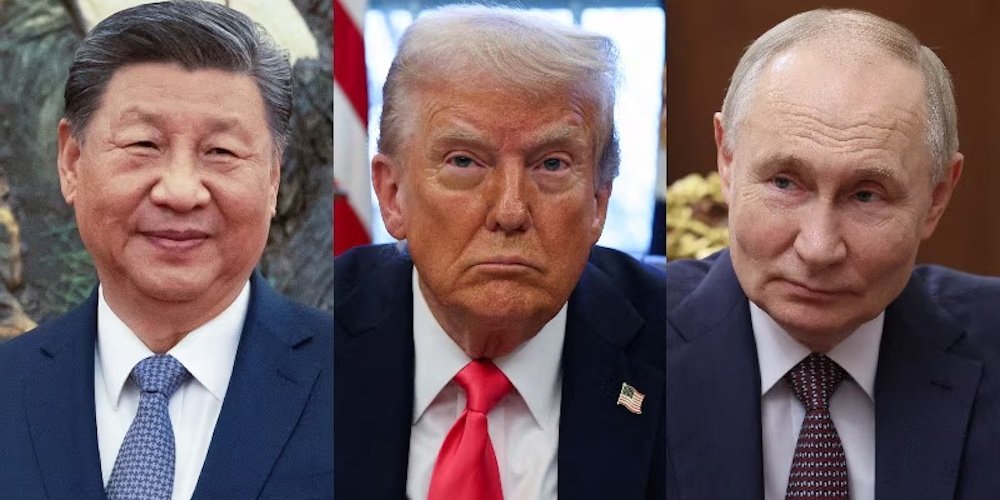
Why does the US’s Donald Trump want to discuss his war on Iran with his friends-cum-foes, China’s Xi Jinping and Russia’s Vladimir Putin? But not the Ukraine conflict, in which the two are directly pitted against him? The topic may be Iran’s nuclear programme, which concerns all.
The summit in China’s Shenzhen next week, although called ‘unprecedented’, is not expected to produce anything dramatic, officials have already said.
At home, Trump has hit a seeming pause on the Iranian challenge, marked by last Friday’s attack on the American radar in Bahrain. He has even taken Vice President Vance off the Iranian peace effort. If Vance is out, who is in? Marco Rubio has also turned a critic.
The post-midterms blues?
Meanwhile…..
What is the future of the business deals that Pakistan struck with Trump’s family members and officials?
Questions arise as the November 3 elections have caused a massive defeat for Trump and his Republican Party. It is bad news for Pakistan. But does it mean good news for India? It is wise not to rush. The geopolitical situation remains complex.
For Pakistan, which painstakingly re-engineered its Washington strategy around transactional, even personalised, access to the White House, this shift introduces a period of profound vulnerability, intense legislative scrutiny, and deep geopolitical friction.
With the Democratic Party securing decisive control of both the House of Representatives and the Senate, American foreign policy is poised to undergo a seismic realignment starting next January.
Under Trump’s second term, US-Pakistan relations changed remarkably. Trump switched his ‘affection’ for “my great friend”, Indian Prime Minister Narendra Modi, to the Pakistan leadership that emerged from the brief India-Pakistan conflict in May 2025.
While India denied any American role, Pakistan seized Trump’s claim of having ‘resolved’ the conflict, repeatedly endorsing his claim for the Nobel Peace Prize.
Pakistan also positioned itself as a critical geopolitical asset to the White House, serving as a vital backchannel mediator between Washington and Tehran amid ongoing Gulf hostilities.
Anchored by Army Chief Field Marshal Asim Munir and Prime Minister Shehbaz Sharif, it built a highly personalised rapport with the White House.
Both sides bypassed traditional State Department frameworks, signing private commercial pacts, ranging from mineral exploration in Balochistan to digital payment initiatives through Trump family-backed cryptocurrency platforms. The deals’ worth is estimated to be $1.3 billion.
In control of both Houses of the US Congress, Democrats will now expose the structural weakness of the American system of governance. While the President remains the chief architect of foreign policy, Congress commands the “power of the purse” and wields immense oversight authority.
The incoming Democratic committee chairpersons will assume sweeping subpoena powers. They have already signalled intentions to launch aggressive investigations into the Trump administration’s foreign policy manoeuvres and business dealings. An institutional Squeeze on the US’s financial and military dealings under Trump-2 appears inevitable.
Consequently, Pakistan finds itself directly in the crosshairs of a bitter domestic constitutional turf war between Congress and the President. This could turn Islamabad’s hard-won political access into a huge political liability.

Trump-2 benefited Pakistan’s economy, especially with the International Monetary Fund (IMF) loan. But while the Trump administration retains the executive authority to negotiate foreign policy, it can no longer guarantee financial or defence deliverables to its international partners.
Direct US civilian and economic aid will face stringent legislative riders. Democratic lawmakers are prepared to condition future assistance on rigorous human rights audits, democratic governance metrics, and press freedoms — benchmarks that traditional Pakistani institutions routinely struggle to meet.
On the defence front, the impact may be immediate. Major initiatives, such as the multi-million-dollar F-16 fleet modernisation and sustainment packages approved in late 2025, alongside emerging private defence startup contracts for unmanned aerial drone systems, face an uphill battle. The Congressional committees can freeze pending component transfers, withhold critical technical assistance, and block defence export licenses entirely under the Arms Export Control Act. Washington’s defence relationship with Islamabad could be reduced to a tightly restricted, maintenance-only paradigm.
The most profound systemic strain on the post-midterm US-Pakistan relationship lies in the sharpening global competition between Washington and Beijing. Pakistan’s historical posture of “issue-based strategic autonomy” — seeking to maintain deep strategic ties with China while enjoying economic and security partnerships with the West — may become increasingly untenable.
Democrats view global statecraft through the lens of a systemic, long-term challenge posed by China. They are intensely critical of the China-Pakistan Economic Corridor (CPEC) and its evolving digital and physical infrastructure footprint. The Congress will aggressively challenge Pakistan’s reliance on Chinese telecommunications, smart-city surveillance networks, and strategic maritime hubs like Gwadar Port. For Islamabad, the threat of technology-transfer restrictions and potential secondary sanctions will become a constant diplomatic hurdle.
The Democratic takeover may pull Washington’s regional focus back toward New Delhi. Unlike the Trump administration’s frequently volatile and transactional approach to India, the Democratic leadership views the US-India partnership as an indispensable anchor of its Indo-Pacific strategy to counter Chinese influence.
The Democrats may try to restore the tilt to New Delhi, as per their traditional stance. But India need not rejoice — not so soon — and may carry riders. Today, Washington is highly polarised, with a hostile Congress poised to introduce unprecedented friction into every dimension of bilateral economic and military assistance.
The incoming Democratic majorities in the House and Senate manage to tilt Washington’s strategic lens back toward India. To that extent, it will reduce Islamabad’s political leverage. Pakistan’s strategic relevance will be heavily devalued, reducing its leverage on the global stage.
However, despite the impending legislative gridlock and heightened oversight, US-Pakistan relations will not suffer a total structural collapse.
Two critical factors will prevent a complete rupture in ties: First, Pakistan’s geographic proximity to major geopolitical flashpoints ensures its continued relevance to global trade and security. Also, the US recognises that a destabilised, nuclear-armed Pakistan facing internal militant threats poses a high risk to regional security. Counter-terrorism cooperation, though narrower and more transactional than in the past, will remain a functional baseline of intelligence sharing.
Second, Pakistan’s role as a trusted diplomatic mediator in the Gulf conflict remains highly valued. With the Trump administration heavily entangled in managing conflicts across the Gulf, Pakistan’s functioning backchannels to Tehran provide a vital firewall against catastrophic regional escalation.
Significantly, both Beijing and Washington share an interest in sustaining this diplomatic safety valve. This ensures that Islamabad retains some strategic utility to the US.
The rules of engagement of 2025-2026 may no longer apply. Islamabad must now navigate a delicate diplomatic act: Defending its vital relationship with Beijing, managing an investigation-heavy US Congress, and preserving its fragile economic lifelines in a deeply polarised world.
Will this make Trump’s “great friend” references to Modi sound genuine and warm? Only time can tell.