RIGHT ANGLE – Rahul Gandhi’s Failed Politics of Allegations
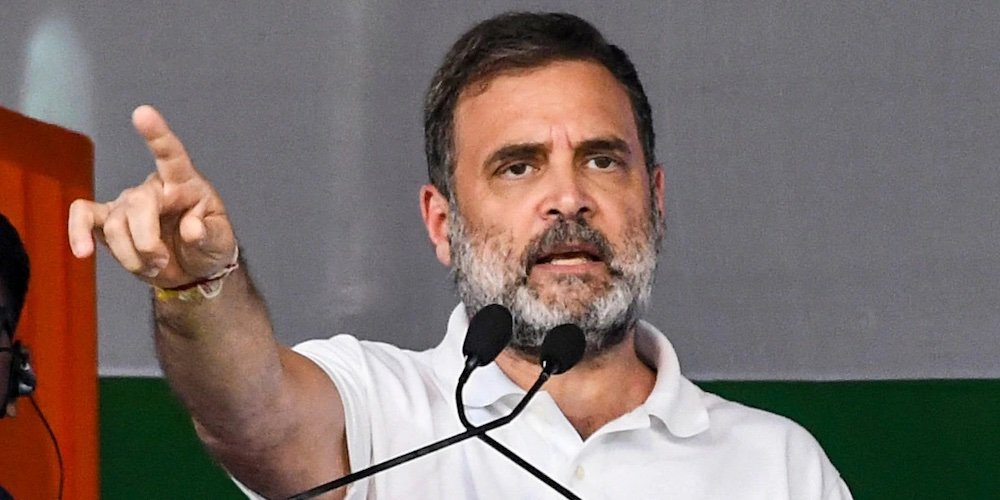
Can a democracy’s principal opposition leader expect the public to believe his accusations when he repeatedly makes serious charges without placing verifiable evidence before the public?
An opposition leader has every right, indeed a responsibility, to question the government, investigate possible wrongdoing and demand accountability. But allegations of corruption, espionage and treason are exceptionally serious. They cannot be established through political rhetoric, repetition or dramatic declarations.
There is a fundamental difference between holding a government accountable and conducting a political campaign through a succession of sensational allegations. The former is the responsibility of a credible opposition; the latter can eventually become an exercise in diminishing one’s own credibility. Unfortunately for the Congress and its leader Rahul Gandhi, the distinction appears to be getting increasingly blurred.
His latest allegation, made on November 13, 2026, that Prime Minister Narendra Modi is tapping his telephone, is a case in point. During an Instagram interaction, Rahul Gandhi held up his phone and declared that the evidence for all his allegations was stored in it, adding that the Prime Minister knew this because his phone was being tapped.
Yet, once again, the country was left wondering: Where is the evidence? Who has examined it? What exactly has been intercepted, and by whom?
These are not unreasonable questions. They are the minimum questions that should be asked of anyone making an allegation of such gravity, particularly someone occupying the office of Leader of the Opposition in the Lok Sabha.
The problem is not that Rahul Gandhi questions the government. Democracies need robust opposition, and governments must never be above scrutiny. The problem is the apparent ease with which he makes extraordinary accusations without providing the accompanying evidence that could establish their credibility.
Consider the Pegasus controversy.
When allegations emerged that the Israeli spyware Pegasus had been used to target Indian politicians, journalists and other individuals, Rahul Gandhi was among those who made serious claims about surveillance. He said that his own phone had been infected and that intelligence officers had warned him to be careful about what he said over the telephone.
The allegations were serious enough for the Supreme Court to intervene. In October 2021, the Court appointed an independent technical committee under its supervision to investigate allegations of unauthorised surveillance.
The Supreme Court-appointed committee did seek phones from petitioners for technical examination. The Indian Express, reporting on November 30, 2021, specifically reported that the committee had emailed petitioners asking them to submit their devices. But Rahul Gandhi refused to hand over his phone to the committee. Even when Anurag Thakur and other BJP leaders publicly challenged him over his failure to submit his phone for examination, he decided against the submission.
Eventually, the committee’s findings, made public by the Court were hardly the confirmation that the most dramatic political claims had anticipated. The committee examined 29 phones and found no conclusive evidence of Pegasus spyware in any of them. Five devices showed possible malware infection, but the available material was insufficient to establish that it was Pegasus.
In other words, the committee’s findings did not substantiate the sweeping allegations of Pegasus infection in the devices examined.
There is thus a larger question: if a politician claims to possess decisive evidence of illegal surveillance, why should the country not expect him to place verifiable evidence before an appropriate independent authority?
A similar pattern was also visible in the Rafale controversy.
Rahul Gandhi made the purchase of 36 Rafale fighter aircraft from France a central political weapon against Narendra Modi in the run-up to the 2019 general election. He repeatedly alleged corruption, questioned the pricing and accused the Prime Minister of favouring industrial interests. His slogan, “Chowkidar Chor Hai”, was intended to turn the Prime Minister’s carefully cultivated image of an incorruptible guardian into a political liability.
But what happened subsequently?
In December 2018, the Supreme Court declined to order an investigation into the Rafale procurement, finding no apparent irregularities in the decision-making process. When review petitions were filed, the Court dismissed them in November 2019, finding no merit in the grounds presented for reopening its earlier judgment.

This did not mean that every conceivable question about defence procurement had been answered for all time. Nor does a judicial decision necessarily settle every political argument. But it certainly meant that the central demand for a court-monitored investigation had failed.
More damaging for Rahul Gandhi was what happened when he attempted to invoke the Supreme Court itself to strengthen his political slogan.
During the election campaign, he suggested that the Supreme Court had endorsed his “Chowkidar Chor Hai” accusation. The Court categorically clarified that it had made no such observation. It subsequently rebuked him for incorrectly attributing the remark to the judiciary. Rahul Gandhi had to tender an unconditional apology, and the Court closed the contempt proceedings with a warning to be more careful in future.
This was not merely a political setback. It was a serious lesson in the consequences of attributing to a constitutional institution something it had never said.
And then there was the electoral verdict. In 2019, Rahul Gandhi lost the Amethi constituency, the traditional Gandhi family stronghold, to Smriti Irani by 55,120 votes. His defeat in Amethi, after years of political association with the constituency, was symbolically significant.
The outcome demonstrated that repeatedly calling a Prime Minister a thief was no guarantee of convincing the electorate. Indeed, the slogan may have strengthened the perception among sections of voters that the Congress was relying more on personal attacks than on a convincing alternative political programme.
The latest phone-tapping allegation brings us back to the larger issue. Rahul Gandhi is not merely suggesting that surveillance may be taking place. He is specifically accusing the Prime Minister of tapping his personal telephone and implying that the device contains evidence of extraordinary wrongdoing, including alleged foreign influence over India’s political and financial systems.
If he possesses such evidence, he should place it before an appropriate investigative authority, a parliamentary committee or another credible independent institution. If he believes those institutions cannot be trusted, he should explain why and identify an alternative means of independent verification.
Simply holding up a telephone before a camera and declaring that it contains proof is political theatre, not evidence. The burden of substantiating an allegation rests equally on the person making it. One cannot demand transparency from the government while expecting the public to accept one’s own assertions without scrutiny.
This brings us to a larger problem with Rahul Gandhi’s political approach. He seems to have developed a tendency to personalise political disagreements and elevate them into allegations of criminality or national betrayal. Modi is not merely a political opponent; he is portrayed as a thief, a traitor or someone acting at the behest of foreign interests. Such language might excite a section of the political audience, but it also raises the evidentiary burden.
The Congress leader must understand that the electorate is not simply looking for someone who can attack Narendra Modi. It is looking for someone who can convincingly demonstrate why he should replace him. The distinction is crucial.
Modi’s political success has rested partly on his ability to project decisiveness, political conviction and a clear narrative of governance. Whether voters agree with every policy or not, they know what he stands for politically. Rahul Gandhi, on the other hand, often appears to be reacting to Modi rather than defining an independent political destination for himself and his party.
If Rahul Gandhi wants to emerge as a credible national alternative, he must demonstrate that he can distinguish between suspicion and proof, between political rhetoric and factual argument, and between an accusation and an established finding.
India needs a strong opposition. It needs an opposition that investigates, exposes wrongdoing, questions procurement decisions, challenges surveillance and demands accountability. But it also needs an opposition whose word carries weight.
The ultimate tragedy for Rahul Gandhi is that when everything becomes an allegation, even a genuine allegation risks losing its impact.
A leader who cries wolf too often may eventually discover that the public has stopped listening. That, perhaps, is the most important political lesson Rahul Gandhi needs to learn.