Anchoring India’s Maritime Sovereignty
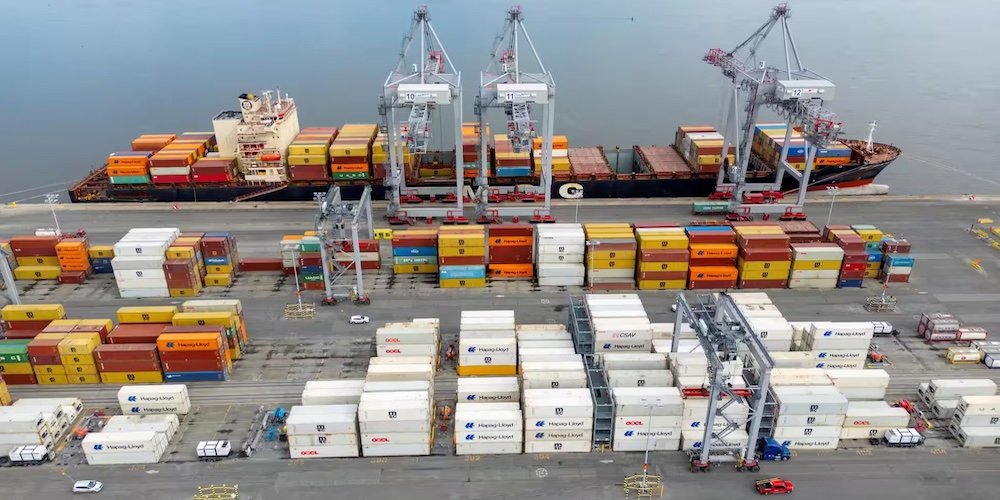
Maritime transport is a cornerstone of global trade, with shipping containers playing a vital role in the seamless movement of goods across borders. As of February 2026, India’s maritime sector facilitated 95% of the country’s trade by volume and 70% by value. Beyond its role in trade, the sector contributes 4-5% to India’s GDP
The humble corrugated steel shipping container is the unsung hero of global commerce, carrying over 80% of the world’s manufactured trade. Yet, for decades, this critical node of global logistics has been an area of acute vulnerability for India. Despite its massive export ambitions, India historically manufactured only a sliver of the containers it required — producing roughly 10,000 to 30,000 Twenty-Foot Equivalent Units (TEUs) annually against China’s staggering 2.5 to 3 million units.
This stark dependency exposed Indian exporters to severe supply-chain bottlenecks, exorbitant freight rates, and acute container shortages during global crises. To fix this strategic blind spot, the Government of India introduced the Container Manufacturing Promotion Scheme (CMPS).
Formally approved by the Union Cabinet on October 28, 2026, with an ambitious ₹10,000-crore budgetary outlay extending up to FY 2039–40, the CMPS is designed to transform India into a self-reliant, globally competitive hub for container manufacturing.
Strategic Blueprint and Key Components
The CMPS is a meticulously structured industrial policy administered under the Nodal Ministry of Ports, Shipping and Waterways (MoPSW). It addresses the structural cost disadvantages that previously discouraged domestic steel fabricators from entering the capital-intensive shipping container market. The ₹10,000-crore funding framework is systematically divided into three complementary pillars designed to stimulate both capital investment and volume-driven production:
1. Operational Expenditure Assistance (OEA) – ₹8,891 Crore: Consuming the lion’s share of the budget, this component bridges the price gap between Indian-manufactured boxes and cheaper global imports. It offers direct financial assistance for every container built to rigorous international standards and sold by eligible domestic manufacturers, enhancing their cost-competitiveness on the global stage.
2. Interest Subvention Assistance (ISA) – ₹859 Crore: To lower the high cost of borrowing for heavy industries, the scheme provides a 3% annual interest subvention on eligible capital loans. This financial cushion applies to setting up new greenfield manufacturing facilities as well as expanding existing brownfield capacities.
3. Testing and Certification Assistance – ₹150 Crore: To ensure domestic containers survive the harsh realities of trans-oceanic shipping, this fund establishes shared testing facilities. It supports critical quality checks like dynamic longitudinal impact testing, ensuring compliance with global maritime standards.
Furthermore, the policy prevents India from becoming a mere assembly line by mandating strict local-content thresholds. Eligible firms must maintain at least 70% domestic inputs through 2031–32, an allocation that scales aggressively to 90% starting from 2032–33, ensuring long-term indigenous manufacturing depth.

Objectives and Macroeconomic Impact
The overarching objective of the CMPS is to achieve a massive tenfold expansion of India’s annual container manufacturing capacity, scaling up to 7.5 lakh TEUs. This rapid scale-up aims to de-risk Indian trade by breaking the near-monopoly of foreign manufacturers, protecting local exporters from geopolitical shocks and sudden spikes in container leasing costs.
The ripple effects of this industrial injection extend far beyond container yards. The scheme is projected to attract up to ₹1 trillion in total investments, generating an economic market value exceeding ₹1.07 lakh crore. It serves as a vital macroeconomic engine for job creation, forecast to yield approximately 3,000 direct industrial jobs and over 50,000 indirect employment opportunities.
This jobs boom directly stimulates heavy ancillary industries, including specialised corten steel production, precision corner castings, marine-grade paints, and wooden flooring.
Integration with National Visions and Synergistic Initiatives
The CMPS does not operate in an industrial silo; it acts as a core accelerator for the broader Make in India initiative and complements the Maritime Amrit Kaal Vision 2047. Realising that factories require guaranteed customers to survive initial scaling phases, the government paired the CMPS with the creation of the Bharat Container Shipping Line (BCSL).
Established via an MoU involving major public sector entities like the Shipping Corporation of India (SCI) and Container Corporation of India (CONCOR), the BCSL plans to deploy an investment of around ₹99,149 crore for a 51-vessel fleet and massive container procurement. This national carrier acts as an assured anchor customer for newly built Indian boxes.
Early validation of this ecosystem approach arrived prior to the cabinet approval, when India rolled out its first domestically manufactured export-import (EXIM) shipping container built to ISO standards for the global shipping giant A.P. Moller–Maersk at the CONCOR Inland Container Depot in Dadri.
Conclusion
The Container Manufacturing Promotion Scheme represents a profound paradigm shift in how India secures its commercial frontiers. By treating a simple steel box not as an afterthought, but as critical maritime infrastructure, the policy systematically eliminates a major strategic vulnerability. Through a well-balanced mix of capital subsidies, operational cost bridging, and strict localized mandates, the CMPS is laying the tracks for an independent, resilient logistics ecosystem.
As the global geopolitical landscape becomes increasingly fragmented, the scheme ensures Indian goods will always have a secure, domestically built vehicle to reach global markets, firmly anchoring India’s position as a rising global export superpower.