Restoring Soil Fertility
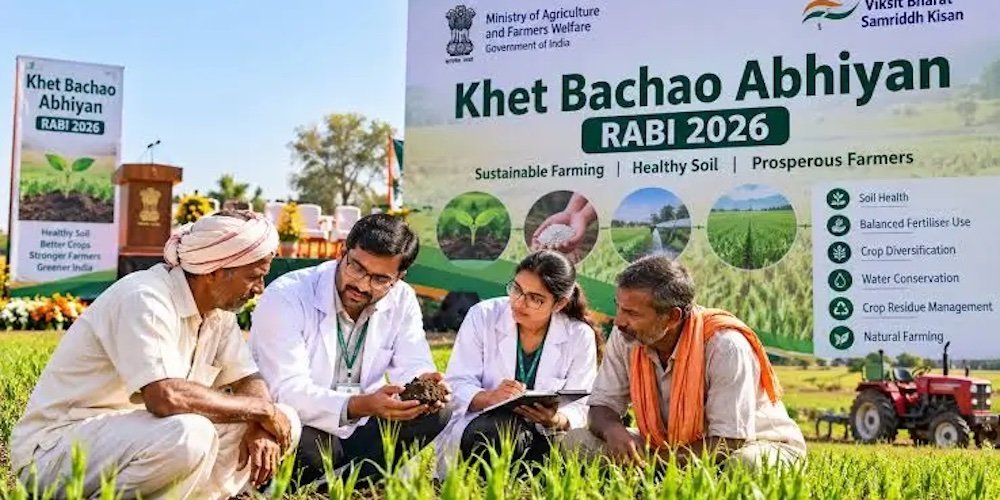
Khet Bachaao Abhiyaan (KBA)-Rabi 2026 is a nationwide campaign running from 22 October to 30 November 2026. It promotes soil health, balanced fertiliser use, and sustainable agriculture across 34 States and Union Territories, over 700 districts and 50,000 villages, targeting around 50 lakh farmers. Key priorities include balanced nutrient management, natural farming, crop residue management, crop diversification and climate-resilient agriculture. The campaign envisages 4,150 teams involving KVKs and ATMA, supported by over 12,000 scientists and ATMA functionaries. The initiative seeks to conduct 50,000 field demonstrations and 11,750 structured training sessions. The campaign projects a social media outreach of 1.5 crore farmers, with an envisaged expansion of overall digital outreach to 2.5 crore.
The bedrock of human civilisation and economic stability has long resided in the quality of its earth. In India, where more than forty-six percent of the workforces derive its livelihood from agriculture and allied sectors, soil health directly dictates the nation’s food security, rural prosperity, and macroeconomic health.
Decades of intensive agricultural practices, characterised by the indiscriminate use of synthetic fertilisers and mono-cropping, have inadvertently catalysed widespread soil degradation, nutrient depletion, and ecological vulnerabilities. Recognising the urgent need to halt this downward spiral and secure the country’s agrarian future, the Government of India, through the Ministry of Agriculture and Farmers Welfare, launched a pivotal nationwide campaign: the Khet Bachaao Abhiyaan – Rabi 2026.
Operating under the evocative focal theme of “Swasth Dhara, Samriddh Kisan”, which translates to Healthy Soil, Prosperous Farmer, this massive awareness initiative marks a strategic shift toward scientific, climate-resilient, and deeply sustainable farming methods across the subcontinent.
The campaign officially commenced its second phase on October 22, 2026, launched from Karnal, Haryana, by the Union Minister of Agriculture and Farmers Welfare, Shivraj Singh Chouhan, and runs through November 30, 2026.
Spanning thirty-four States and Union Territories, the Khet Bachaao Abhiyaan targets over seven hundred districts and approximately fifty thousand villages. The scale of this intervention is immense, aiming to directly touch the lives of around fifty lakh farmers through physical events, while actively expanding its digital and social media footprint to reach an astonishing one and a half to two and a half crore participants.
By mobilising four thousand one hundred and fifty specialised teams composed of scientists and extension functionaries from Krishi Vigyan Kendras, Indian Council of Agricultural Research institutes, and the Agricultural Technology Management Agency, the government has forged a powerful mechanism to bridge the gap between advanced agricultural laboratory research and the immediate realities of rural farmlands.
At the core of the Khet Bachaao Abhiyaan is an aggressive campaign to restore soil fertility through the balanced and judicious utilization of fertilizers. For years, the agricultural landscape has suffered from a disproportionate reliance on nitrogenous fertilisers like urea, resulting in soil acidification, low nutrient-use efficiency, and secondary groundwater contamination. The campaign systematically addresses this crisis by advocating for soil testing as a fundamental precursor to the sowing season.
By empowering farmers to interpret and act upon their Soil Health Cards, the initiative champions the 4R Principles of nutrient management: applying the right nutrient source, at the right rate, at the right time, and in the right place.

Furthermore, it aggressively promotes environmentally friendly substitutes, including nano-urea, bio-fertilisers, organic manure, and green manuring. This combined strategy seeks to lower the escalating input costs of cultivation while concurrently enhancing long-term agricultural productivity.
Beyond basic nutrient management, the Rabi 2026 campaign integrates crop diversification and natural farming into its primary agenda. Relying strictly on traditional wheat and paddy cycles depletes specific soil micronutrients and increases vulnerability to pests.
To combat this, the Abhiyaan actively pushes for the implementation of the National Missions on Oilseeds and Pulses, alongside robust horticultural development. Farmers are being trained to utilise rice fallows — land left uncultivated after the autumn paddy harvest — to plant short-duration legumes, which naturally fix atmospheric nitrogen into the ground.
Simultaneously, structured field demonstrations and technical training sessions instruct farming communities on the tenets of regenerative agriculture.
These eco-friendly methodologies minimise external chemical inputs, foster subterranean biodiversity, and construct resilient ecosystems that can withstand the erratic weather patterns triggered by global climate change.
Another crucial dimension of the campaign is its zero-tolerance focus on crop residue management and environmental conservation. The arrival of the Rabi season historically coincides with severe air pollution challenges across northern India due to stubble burning. The Khet Bachaao Abhiyaan actively counters this destructive practice by presenting viable, mechanised in-situ and ex-situ crop residue management options, showing farmers how incorporated crop stubble transforms into valuable organic matter that improves soil moisture retention.
In parallel, the campaign emphasises micro-irrigation systems, rainwater harvesting, and groundwater recharge strategies to maximise water-use efficiency. By merging mechanical interventions with eco-friendly concepts like integrated pest management and bio-based pest controls, the programme outlines a comprehensive roadmap to build a highly sustainable, circular agricultural economy.
Ultimately, the true strength of the Khet Bachaao Abhiyaan lies in its reliance on grassroots public participation, evolving from a bureaucratic mandate into a genuine community movement. Through localised interactive forums like Kisan Chaupals, agricultural exhibitions, and exposure visits, complex scientific directives are converted into actionable, site-specific wisdom.
By aligning closely with global benchmarks like United Nations Sustainable Development Goal 2 for Zero Hunger and Goal 13 for Climate Action, the campaign serves as a crucial pillar for India’s domestic vision of a fully developed nation, or Viksit Bharat.
By systematically safeguarding the health of the soil today, the Khet Bachaao Abhiyaan ensures that the fields of tomorrow remain fertile, resilient, and abundantly prosperous for generations to come.