India’s Supercomputing Capabilities: A Strategic Imperative for the 21st Century
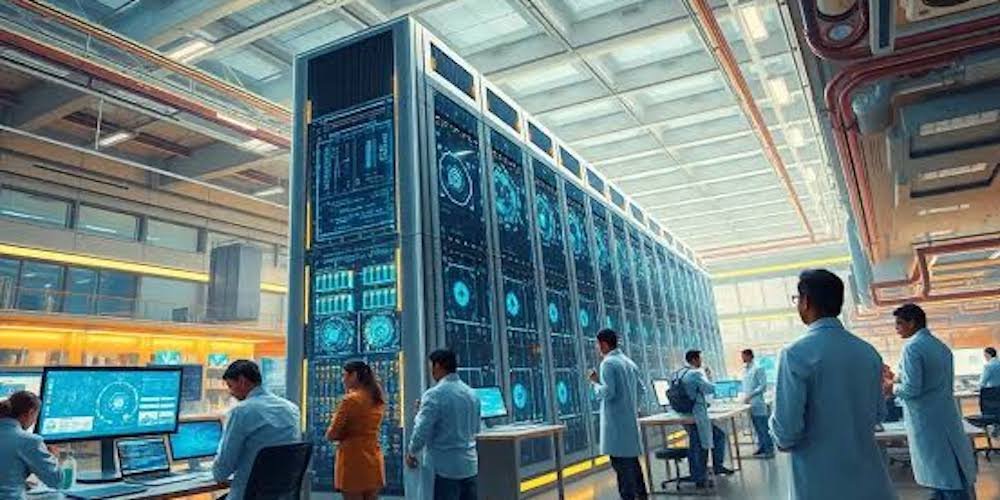
In the modern digital era, high-performance computing (HPC) serves as the backbone of scientific innovation, economic growth, and strategic sovereignty. As data becomes the world’s most valuable resource, the ability to process it at unprecedented speeds determines a nation’s competitive edge. For India, building robust indigenous supercomputing capabilities is no longer a luxury confined to academic research; it is a critical national imperative. By advancing its supercomputing infrastructure, India can accelerate breakthroughs in climate modelling, healthcare, space exploration, and artificial intelligence, positioning itself as a global technology leader
The Evolution and Current Landscape
India’s journey into supercomputing began in the late 1980s when denial of access to foreign technology prompted the creation of the Centre for Development of Advanced Computing (C-DAC). This led to the historic development of the PARAM 8000 in 1991, proving India’s capacity for indigenous innovation.
To systematise this growth, the Government of India launched the National Supercomputing Mission (NSM) in 2015, jointly managed by the Department of Science and Technology (DST) and the Ministry of Electronics and Information Technology (MeitY).
Today, the NSM has successfully deployed a grid of supercomputers across prestigious institutions like the Indian Institute of Science (IISc) and various IITs. Systems like PARAM Siddhi-AI, AIRAWAT, and Param Ananta have placed India on the global Top500 list of fastest supercomputers. These advancements represent a shift from purely scientific computing to specialised AI-driven workloads, reflecting global technology trends.
Strategic Drivers and Application Areas
The necessity for high-capacity supercomputing spans across vital sectors of the Indian economy and governance such as climate and agriculture; healthcare and genomics; national security; and space exploration.
Beyond these traditional fields, the explosion of Generative AI requires massive compute clusters. Supercomputers provide the necessary hardware architecture to train Large Language Models (LLMs) tailored to India’s multilingual and diverse cultural context, ensuring digital inclusion.

Challenges in Scaling Capability
Despite significant milestones, India faces several structural hurdles in achieving absolute self-reliance in high-performance computing:
1. Hardware Dependency: While system integration and software stack development are largely indigenous, India remains heavily reliant on global supply chains for critical silicon components, specifically advanced microprocessors and Graphical Processing Units (GPUs).
2. Infrastructure and Energy Consumption: Supercomputers are notoriously power-hungry. Operating exascale data centers requires a massive, uninterrupted supply of electricity and sophisticated liquid cooling infrastructure, making sustainability a core financial and engineering challenge.
3. Skill Gap and Brain Drain: Developing and maintaining supercomputing architectures demands specialised expertise in parallel programming, quantum computing algorithms, and hardware engineering. Retaining top-tier technical talent against lucrative international offers remains difficult.
The Path Forward: Achieving True Self-Reliance
To secure its position in the global computing race, India must adopt a multi-pronged strategy that bridges current gaps.
First, the success of the IndiaAI Mission and the Semiconductor Mission (ISM) must be tightly integrated with supercomputing goals. Establishing commercial semiconductor fabrication plants (fabs) within India will eventually secure the supply of indigenous processors, such as the SHAKTI and VEGA processor series, minimizing geopolitical supply chain risks.
Second, fostering public-private partnerships (PPPs) is crucial. Historically, supercomputing in India has been driven by the state and academia. By incentivising private tech enterprises and startups to co-invest in and utilise HPC infrastructure, India can build a self-sustaining ecosystem. Cloud-based access to supercomputing resources (HPC-as-a-Service) can democratize access, allowing smaller enterprises to innovate without prohibitive upfront capital costs.
Finally, looking toward the horizon, India must actively invest in Quantum Computing. By blending classical supercomputing grids with quantum accelerators, the nation can leapfrog current binary limitations and prepare for the next paradigm of computational dominance.
Conclusion
Building supercomputing capabilities is a foundational investment in India’s future. It transforms the nation from a consumer of technology into a creator of global solutions. Through sustained policy support under the National Supercomputing Mission, integration with indigenous chip manufacturing, and cultivation of a highly skilled workforce, India is well on its way to achieving computational sovereignty.
In the race toward exascale and quantum frontiers, India’s supercomputing prowess will ultimately define its status as an economic powerhouse and a technological superpower.