RIGHT ANGLE – Inviting Anarchy
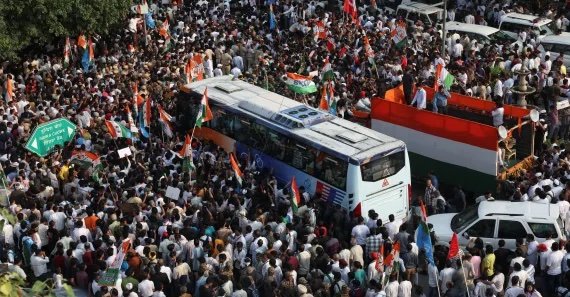
India’s democracy is witnessing an increasingly bitter contest over the meaning of constitutional morality. A section of the political Opposition, unable to translate its criticism of the government consistently into electoral support, appears determined to shift the battle from the electorate to the institutions of the Republic. The Election Commission is portrayed as partisan, judicial decisions are questioned in sweeping political terms, and allegations of institutional capture are increasingly deployed to explain political setbacks.
Alongside these political campaigns are civil-society organisations and individuals who challenge government policies, sometimes with financial support from abroad. Some make legitimate contributions to public debate; others may warrant scrutiny where credible evidence suggests unlawful activity or opaque political financing. The question is not whether dissent should be permitted. It must. The question is whether constitutional language is sometimes being used selectively to undermine institutions whose decisions fail to serve particular political interests.
The irony is that some of the loudest contemporary accusations of constitutional erosion come from a political tradition whose own record contains deeply troubling examples of executive interference with institutions, controversial judicial appointments and the movement of former constitutional functionaries into partisan politics.
The Congress party, in particular, must answer an uncomfortable question: can a party credibly present itself as the principal defender of constitutional morality without confronting the precedents established during its own long periods in power?
When electoral defeat becomes an institutional conspiracy
In a democracy, elections are the principal mechanism through which citizens determine who governs. They are not the only measure of democratic health, but their verdict cannot be dismissed merely because it disappoints a political party.
The Opposition has every right to challenge electoral irregularities, question the accuracy of voter lists and demand accountability from the Election Commission of India. Electoral integrity is too important to be shielded from scrutiny. Allegations supported by evidence must be investigated, and demonstrable failures must be corrected.
But there is a difference between questioning a particular decision and suggesting that the entire electoral process is illegitimate. When every defeat becomes evidence of manipulation, the political contest risks becoming a contest over whether the electorate itself can be trusted.
This is a convenient escape from the difficult work of political renewal. Parties that fail to win sufficient public support must examine their leadership, policies, organisation and ability to connect with voters. It is easier to allege institutional bias than to acknowledge political weaknesses.
Nor is the problem confined to electoral politics. The Supreme Court, too, has increasingly become a target of political commentary whenever its decisions fail to satisfy particular expectations. The judiciary must be open to criticism, and no judgment should be beyond reasoned scrutiny. But an adverse ruling is not, by itself, evidence that judges have surrendered their independence.
A constitutional republic cannot function if the legitimacy of every institution is made conditional on whether it produces a politically convenient outcome.
M.S. Gill and Navin Chawla: the Election Commission and the revolving door
One historical example deserves particular attention: the career of Manohar Singh Gill, better known as M.S. Gill.
Gill served as Chief Election Commissioner of India from December 1996 until June 2001. In 2004, he entered Parliament as a Congress member of the Rajya Sabha. In April 2008, the Congress-led United Progressive Alliance government appointed him Minister of State with independent charge of Youth Affairs and Sports. He subsequently held Cabinet rank in the second UPA government and later served as Minister of Statistics and Programme Implementation. These dates are recorded in the Rajya Sabha’s biographical publication and the Union Sports Ministry’s official account of his tenure.
The significance lies in the sequence. Gill moved from the highest executive position in the Election Commission to parliamentary politics under the Congress banner and subsequently to ministerial office in a Congress-led government. His political entry came in 2004, roughly three years after his retirement as Chief Election Commissioner; he became a minister in 2008.

There is no basis for declaring that Gill necessarily acted improperly while heading the Election Commission merely because he later entered politics. Nor is a former constitutional functionary automatically disqualified from participating in public life. Yet the sequence raises a legitimate question about the appearance of independence and the institutional safeguards needed to protect it.
If a retired election chief subsequently becomes a legislator for a political party and a minister in its government, citizens are entitled to debate whether adequate cooling-off periods and other safeguards should apply to senior constitutional officials.
Similarly, the appointment and elevation of Navin Chawla as Chief Election Commissioner (CEC) of India in 2009 remains one of the most controversial episodes in the country’s electoral history, marked by emergency-era criticisms, a push for removal by a sitting CEC, and stiff opposition from political parties.
In the late 1970s, the Justice J.C. Shah Commission strongly criticised Navin Chawla’s conduct and authoritarian actions while he served as an official during the 1975–1977 Emergency imposed by Prime Minister Indira Gandhi.
Chawla was appointed as an Election Commissioner of India on May 13, 2005, by the UPA government led by the Congress party. This immediately triggered protests from the National Democratic Alliance (NDA) and over 200 opposition MPs, who petitioned the President for his removal, citing his past Emergency conduct and allegations regarding family-run trust funds
In January 2009, then-Chief Election Commissioner N. Gopalaswami sent a 93-page recommendation to President Pratibha Patil seeking Chawla’s removal from office, alleging partisan functioning and political bias. : But the UPA government rejected Gopalaswami’s recommendation, arguing that the CEC lacked unilateral suo motu authority to initiate the removal of a fellow Election Commissioner and that the allegations lacked merit. On the contrary, following Gopalaswami’s retirement on April 20, 2009, Chawla was elevated to the post of the 16th Chief Election Commissioner.
That debate cannot be dismissed as an attack on an individual. It concerns public confidence in an institution whose authority rests on its impartial administration of elections.
The question for Congress is equally straightforward: if post-retirement political appointments can raise concerns about institutional independence when made by its opponents, why should comparable appointments associated with its own governments be exempt from scrutiny?
Indira Gandhi and the subordination of judicial seniority
The historical record becomes more serious when we examine Indira Gandhi’s treatment of the higher judiciary.
On 26 April 1973, following the Supreme Court’s landmark judgment in Kesavananda Bharati v. State of Kerala, her government appointed Justice A.N. Ray as Chief Justice of India, superseding three senior judges: Justices J.M. Shelat, K.S. Hegde and A.N. Grover.
The appointment broke the established convention of appointing the senior-most Supreme Court judge as Chief Justice. All three superseded judges subsequently resigned. The episode became one of the most consequential controversies in the history of judicial independence in India.
The timing was particularly significant. In Kesavananda Bharati, the Supreme Court had established the basic-structure doctrine, holding that Parliament’s power to amend the Constitution did not extend to destroying its basic structure. The judgment imposed a constitutional limit on parliamentary power, and the supersession of the three senior judges was widely interpreted as a confrontation between the executive and judges who had ruled against the government’s expansive claims.
In January 1977, the Indira Gandhi government again departed from the seniority convention, appointing Justice M.H. Beg as Chief Justice of India over Justice H.R. Khanna, whose celebrated dissent in the ADM Jabalpur case had defended individual liberty during the Emergency.
These were not minor administrative decisions. They affected the judiciary’s independence and reinforced fears that judges might face adverse consequences for judgments that displeased the executive.
The contrast with contemporary political rhetoric is striking. Today, Congress leaders frequently invoke the Constitution and warn against the erosion of judicial independence. They are entitled to do so, but their claims cannot be assessed in isolation from the party’s historical record.
Constitutional morality requires acknowledging uncomfortable precedents, not erasing them from public memory.
Justice Baharul Islam: from Congress politics to the Supreme Court and back
The career of Justice Baharul Islam presents another troubling example of the blurred boundaries between judicial office and partisan politics.
Islam was elected to the Rajya Sabha as a Congress member in 1962 and again in 1968. In January 1972, he left Parliament to become a judge of the then Assam and Nagaland High Court, later becoming Chief Justice of the Gauhati High Court. After retiring from that court in March 1980, he was appointed a judge of the Supreme Court in December of the same year.
His elevation was unusual because he had already retired from the High Court and could serve on the Supreme Court for only a little over two years. On 13 January 1983, he tendered his resignation from the Supreme Court, approximately six weeks before his scheduled retirement, and subsequently received the Congress nomination to contest the Lok Sabha election from Barpeta in Assam. When the election there could not be held as scheduled amid the Assam agitation, he returned to Parliament through the Rajya Sabha in 1983.

Islam’s case was especially controversial because his Supreme Court appointment followed a career in Congress politics, and his resignation to return to electoral politics came shortly after he had delivered a judgment favourable to then Bihar Chief Minister Jagannath Mishra of the Congress (I) in a case concerning allegations of forgery and criminal misconduct.
Contemporary commentary raised questions about the propriety of the sequence. Those questions do not establish that a quid pro quo occurred; no such conclusion should be asserted without proof. But the circumstances created an appearance of potential conflict between judicial independence and political allegiance that was damaging to public confidence.
The essential point is not to impugn every judge who enters public life after retirement. It is to recognise why judicial appointments and post-retirement political rewards require exceptional care. A judiciary dependent, or perceived to be dependent, on the goodwill of the executive cannot command the same public confidence as one demonstrably insulated from political favour.
Congress cannot invoke judicial independence as an absolute principle today while refusing to examine the implications of such episodes in its own history.
Foreign-funded organisations and the limits of legitimate activism
The role of foreign-funded NGOs and politically active individuals must be considered with equal care.
Civil-society organisations are essential to a healthy democracy. They expose abuses, support vulnerable communities, conduct research and question public policy. Foreign contributions to lawful social and developmental work are not inherently suspicious, nor does criticism of the government establish disloyalty.
Nevertheless, financial transparency matters. Where credible evidence indicates unlawful funding, concealed political relationships or activities prohibited by law, the authorities have a responsibility to investigate. India’s Foreign Contribution (Regulation) Act provides a legal framework for regulating foreign contributions, and its provisions must be enforced consistently and subject to due process.
The distinction between legitimate advocacy and unlawful intervention cannot be settled through slogans. Neither should the government be permitted to label inconvenient critics as foreign agents without evidence.
Equally, NGOs and individuals receiving foreign funding must not assume that their political objectives place them beyond scrutiny. The public is entitled to know whether funding arrangements are lawful and whether claims of foreign-sponsored destabilisation have any demonstrable factual basis.
The same standard applies to political parties. Allegations of foreign interference must be established through financial records, documented communications or other credible evidence, not inferred merely from ideological agreement or political coincidence.
The real threat is selective constitutional morality
The broader danger is the normalisation of a political culture in which constitutional principles are invoked selectively.
A party that criticises executive influence over the judiciary must be willing to condemn such influence when exercised by its own leaders. A party that demands the Election Commission’s independence must examine the implications of its own appointments of former election officials to political office. A party that warns of democratic decline must also acknowledge the constitutional damage caused by executive overreach during its periods in power.
The same test applies to the present government. An electoral mandate is not a licence to weaken institutions, disregard civil liberties or evade accountability. The government must accept legitimate criticism, respect judicial review and ensure that constitutional authorities can discharge their duties independently.
The answer to political hypocrisy is not a competing form of hypocrisy. It is consistency.
India’s constitutional institutions are neither infallible nor beyond reform. They must be scrutinised, strengthened and held accountable. But their credibility cannot survive if every adverse decision is treated as proof of conspiracy, or if public confidence is systematically eroded without evidence.
The Constitution is not the property of Congress, the BJP or any other political formation. It belongs to the people of India. Its defence requires both the government and the Opposition to accept the limits of their authority and the legitimacy of lawful procedures.
The most damaging erosion of constitutional morality occurs when political actors demand institutional independence from their opponents but fail to practise the same principle when they hold power. Those who now present themselves as the guardians of the Constitution must be prepared to answer for the occasions when their own governments tested its limits.
The ultimate test of constitutional commitment is not the volume of one’s denunciations. It is the consistency of one’s conduct.
When political actors systematically discredit electoral verdicts, undermine public confidence in constitutional institutions and portray lawful processes as irredeemably illegitimate without sufficient evidence, they risk creating a climate in which institutional authority is rejected, and political confrontation replaces constitutional resolution. The ultimate test of constitutional commitment is not the volume of one’s denunciations. It is the consistency of one’s conduct. Such a climate can become fertile ground for anarchy — not necessarily through an immediate breakdown of law and order, but through the gradual erosion of public trust, respect for lawful authority, and the shared democratic rules that hold the Republic together.