HOW TO SOLVE A PROBLEM LIKE HASINA?
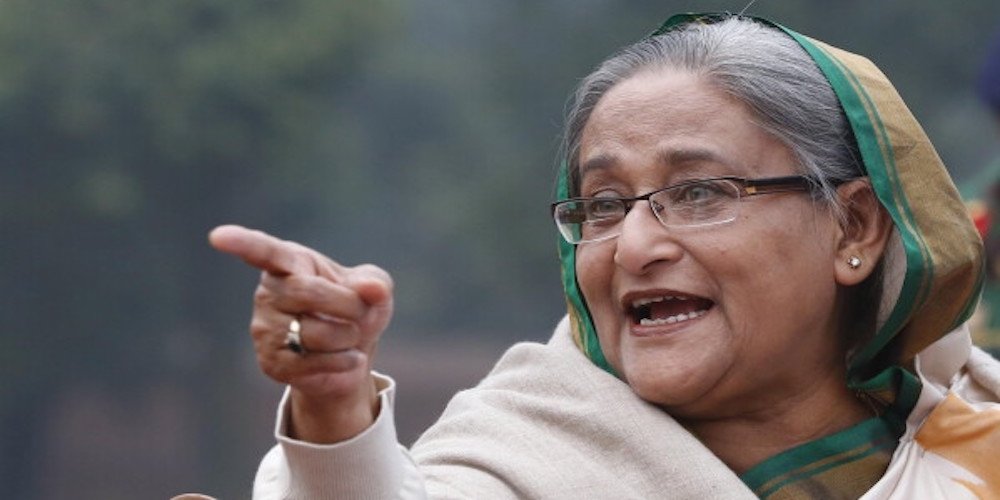
Indian High Commissioner Dinesh Trivedi has conveyed a few home truths to his host country, Bangladesh. They seem to have been forgotten while demanding that ousted former Prime Minister Sheikh Hasina be returned: on August 5, 2024, she was “not brought by the Indian Air Force or the Indian Army.”
India had “hardly any choice” and was ‘unprepared’ while receiving her.
Now a diplomat, the politician avoided stating the obvious: she was brought from Dhaka to India on a Bangladesh Air Force aircraft.
Another reminder: “At that point in time, Hasina Ji was still the prime minister of Bangladesh.”
He said that legal procedures were ‘underway’ for her extradition, and that they take time.
Of course, he didn’t refer to Hasina’s announcement, reiterated many times, that she will return of her own volition in December.
How times have changed! Once considered the ‘friendliest’ in South Asia, India’s relations with Bangladesh have become complex, even delicate.
Sheikh Hasina’s exile in India and her proposed return have added another layer of complexity to an already extraordinarily complicated relationship.
Addressing the media and her Awami League cadres through audio calls, she has repeated that she will return home, despite knowing that arrest and prosecution await her.
Trying to garner international support from lawmakers and human rights organisations, she has addressed seminars in London and Geneva through audio participation.
Prime Minister Tarique Rahman’s government expressed ‘outrage’ at her audio address in Delhi and has banned domestic media from reporting it. It did not respond to India’s twin invitations, one bilateral and the other for the BRICS summit in New Delhi.
A brief update is essential. Following Hasina’s ouster, an interim government led by Mohammed Yunus sustained itself on anti-Hasina and, since she was in India, anti-India sentiment. Since this year’s February elections, a party with a history of problematic relations with India has been in power. The elections also threw up an opposition force of Jamaat-e-Islami and students who worked to oust Hasina, and who see India as an adversary.
As India tries to rebuild bilateral ties under totally changed circumstances, hosting Hasina has complicated them. Rahman’s possible visit in November has been discussed at different levels, but exploring dates and announcing final dates are different.
To anyone unversed in India-Bangladesh ties, the two issues — Hasina’s return and Tarique’s visit — may appear separate. In reality, they are closely intertwined.
The government in Dhaka wants Hasina back, convicted of serious crimes and sentenced to death. Since it involves a bilateral extradition treaty, India cannot simply hand her over.
As Rahman faces pressure, especially from the opposition, he must weigh in on Hasina’s presence while visiting India. His government’s grievance, also sought to be used as leverage, affects ties with Delhi.
Delhi, meanwhile, has a larger strategic interest: building a workable relationship with the government in Dhaka, whoever leads it. Bangladesh is too important to India to let the relationship remain permanently hostage to a former prime minister’s fate.
That is why the proposed Tarique visit matters. But it is also why it is difficult. There is a certain diplomatic stalemate.

Dhaka cannot easily separate Hasina’s presence in India from its own domestic politics. It wants Delhi to accept the new political reality. Yet the Hasina question remains the most emotionally and politically charged issue between them.
Both neighbours want a relationship based on mutual interests and reciprocity. But neither wants to be seen conceding on Hasina to facilitate Rahman’s visit. Any ‘understanding’ with India on this would expose Rahman at home to the charge of having surrendered.
This explains why Rahman’s visit in November is possible, but not certain.
Because after November comes December.
Assuming Hasina returns, another question becomes unavoidable: what happens to her safety?
If the Rahman government arrests and prosecutes her, it is also duty-bound to protect her. It may regard her as responsible for grave political and human-rights abuses. It may even seek to establish her responsibility through courts. But it cannot allow her fate to be decided by an assassin, a mob or an extremist organisation.
With several past attempts on her life, Hasina herself has acknowledged that she could face death if she returns. The Bangladesh government has responded by saying that she would receive full security and legal protection.
The world witnessed the assassination of another former prime minister, Benazir Bhutto of Pakistan, in 2007. It reminds us that government protection does not make an extremist threat disappear. A politically prominent person can remain a target even when the state has formally undertaken to protect her.
One would not like to push the Benazir angle too far. Nothing so far suggests a conspiracy or that Hasina is destined to meet the same fate. But religious extremism has deep roots in Bangladesh. It also witnessed killings of people in jail in 1975. Hence, the threat to Hasina’s life cannot be dismissed.
That creates a paradox for Rahman’s government. It is not just a political gesture to an adversary; Hasina’s protection is an obligation of the state.
Indeed, it is particularly important since Hasina is not merely another former prime minister. She is the daughter of Sheikh Mujibur Rahman and has been at the centre of Bangladesh’s political life for decades. To her supporters, she represents a political tradition that is now under assault. To her opponents, she represents a period of authoritarian rule for which she must answer.
If she returns and faces trial, Bangladesh will certainly be under an international microscope. If the proceedings are conducted peacefully and as per law, the government can argue that the country has chosen the judicial route.
If she is imprisoned, the government will have to demonstrate that imprisonment does not become an excuse for political revenge.
And if, despite state protection, she were killed by extremists, the political consequences could be enormous — even if the government itself had nothing to do with the assassination.
Hasina could become a martyr. The now-banned Awami League could acquire a powerful new symbol. The credibility of the new government could be damaged. And the already polarised politics of Bangladesh could become still more dangerous.
Both must consider the wider strategic considerations.
India cannot build its Bangladesh policy entirely around Hasina. Her sixteen-year rule created a close relationship between New Delhi and Dhaka, particularly on security and connectivity. But governments change. India has to deal with the Bangladesh that exists, not simply the Bangladesh it would prefer to see.
That means engaging Tarique Rahman’s government. It means rebuilding political contacts and restoring economic and commercial links. It means dealing with border security, connectivity, water, the Northeast and China’s growing influence. It means recognising that the new Bangladesh will have its own political priorities.
But normalisation does not require India to forget Hasina. Nor does it require Bangladesh to abandon its demand for justice.
Perhaps the two countries can eventually learn to separate these questions. Tarique Rahman can visit India.