Make in India Policy a Vision for becoming a Global Manufacturing Hub
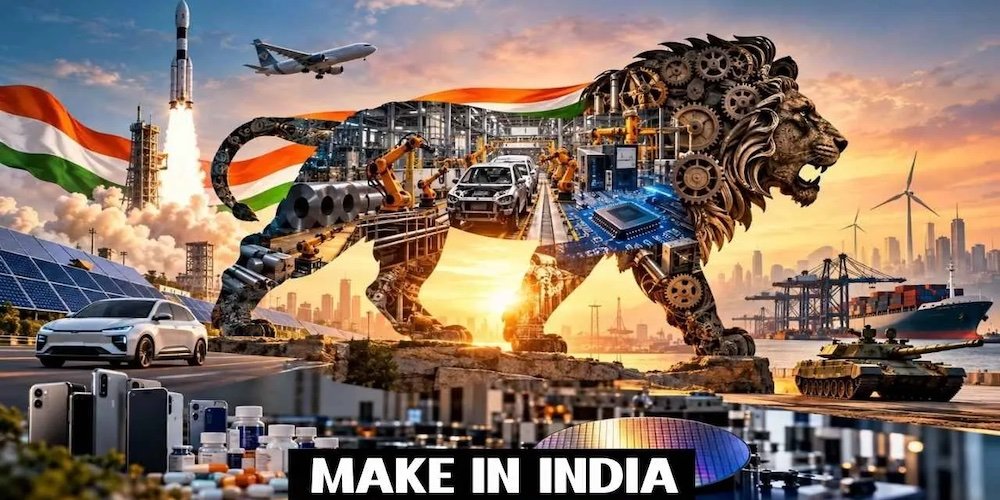
As Make in India completes twelve years, the initiative has transformed India’s manufacturing landscape by expanding production, investment and capabilities across industries. During this period, production has increased across electronics, automobiles, pharmaceuticals, steel, railways and defence. India has also developed the capacity to manufacture components, machinery, strategic materials and advanced technologies. Initiatives such as NSWS, PLI, PM GatiShakti and the India Industrial Land Bank have supported investment and production. New schemes focus on semiconductors, mobile phones, industrial parks, specialty steel and rare-earth magnets, further strengthening domestic manufacturing
On September 25, 2014, Prime Minister Narendra Modi launched the Make in India initiative with a bold, transformative vision: to turn India into a global hub for design, innovation, and manufacturing.
Guided by the core philosophy of “Minimum Government, Maximum Governance”, the scheme aimed to modernise crumbling infrastructure, liberalise archaic policies, and invite domestic and foreign corporations to build within the country.
As the flagship initiative completed 12 years on September 25, 2026, it stands as a testament to India’s evolving macroeconomic trajectory. This journey has been marked by profound technological upgrades, massive capital inflows, and an inevitable structural shift from basic assembly to deep-tier, high-value strategic manufacturing.
The Strategic Evolution: From 1.0 to 2.0
When first introduced, the initiative focused primarily on simplifying administrative approvals, dismantling bureaucratic red tape, and establishing an attractive environment for Foreign Direct Investment (FDI). Over the years, the programme underwent crucial iterations to stay ahead of changing global supply chains.
Recognising the dynamic demands of a highly competitive globalized economy, the government subsequently upgraded the program to Make in India 2.0. This revised iteration expanded the country’s economic focus to 27 frontier sectors — meticulously divided into 15 core manufacturing sectors and 12 strategic service sectors.
This crucial shift acknowledged that modern industrial leadership cannot exist in a vacuum; it requires a symbiotic relationship between hard manufacturing and high-end services, such as software development, advanced logistics, digital finance, and specialized engineering design.
Quantitative Triumphs and Structural Enablers
Over its twelve-year trajectory, the manufacturing Gross Value Added (GVA) expanded at a remarkable CAGR of 10.88% between 2022–23 and 2025–26, signaling robust underlying industrial momentum.
Key manufacturing sectors displayed exponential jumps. Most notably, electronics output surged to an unprecedented ₹13.11 lakh crore by 2025–26, anchored by a mobile manufacturing sector that multiplied its production capacity 33-fold compared to 2014 baselines.
Simultaneously, commercial and passenger vehicle production grew significantly, positioning India as a primary automotive exporter to developing markets.
Furthermore, domestic defence production — long reliant on foreign imports — attained a record-breaking ₹1.78 lakh crore in FY 2025–26, reflecting a profound shift toward national self-reliance.
Catalysing these major milestones were core structural policy pillars designed to reduce the cost of doing business in India. Chief among these is the Production Linked Incentive (PLI) scheme, which deployed vast fiscal incentives across 14 critical sectors to reward incremental production.

Complementing this is the National Single Window System (NSWS), which digitised and streamlined bureaucratic clearances, eliminating the need for investors to seek approvals from multiple ministries.
On the logistics front, PM GatiShakti provided a digital framework to coordinate multi-modal infrastructure projects, drastically reducing transit times across states.
Together, these unified structural updates successfully drew a staggering $843 billion in cumulative FDI over the twelve-year period, establishing India as a preferred global investment destination.
Evolving Employment and Socio-Economic Impact
Beyond the macroeconomic numbers, the Make in India initiative has acted as a vital engine for socio-economic transformation. By prioritising industrialisation, the scheme created millions of direct and indirect employment opportunities, shifting a portion of the labor force away from disguised unemployment in agriculture toward structured, formal jobs. It has spurred the creation of vibrant industrial corridors, manufacturing zones, and smart cities that have revitalised regional economies.
Furthermore, the initiative has placed a heavy emphasis on upskilling the Indian workforce. Programmes like Skill India were integrated to align institutional training with the specific technical demands of modern smart factories. This focus on human capital ensures that as international companies establish production lines in India, the local workforce successfully transitions from low-skilled manual labour to high-skilled roles in automation, robotics, precision engineering, and sustainable manufacturing practices.
Challenges, Critiques, and the Road Ahead
Despite these notable capital inflows and targeted sectoral triumphs, the journey has not been entirely free of structural challenges. The manufacturing sector’s overall share of India’s GDP still hovers stubbornly between 13% and 17% — falling short of the ambitious initial target of 25%.
Critics frequently point out that much of the industrial growth has leaned heavily toward capital-intensive sectors or basic low-tier assembly fields, such as smartphone packaging, rather than deep-rooted, end-to-end component manufacturing.
Additionally, India’s vital Micro, Small, and Medium Enterprises (MSMEs) — which form the backbone of the domestic supply chain — continue to face ongoing credit bottlenecks, high regulatory compliance costs, and technological gaps that hinder them from fully integrating into global value chains. High logistics costs, though actively being mitigated by recent infrastructure developments, still remain slightly uncompetitive compared to peers in Southeast Asia.
Moving decisively forward into its next decade under the resonant theme “12 Years of Make in India: From Made in India to Made for the World”, the national focus is shifting from mere import substitution to aggressive export orientation. The roadmap ahead rests on deepening domestic component ecosystems, investing heavily in green hydrogen and semiconductor fabrication, and empowering MSMEs with easy credit and technology transfers.
By addressing these foundational gaps, India aims to ensure that the momentum gained over the past twelve years acts as a springboard for Aatmanirbharta (self-reliance) and the ultimate realization of a developed nation, or Viksit Bharat, by 2047.