RIGHT ANGLE – Can Rahul Gandhi Win As A Comedian?
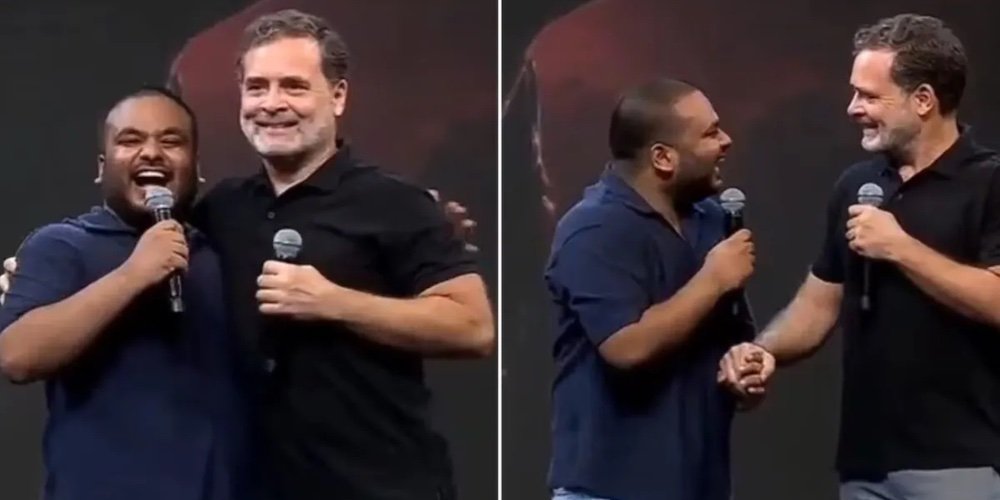
There is a new pattern in Rahul Gandhi’s public outreach. He is less often seen with economists, ex-soldiers, or entrepreneurs, and more often with stand-up comedians and social media jokers in programmes billed as interaction with students.
The question is obvious: are these comedians students? Or are they hired crowds to ensure a decent gathering for a leader whose party now loses more elections than it wins?
Look at the recent events. The front rows are not filled with students asking about jobs, UPSC, or research fellowships. They are filled with professional laugh-providers whose job is to clap, crack jokes at the government, and create a viral reel. For a serious political programme, the optics are telling.
The freshest instance was on 19th September in Indore of Pulkit Mani — a stand-up comedian and Instagram influencer- who shared the stage with Rahul Gandhi at Congress’s ‘Chhatron Ki Goonj’ student outreach programme. He did a full mimicry act of PM Modi — “my friend” phrase, foreign leader hugs, coin trick with children, and re-enacting Modi asking for a chair for an elderly woman.
Congress’s own handle posted the clip as satire on foreign policy. Rahul Gandhi was seen laughing on stage and replying, “I am fine. How are you, Modi Ji?”
Earlier associations that often get cited are of Kunal Kamra, who has appeared in podcasts discussing Rahul Gandhi and opposition politics, invited him to his show, and his sets lampooning Modi.
There are also the likes of Sorabh Pant and Appurv Gupta, who were among comedians who have interacted with Rahul in informal “candid chat” formats in past years, though not at official student rallies.
In fact, I find merit in what many political observers are saying: that Rahul is systematically behaving as a comedian himself, in what and the way he speaks in Parliament and outside.
After all, comedians do succeed in politics. The global example is Volodymyr Zelensky in Ukraine. He was a successful television comedian and then became the president. He won elections.
Former Slovenian Prime Minister Marjan Šarec (2018-20) was a well-known comedian and satirist before venturing into the world of politics.
Before serving as President of Guatemala from 2016 to 2020, Jimmy Morales was a well-known actor and comedian. He had risen to fame as a TV comedian.
India has its own example. Punjab Chief Minister Bhagwant Mann was a comedian before he was a politician. His mimicry and satire brought him crowds that traditional speeches could not. He converted laughter into votes.
What explains the success of the comedians / entertainers in politics? Political scientists have identified many reasons, three of which are particularly noteworthy.
First, they tend to reject the values and authority of the existing power establishment — whatever shape that establishment might take. They are the most effective communicators against corruption; the press may be identifying the problem, but satirists or comedians reach the people’s hearts more effectively because, unlike the journalists, they are identified as anti-elites because of the manner in which they impersonate and mock the leaders and the government functionaries.
Secondly, comedians have a psychological advantage in appealing to the public. Their humour makes people feel good. At a time when the world is undergoing serious economic and technological changes that are resulting in upheavals and uncertainties, voters tend to lean towards “basic feel-good leadership involving not only humor but also obviously unrealistic promises.”

Thirdly, the advent of social media has greatly facilitated the reach of these colorful personalities. There is possibly no more effective message than a funny one. A joke at a political opponent’s expense not only garners a laugh but is also an effective deflection strategy, particularly when it is amplified through online portals and applications.
Indeed, this factor is now being described by media experts as being behind the way political news is increasingly being repurposed for entertainment.
So the question arises: does Rahul Gandhi now believe that, as a conventional politician, he cannot defeat Narendra Modi, and therefore he must rebrand as a comedian-politician?
It is a logical thought. As a traditional politician fighting on governance, delivery, organization, and electoral strategy, his record is poor. The Congress under him has lost state after state, including its bastions. As a parliamentarian, his speeches inside and outside Parliament often invite literal laughter, not for their humour but for their quality, factual errors, and manner of delivery. The famous interventions on “aatma”, on flour, on “khatam, tata, bye bye” are repeated more as memes than as political arguments.
If people are going to laugh anyway, why not make them laugh deliberately? That seems to be the new strategy. Stand with comedians, laugh with comedians, become one of them. In a country where political satire gets more YouTube views than political analysis, perhaps being a professional entertainer is more electable than being an opposition leader.
Can Raul, as he is called in memes, win elections as a comedian?
He has advantages. He has name recognition that no stand-up comic has. He has a built-in ecosystem of media that will amplify any joke as brave satire. And his core voter base already forgives lack of administrative detail if the punchline is against Modi.
Behavioral economists explain the supposed irrationality of electing a less experienced candidate through what is called “evolutionary aversion to loss”. Faced with a “sure loss” of maintaining the status quo through establishment suit-types, voters may be inclined to take the risky bet of voting in an outsider.
And it is precisely here that there are problems with comedians or entertainers assuming office. All told, governance needs pragmatism, expertise, and experience. The record here is not impressive to talk of, with the possible exception of President Reagan.
Prime Minister Sarec could not complete his term and preferred to resign.
Similarly, President Zelenskyy may be seen as a hero today, but there was a near consensus before the Russian invasion that he was not worth the office he was occupying. He could not end corruption, and the country’s economy was (is) literally in a mess. But ironically, he mishandled foreign policy badly, too. During his electioneering, he had said that the question of whether Ukraine should join NATO should be left for the people to decide in the future, for which his opponents had called him “dangerously pro-Russia”.
Even Mann’s record is something which Rahul Gandhi will not approve of.
Such records of comedians elsewhere raise natural apprehensions about whether Rahul Gandhi, even if he wins as a comedian, has the capacity to lead India.