TARIFFS: TRY BULLYING BEIJING, MR. TRUMP?
A key takeaway from last week’s New Delhi BRICS Summit was the long-delayed, but warranted, call to protect critical energy and civilian infrastructure threatened by a Gulf War that is lengthening and escalating each day.
It came as Brent crude surpassed $108 per barrel, as Iran is being hit and is hitting America’s allies in the region.
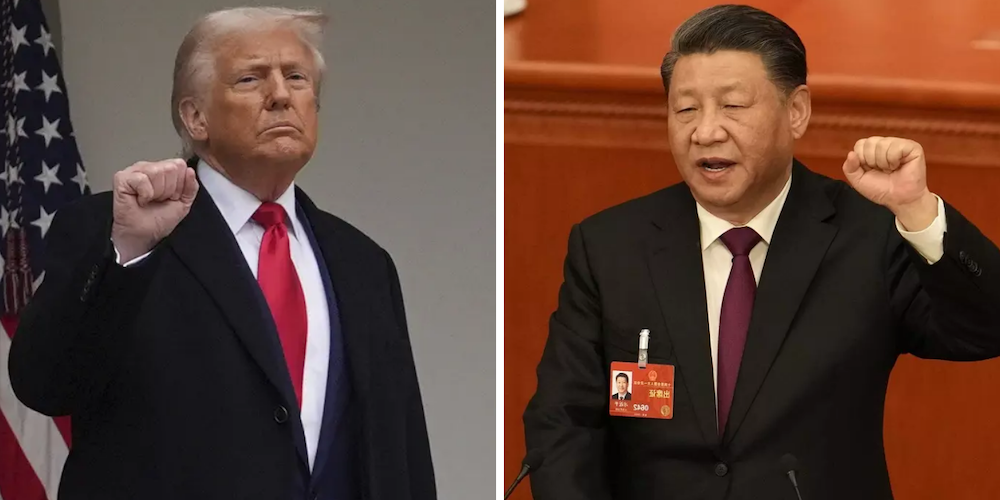
But President Trump has responded to the 18th BRICS Summit by viewing India, its host, China and Russia as an “axis of evil” that he must punish. A US law, enacted with great alacrity, empowers him to impose 100% tariffs on anyone who buys Russian oil. That is really kicking the cat.
In an instant response, India has warned that this could impact Indo-US bilateral relations. This enough-is-enough is somewhat surprising. Consider the tariffs, threats and pressure it has borne in the last year from a ‘friend’ whose smile has become a smirk.
Wonder if this is the BRICS effect. India has been most patient. Reports now say the US may hold off punishing China, the other big target, till Trump meets Xi Jinping next week. There is a limit to bullying. Try bullying Beijing, Mr Trump?
He has dispelled any doubt that oil, essentially oil, is the reason for his Gulf War. A day after the BRICS summit, he announced that the US might “stay on” in Iran, and as it has done in Venezuela, “keep the oil.” With such daily threats, and the power to carry them out, with destructive but varying results, though, nobody is taking chances.
Let us focus on Asia; it is the worst affected. Thankfully, in the wake of the Gulf War, many Asian nations have created a novel cooperative arrangement which has begun seeking a more permanent solution to history’s biggest energy disruption.
They are working feverishly to build reserves that can be accessed without hindrance and utilised when needed. More importantly, locating them away from battle hotspots.
The answer is: one, create an infrastructure that bypasses geopolitical risk, and two, reduce exposure to imported fuel as much as possible.
Among the larger Asian economies, India is working to ensure supplies. Latest figures show Russia as the largest supplier of crude (57%) last month, while the US is also wooed with high purchases (48%) of LPG and LNG.
India simultaneously hosts other countries to keep their stocks safe and easy to access. These relationships are being expanded.
The UAE and its Abu Dhabi National Oil Company (ADNOC) already store oil in Singapore, India, South Korea, and Japan, while Kuwait and Saudi Arabia also have stockpiles in South Korea and Japan, according to the Observer Research Foundation (ORF).
ADNOC is aiming to raise its crude oil storage capacity in India to 30 million barrels, while New Delhi is considering storing some of its strategic reserves at the UAE port of Fujairah on the Gulf of Oman, beyond the Strait of Hormuz bottleneck.
In China, the world’s second-biggest oil consumer after the United States, the closure of the Strait of Hormuz has reinforced the belief that the country must invest in its energy security.
Its latest five-year plan (FYP) for oil and gas development, which sets policy for 2026 to 2030, includes provisions for more pipelines and expanded LNG storage. It is also intensifying deep-water drilling.

State-owned pipeline operator, PipeChina, said in May that it was accelerating construction on some of its nearly 40 oil and gas projects, including 9,000 kilometres of domestic pipeline.
While these plans were drafted before the Iran war, the conflict has reinforced the rationale for such investments.
Though highly dependent on Gulf energy, Japan has weathered the crisis better than many other economies because it holds one of the world’s largest strategic oil reserves.
Tokyo has asked its Southeast Asian neighbours to follow its lead. In April, Japanese Prime Minister Sanae Takaichi announced the $10bn “POWER Asia initiative”, aimed at helping Southeast Asian economies procure oil and petroleum products and, in the long term, build up strategic stockpiles.
At the outbreak of the Iran war in February, Vietnam only held enough oil in its national reserves to meet the country’s needs for five to seven days, according to state media. Commercial inventories and other sources extended supplies for up to another 65 days.
Thailand held about 61 days of reserves across the public and private sectors, against a 25-day mandated minimum in early March, while the Philippines was estimated to have 50-60 days of supplies in private commercial inventories. All figures were below the International Energy Agency’s 90-day minimum benchmark.
In Bangkok and Manila, the war has revived a push to establish comprehensive state-held strategic oil reserves.
Last month, a parliamentary panel in the Philippines approved a bill to create a 60-day government-held reserve.
Asians are going for strategic stockpiles. India is among those Asians revising their strategic stockpile. It had about 74 days’ worth of oil stocks in May, more than 90% of which is held by public sector enterprises.
In July, the Oil and Natural Gas Corporation (ONGC) announced that it would build a reserve of 1.75 million metric tonnes, or 13 million barrels, in the country’s southern region, adding to the company’s plans to expand existing stockpiles by 6.5 million metric tonnes.
Asia’s bigger economies, meanwhile, have been exploring storage deals directly with Gulf suppliers.
Japan, South Korea, and Singapore have longstanding relationships and partnerships with several West Asian countries to locate storage supplies closer to their shores.
South Korean media have reported that Seoul is mulling whether to expand its oil reserves of some 146 million barrels by an additional 30-40 million barrels, up from initial plans for an extra 20 million barrels.
So, while Hormuz couldn’t have directly driven this language, it underscores for policymakers that this line of thinking is correct and that their assumptions about chronic instability are well-founded.
In sum, it is no longer enough to ask where the next barrel comes from. Difficult times demand difficult solutions. Nations must also ask how it gets there, how long they can operate without it, and whether they can reduce their need for that barrel altogether.