Golden Fibre Jute Sustaining Millions of Livelihoods in India
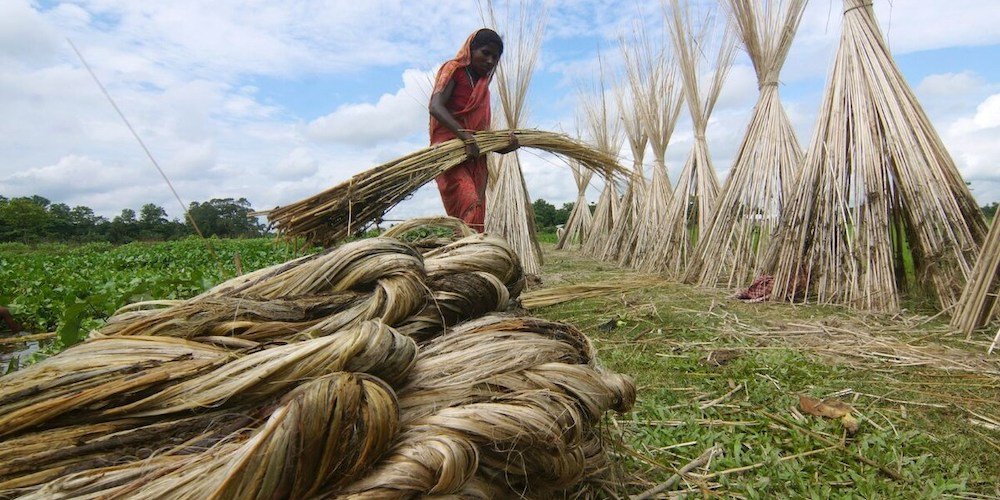
India leads global raw jute production, supporting millions of livelihoods while advancing sustainable industrial growth. India produced 76 lakh bales of raw jute and 12.80 lakh MT of jute goods in FY 2025-26.
During the same year, India exported 22,700 MT of raw jute worth ₹225.11 crore and 1,71,300 MT of jute goods worth ₹3,155.27 crore.
Government interventions have strengthened farmer incomes, modernised the value chain, and promoted product diversification. Jute’s biodegradable nature and expanding applications make it a key alternative to synthetic materials. Innovation, market expansion, and digital technologies are positioning India’s Golden Fibre as a globally competitive and environmentally responsible industry.
Known historically and commercially as the “golden fibre” due to its natural colour and high monetary value, jute occupies a position of paramount importance in the socio-economic fabric of India. Beyond its ecological benefits as a biodegradable, renewable, and carbon-sequestering crop, jute acts as a massive economic engine. In a country where rural employment and agricultural stability are critical pillars of development, the jute sector provides a robust safety net, sustaining the livelihoods of over four million farming families and hundreds of thousands of industrial and ancillary workers.
The geographical concentration of jute cultivation is primarily nestled within the fertile, alluvial plains of eastern India. States such as West Bengal, Bihar, Assam, Odisha, and Tripura benefit from the specific climate and abundant water supply required to grow this intensive crop.
For the small and marginal farmers who dominate these regions, jute is not merely a crop; it is a vital cash crop that bridges the crucial income gap between the spring and monsoon harvest seasons.
Unlike food crops that are often grown for self-consumption, jute is cultivated almost entirely for the market. The immediate cash flow generated from selling raw jute bark allows farmers to purchase high-quality seeds, fertilizers, and equipment for subsequent food crops like paddy, thereby securing both their financial stability and food security.
Beyond the farm gates, the jute industry transforms into a labour-intensive manufacturing powerhouse. West Bengal, particularly along the banks of the Hooghly River, houses the highest concentration of jute mills in the world. These mills employ roughly 370,000 workers directly. For generations, these manufacturing hubs have absorbed rural labor, offering stable employment to semi-skilled and unskilled workers who might otherwise face underemployment or distress migration. The factory floors provide a structured livelihood, complete with wages that support household expenditures, healthcare, and education for the workers’ children.

Furthermore, the economic footprint of jute extends far wider through its vast ancillary networks. The transition of raw jute from a standing crop in a rural field to a finished gunny bag in a urban warehouse requires an extensive supply chain. This ecosystem supports hundreds of thousands of traders, commission agents, transport workers, brokers, and packers. From the boatmen navigating the waterways of Assam to the truck drivers transporting heavy bales across state lines, the jute trade breathes life into the rural and semi-urban logistics sectors.
In recent years, the livelihood landscape of the jute sector has undergone a significant and empowering evolution through the rise of Jute Diversified Products (JDPs). Traditionally limited to producing sacking cloth and gunny bags, the industry has pivoted toward high-value lifestyle and industrial goods, including trendy carry bags, rugs, footwear, home furnishings, and geo-textiles.
This diversification has democratised the industry by shifting production from large-scale, capital-intensive mills to MSMEs (Micro, Small, and Medium Enterprises) and rural Self-Help Groups (SHGs).
This shift has had a profound impact on women’s empowerment in rural India. Thousands of women have been trained in jute handicrafts, stitching, and designing, allowing them to establish home-based businesses or collaborative cooperatives. By earning an independent income through jute diversification, these women have gained financial autonomy, elevated their social standing within their communities, and directly contributed to raising the standard of living of their households.
The sustenance of these millions of livelihoods is further bolstered by proactive government intervention. Recognising the sector’s vulnerability to synthetic alternatives like plastic, the Government of India maintains strict mandates under the Jute Packaging Materials (Compulsory Use in Packing Commodities) Act of 1987. By legally requiring specific percentages of foodgrains and sugar to be packed in jute sacks, the government guarantees a stable, domestic institutional demand. This shield protects millions of farmers and mill workers from volatile international market fluctuations and the aggressive pricing of synthetic polymers.
In conclusion, jute is far more than an agricultural commodity or an eco-friendly packaging alternative; it is an irreplaceable socio-economic lifeline for eastern India. From the marginal farmer tending to his crops in Bihar to the women artisans creating intricate handicrafts in West Bengal, the golden fibre weaves together a vast network of human resilience and economic survival.
As the world increasingly pivots toward sustainability, investing in and modernising the jute sector is not just an environmental imperative, but a direct investment in the dignity and prosperity of millions of Indian families.