RIGHT ANGLE – The Reversal of Sanskritisation
When the BJP retained power in Uttar Pradesh and Uttarakhand in the 2022 Assembly elections, I wrote an essay in an American publication. Four years later, today, I regret writing that essay, because the points I made in it proudly are not true anymore.
This is what I had written:
“The election results defied the perceived ever-relevant political dictum that winning elections in a state like Uttar Pradesh depended on caste or religious calculations rather than on any administrative or development agenda. If one heard and read the strategies and analyses, victory depended on how many castes were with you on the one hand and how many Muslims on the other. The underlying assumption was that people belonging to a particular caste and religion (Islam) were all monolithic blocks and would vote for parties irrespective of what they said and did.
“However, all this has been made irrelevant by Modi and Yogi once again. The Prime Minister and his party are winning elections repeatedly essentially because they have worked hard to ensure that the conventional barometers to study elections have outlived their utility. Modi has proved once again the limitations of the often lauded identity politics of caste, creed, and region.
“The latest round of elections has proved beyond any shadow of doubt that people have not voted on caste lines. And it is a healthy development. Indian democracy will be much stronger if one votes as an Indian, not as a member of a particular caste or religion. Unfortunately, the dominant sections within the Indian polity, and this includes the intelligentsia, glorify identity politics. For instance, if Yadavs, Muslims and Dalits vote as a block, they laud the phenomenon as consolidation for their respective democratic rights. If somebody opposes this trend, he or she is branded as communal.
“In that sense, Modi is proving that elections can be won above caste and communal considerations. Modi has never highlighted the fact that he belongs to the OBC. Our electoral pundits do not realize that, going by their theory, Modi is perhaps the most successful OBC politician in independent India’s history by becoming the Prime Minister of the country. But Modi has never exploited this factor. And rightly so”.
Unfortunately, today I cannot say the same about Modi and his BJP. He has been co-opted into the ecosystem of identity politics. And I feel terrible about it.
After all, independent India began with a promise that “Caste” would wither away. Modernity, industrialisation, education, urbanisation and above all, the Constitution, would de-legitimise caste.
Now, 79 years later, the opposite has happened. Caste has not disappeared. It has been re-legitimised, re-institutionalised and re-celebrated. If India’s greatest sociologist M.N. Srinivas gave us the concept of “Sanskritisation” in the 1950s, we are living through its reversal — “De-Sanskritisation”.
Sanskritisation to De-Sanskritisation
Srinivas observed that lower castes sought upward mobility by emulating upper castes — vegetarianism, sacred thread, abandoning liquor, claiming Kshatriya or Brahmin origin. Mobility meant becoming more “upper”.
Today the vector is exactly opposite. Everybody wants to become backward.
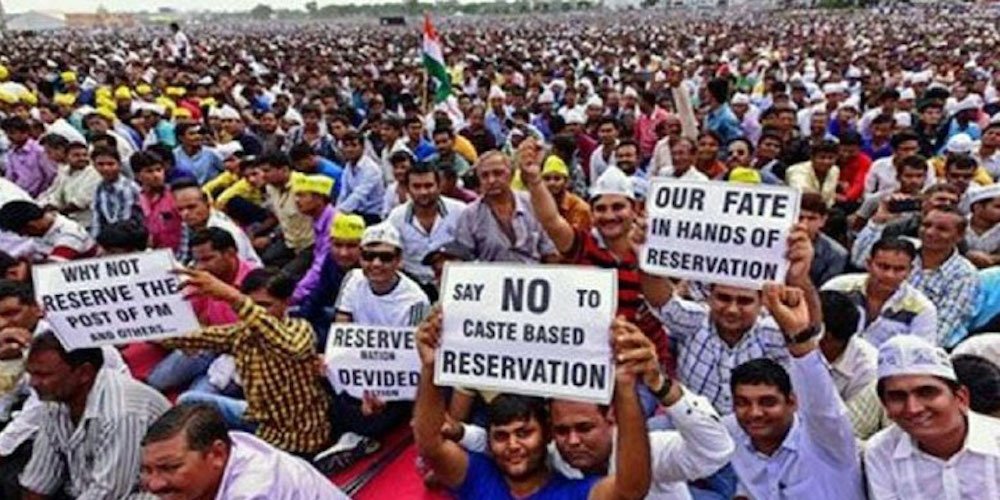
No community in India now wants to be called forward. Jats in Rajasthan, Marathas in Maharashtra, Patidars in Gujarat, Kapus in Andhra, Lingayats in Karnataka — all dominant, land-owning, politically powerful castes — have agitated not to be called upper, but to be classified as OBC, backward, deprived. The race is downwards.
Why? Because the incentive structure of the Indian state has inverted.
Sanskritisation was a social strategy for respect. De-Sanskritisation is a political strategy for reservation. Politics has made Caste permanent.
Three turning points institutionalised this reversal.
First, Mandal in 1990. V.P. Singh’s implementation of 27% OBC reservation made caste not a social evil to be eradicated, but a certificate to be possessed. Overnight, caste became the most valuable political asset. Parties realised counting castes is more profitable than abolishing them.
Second, the capture of power. In north India, Lalu Yadav in Bihar and Mulayam Singh in UP openly made MY — Muslim-Yadav — and caste coalition the basis of rule. It was not anti-caste. It was caste-as-power. The message to every other caste was simple: if you mobilise as a caste, you rule. Caste became a path to chief ministership, not a stigma.
Third, the permanent state of reservation. What was meant to be a 10-year temporary affirmative action in 1950 is now 75 years old and expanding. We have moved from a 22.5% SC/ST quota to nearly 60% in many states with OBC+EWS+state quotas.

With caste census demand, the logic is: first count castes, then proportionate share. When your share in jobs, admissions and contracts depends on your caste label, why would you ever give it up?
Why Everybody Wants to Be Backward
In a scarcity economy of government jobs — where one government clerk post gets 10,000 applications — a certificate is worth more than a degree. For a young person in a village in Bihar or Rajasthan, being General category means competing in the open for only 30% to 40% of seats. Being OBC or SC/ST means a separate, smaller pool with relaxed cut-offs, age relaxation, and now even fee waivers.
The result is that families who had hidden their Dalit or backward identity in the 1960s out of inferiority now proudly assert it with superiority. Matrimonial ads, which earlier said “caste no bar”, now specifically seek “SC boy IAS” because that category has power. It is a matter of pride to be called Dalit, OBC, Adivasi — because the Constitution attaches power to it.
This is not just sociological. It is psychological. So much so that, unlike in the past, Prime Minister Modi himself says with pride that he is OBC, and now every party leader begins his or her speech with “I am from such and such backward community”.
The signal from the top is clear: forward is backward, backward is forward.
I have seen this in my 50 years in Delhi. In the 1980s, when I was in the university, many of my friends hid their caste. Now they, particularly those in politics and bureaucracy, tattoo it on their forehead.
The New Rulers and the New Arithmetic
The result is what I call the rule of the proclaimed backward. In many states, the so-called lower castes are the new rulers — not socially, but politically. In Bihar, power has not gone out of Yadav-Kurmi hands for 35 years irrespective of party. In Tamil Nadu, Dravidian parties have made anti-Brahminism state ideology for 60 years. In Maharashtra, Maratha reservation agitation is not about deprivation; it is about retaining dominance.
This has two dangerous consequences.
One, the genuinely deprived — the Mahadalits among Dalits, the most backward among OBCs — are left out. The creamy layer among OBCs and SCs captures the benefit generation after generation, while the really poor remain poor. Reservation was meant to eliminate graded inequality; it has created graded inequality within backwardness itself.
Second, it kills the idea of common citizenship. When a child fills a school form, the first thing we ask is not his dream, but his caste. When a medical seat is allotted, we first check caste. The state itself is teaching every citizen from age five that you are not Indian first; you are SC, ST, OBC, EWS first. How can caste be eliminated when the state asks for caste in every document?
What Ambedkar Wanted vs What Happened
Ambedkar was clear. Reservation was to be temporary, to compensate for historic denial of education. His ultimate aim was annihilation of caste. Gandhi also wanted caste to wither through inter-dining and inter-marriage.
What we have done is the opposite. We have abolished inter-caste competition but strengthened inter-caste mobilisation. We have parties whose name itself is caste — Bahujan Samaj Party, etc. Elections are now caste censuses in advance. Tickets are distributed not on merit but on caste arithmetic: “Here Yadav votes 18%, so Yadav candidate”.
The demand for a caste census is the final legitimation. Once you count every caste officially and link entitlements to that count, caste will become permanent for another 1000 years. No politician will dare to say Let us abolish caste columns.
The Way Out? But Does Anyone Want It?
The irony is that urban India, the private sector, and youth actually want caste to go. In private IT jobs in Bangalore and Gurgaon, no one asks about caste. Marriages in metros are increasingly inter-caste. But politics pulls it back.
If we really wanted to de-legitimise caste, we have to do three things:
1. Make reservation income-based after 80 years, with SC/ST getting priority but within that income ceiling.
2. Stop asking for caste in school forms, except for a decadal anonymous census for policy.
3. Reward inter-caste marriage and de-caste politics with incentives.
But no party wants it. Because in a first-past-the-post system, a consolidated caste block of 8% can win you an election. Caste is no longer a social identity. It is vote bank technology.
Srinivas thought India would Sanskritise — lower castes would become upper. Today India is doing the reverse. Upper castes want to become lower, because being lower is now more profitable, more powerful, and more legitimate.
That is the tragedy. We started to abolish caste to create equality. We have ended up perpetuating caste to create power. And in that power game, caste is no longer a shame to be hidden. It is a pride to be flaunted — and a certificate to be fought for.