Cotton – India’s White Gold
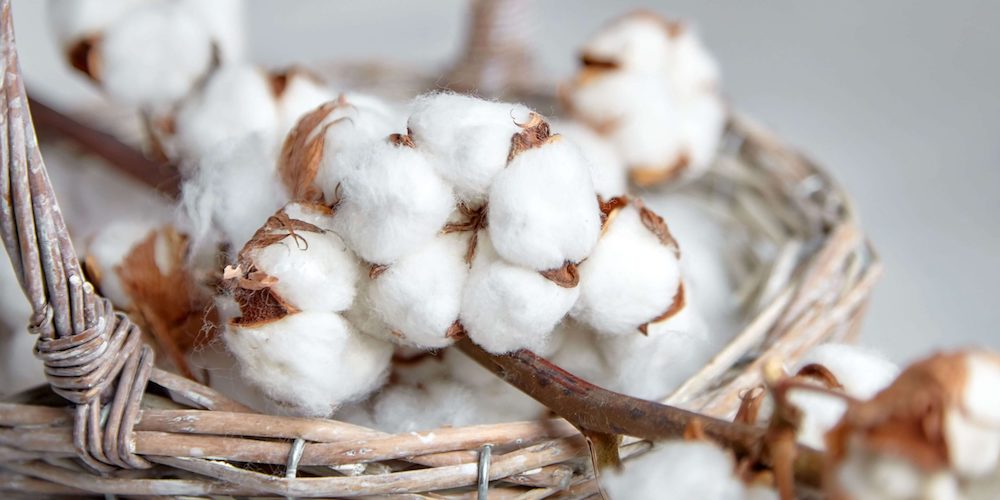
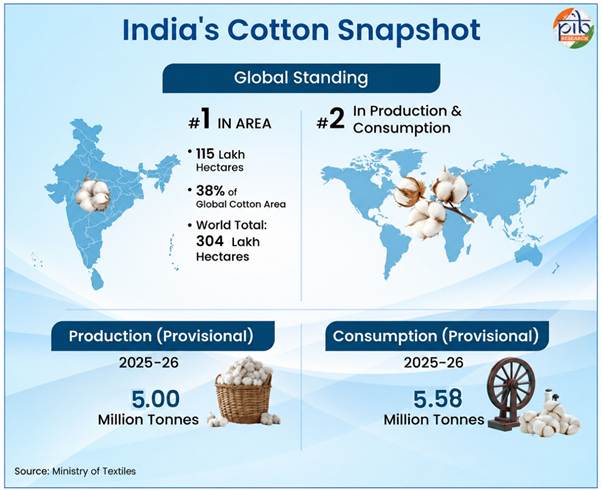
India is the global leader as the only country cultivating all four recognised cotton species. It ranks 1st in cultivated acreage (114.84 lakh hectares) and 2nd in production and consumption. Provisional production for 2025–26 stands at 290.91 lakh bales, with domestic consumption reaching 328 lakh bales
Cotton occupies a unique position in India’s agricultural and industrial economy. India is the only country cultivating all four recognised cotton species. It ranks first globally in acreage and second in production and consumption. Cotton production stood at 290.91 lakh bales in 2025-26 (provisional). Domestic consumption reached 328 lakh bales during the same period. The sector contributes nearly 19 percent of global fibre production. Recent interventions focus on productivity, quality, market access and value addition. MSP operations continue to provide price support during market downturns. The Mission for Cotton Productivity aims to raise output to 498 lakh bales by 2031. Technology demonstrations, digital procurement and traceability initiatives are strengthening competitiveness. These efforts are enhancing productivity, improving quality and reinforcing India’s position in the global cotton economy.
Cotton is one of the most important commercial crops cultivated in India. It accounts for around 23 percent of global fibre production. The crop supports the livelihoods of around 6 million cotton farmers. It also sustains employment for another 40-50 million people engaged in related activities such as cotton processing and trade. Beyond clothing, cotton plays a vital role in earning foreign exchange through exports of fibre, yarn, fabrics and garments. Due to its economic importance in India, it is also termed as “White-Gold”.
India’s cotton sector reflects both depth and dynamism. Its strength lies in biological diversity, extensive cultivation, and a robust textile ecosystem. Policy interventions, including MSP operations, the Mission for Cotton Productivity, and Kasturi Cotton Bharat, are reinforcing this foundation. Technology adoption, market reforms, and quality enhancement efforts are further shaping the sector’s future trajectory.
From Swadeshi to Atmanirbhar Bharat
India’s association with cotton stretches back thousands of years. The subcontinent was once a global centre for cotton textiles, trading its fabrics across Eastern and European markets. In ancient times, cotton cloth even functioned as a medium of exchange. This highlighted its economic value and widespread acceptance.
The modern cotton industry began taking shape in the 19th century with the establishment of textile mills in Kolkata, Mumbai, and Ahmedabad. The latter earned the title “Manchester of India”. Expansion gathered pace in the late 19th and early 20th centuries. The Swadeshi movement promoted the establishment of Swadeshi Mills to contest against British goods. Global demand during the World Wars further boosted the domestic industry. By the mid-20th century, the number of textile mills had risen steadily across the country. This resulted in a significant increase in cotton cloth production in the years leading up to Independence. This reflected the expanding scale and resilience of India’s cotton industry.

The Many Dimensions of India’s Cotton Sector
India is the only country that cultivates all four recognised cotton species. These include G. Arboreum and G. Herbaceum, commonly referred to as Asian cotton. The other species are G. Barbadense, known as Egyptian cotton, and G. Hirsutum, known as American upland cotton. Among these, G. Hirsutum accounts for nearly 90 percent of hybrid cotton production in India. All Bt cotton hybrids currently cultivated in the country belong to this species.
In addition to botanical diversity, cotton in India is also classified by staple length. This length determines fibre quality and end use.
Cotton production in India is largely concentrated in 9 major states, grouped into 3 distinct agro-ecological zones:
• Northern Zone comprising Punjab, Haryana, and Rajasthan
• Central Zone comprising Gujarat, Maharashtra, and Madhya Pradesh
• Southern Zone comprising Telangana, Andhra Pradesh, and Karnataka
In addition to these states, cotton is also grown in Odisha and Tamil Nadu.
India’s Cotton Strength in Area, Production, and Consumption
India ranks first in the world in cotton cultivation area (in hectares), with 114.84 lakh hectares devoted to the crop. This accounts for around 38 percent of the global cotton area of 304.08 lakh hectares. A large share of the country’s cotton production depends on rainfall, with approximately 62 percent grown in rain-fed regions. The remaining 38 percent is cultivated under irrigated conditions.
India ranks second globally in both cotton production and consumption. This shows the scale of its cultivation base and the strength of its textile industry. Cotton production is commonly reported in bales; it is the standard unit used in the cotton trade. One bale is equivalent to 170 kg. During the 2024-25 cotton season, cotton production pegged at 297.24 lakh bales (5.06 million tonnes). This accounts for nearly 20 percent of global cotton output.
For 2025-26 (provisional), cotton production stood at 290.91 lakh bales (4.95 million tonnes). Domestic consumption, including Micro, Small, and Medium Enterprises (MSME), non-MSME, and non-textile segments, stood at 328 lakh bales (5.58 million tonnes). These reflect India’s prominent position in the global cotton economy.
Cotton Exports and India’s Trade Footprint
India continues to maintain a strong presence in the global cotton trade. In 2024-25, the country exported an estimated 18 lakh bales, equivalent to 0.31 million metric tonnes. This accounts for about 3.37 percent of total world exports, amounting to 541.69 lakh bales (9.21 million metric tonnes). This reflects India’s role as a significant exporter in the international cotton market.
Further, India exports cotton to several major global markets, reflecting strong and diversified international demand. In value terms, cotton exports reached US$ 11.49 billion in FY25. The United States of America emerged as the largest destination for Indian cotton fabrics and made-ups exports, accounting for 26.35 percent of cotton exports. This was followed by Bangladesh at 19.81 percent and Sri Lanka at 5.11 percent. Other important destinations included the United Kingdom, with a share of 2.38 percent, and the United Arab Emirates, at 2.32 percent.
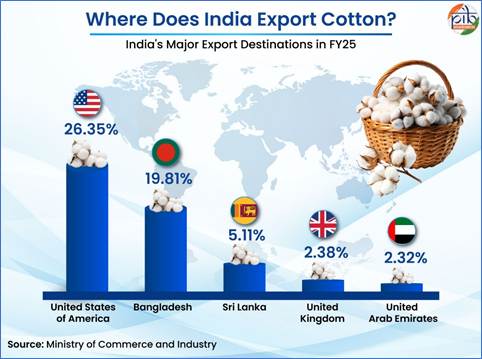
These export patterns highlight the diverse global demand for Indian cotton and reinforce its importance in the country’s agricultural and textile economy.
Building a Competitive Cotton Ecosystem
A multi-pronged strategy has driven the development of the cotton sector. Key priorities include price support, productivity enhancement, technology adoption, and market strengthening. To safeguard farmer incomes and improve the competitiveness of Indian cotton, several targeted initiatives have been undertaken, as outlined below.
Minimum Support Price Operation
Stable returns are essential for sustaining cotton cultivation. The Minimum Support Price (MSP) system serves as a key safeguard for cotton farmers. It ensures remunerative prices when market rates fall below the announced support level. Before each cotton year (Oct. to Sept.), MSP is recommended by the Commission for Agricultural Costs and Prices (CACP). It is announced for Medium Staple and Long Staple varieties of seed cotton (kapas). The objective is to ensure that farmers receive at least 50 percent of their returns on production costs.
Role of CCI
The government has designated the Cotton Corporation of India (CCI) to undertake MSP operations for cotton procurement. It intervenes when seed cotton prices fall below the MSP level. As the central nodal procurement agency, CCI has steadily expanded its operational network. The number of procurement centres increased from 508 in 2024-25 to 571 in 2025-26. These centres cover 152 districts across 11 cotton-growing states.
For 2025-26, the MSP for cotton was fixed at Rs. 7,710 per quintal for medium-staple cotton and Rs. 8,110 per quintal for long-staple cotton. For 2026-27, it was increased to Rs. 8,267 per quintal for medium-staple cotton and Rs. 8,667 per quintal for long-staple cotton. This marked an increase of Rs. 557 per quintal for both varieties.
During the Cotton Season 2025-26, the Cotton Corporation of India Ltd. (CCI) procured 105.09 lakh bales of cotton, valued at Rs.41,530 crore, through 24 lakh procurement transactions with cotton farmers under MSP operations.
Mission for Cotton Productivity
Sustained growth in the cotton sector depends not only on remunerative prices but also on higher productivity. To address this, a five-year Mission for Cotton Productivity was launched in 2025-26 to strengthen cotton production nationwide.
With the provision of Rs. 5,659.22 crore, the mission focuses on research, innovation, and field-level extension support. It aims to develop climate-resilient, pest-resistant, and high-yielding cotton varieties. Special emphasis has been placed on Extra Long Staple (ELS) cotton. These efforts will be supported by advanced breeding and biotechnology tools.
Aligned with the ‘5F’ vision of farm, fibre, factory, fashion and foreign, the initiative seeks to enhance farmer incomes and ensure a steady supply of quality cotton. The mission will cover nearly 24 lakh hectares across 140 districts in 14 cotton-producing states and is expected to benefit around 32 lakh farmers. The Mission also sets ambitious production targets for the coming years. Cotton production is targeted to increase from 297 lakh bales to 498 lakh bales by 2031. Higher productivity is expected to improve domestic cotton availability. It will also reduce dependence on imports and strengthen the textile sector.