NO RESPITE FROM HOT, HUMID & TOUGH WEATHER
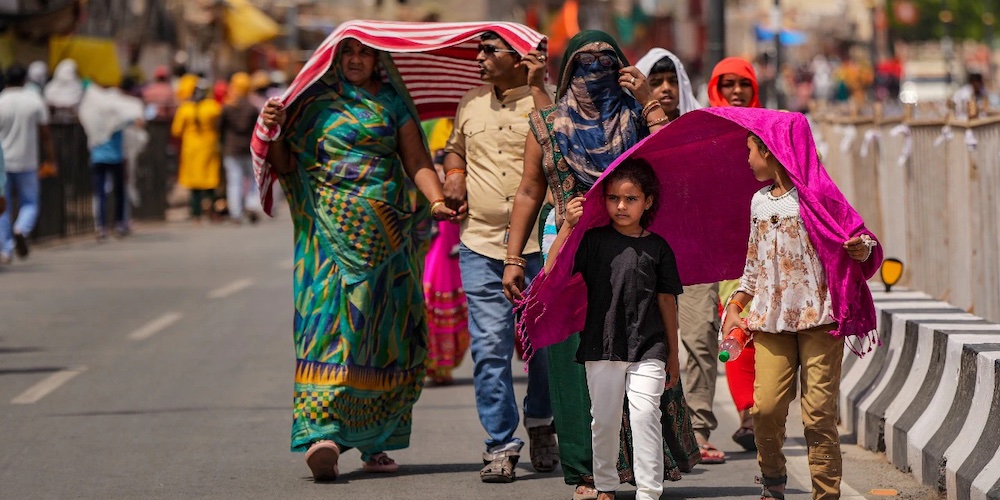
May & June are the hottest months in North India while July and August experience an average of 250 m.m.of rainfall. In deep South, scenario is generally different, especially in coastal areas.
As last two years were exceptions, ‘Black’ Yamuna river was in spate in Delhi, parts of Haryana and U.P. Whether Yamuna is under flowing or over the embankments, false promises to clean the river are perpetually made.
If the rivers of European countries were not kept clean, people would not have attempted a jump during intense heat phase, therein.
It’s really a tough time as far as hot and humid conditions are concerned in N.C.R. and parts of Punjab, Haryana and Rajasthan.
Depressing Monsoon
Monsoon activity appears to have become very weak after a few days of negligent rain in the beginning of July. If one looks at IMD forecast, moderate rain is ” likely”. It may be light to moderate alongwith thunderstorms, lightening and gusty winds.
Actual happening so far would reveal that in Punjab it has been 14% below the long period average. In Haryana too deficit has been to the extent of 3% thus far. Overall, deficit in both these states has been whopping 20% since June 1.
It may be worthwhile to recall that Union Agriculture Minister himself has confessed deficiency part almost a month ago.
Surplus Areas
Kinnaur in H.P., on the other hand, had a surplus rain of 121% by the beginning of July. Similar has been story in J & K after initial dry patch. Monsoon has also intensified in Mumbai, different parts of Maharastra, Kerala, Sikkim, North Bengal, Odisha and Jharkhand.
In North Bengal and South Sikkim, Teesta river has continued to cross both banks for the third year in a row, so much so that one road to Darjeeling has been closed already, while national highway to Gangtok and Kalimpong is very much threatened. No solution has been found out despite perpetual slips and slides as well.
N.C.R. SCENARIO
Monsoon arrived five days late on July 2. During four preceding years it had been ‘hitting’ between June 23 and June 29. Maximum temperature fell down marginally to 34.8 degrees and 4.6 m.m. of rain recorded at Safdarjung weather station too could be considered insignificant.
Welcome rain of 2nd July was followed by three days of almost non stop rainfall between 8th and 10th July. Though usual inadequecy of civic services was exposed, what a relief and soothing experience it was !. But thereafter,
days are either cloudy or partly cloudy. Next spell of heavy rain has been “promised” by July 19.
Eastern India
IMD has predicted heavy to very heavy rain in South Bengal by July 18. There will be also possibility of thunderstorms alongwith gusty winds throughout the week. Affected areas will be Howrah, two 24 Pargana Dists., Midnapore, Jhargram and Bankura. Five districts of North Bengal, including Darjeeling, Kalimpong and Alipurdoars may also experience thunderstorms.

HOT & HUMID CONDITIONS
Continued hot and humid conditions are very tough for people of all ages. Average maximum and minimum temperatures being in the range of 37 to 39 degrees and 27 to 29 degrees are not good for human health.
Delayed Monsoons are causing inconvenience all over. Clouds are only visible for visibility sake. There is no reduction in humidity. But possibility of scattered thunderstorms and gusty winds may bring some hope & positivity.
How To Face Humidity ?
Coming directly under a fan can be soothing. Air conditioners can also remove humidity as a natural by product of the cooling process.When an A.C. runs, it pulls warm, moist air across cold evaporator coils. It has been found that most A.C. units reduce a room’s humidity by upto half, generally bringing it to a comfortable, relative humidity level of 30 to 60%.
While filters of A.C.’s have to be kept clean, over cooling has to be avoided at any cost. One should not undermine the fact that more than a dozen fires in the high rises in the last two months were caused by wrong handling of Air Conditioners in the NCR alone. Comfort loving consumers may take suitable note of it.
High Night Temperature : Health Implications
According to a study conducted by a U.S. based Climate Advocacy Group, quoted in a national newspaper, people are losing sleep in metro cities owing to high night time temperature. Chennai in India leads the table, followed by Mumbai, Kolkata, Ahmedabad and Hyderabad. Delhi alongwith Pune, surprisingly, is at fag end.
Ten percent of the loss in sleep could be directly attributed to human induced climate change. Incidently, Bengaluru has the highest foot print of climate change.
When quality of sleep is affected, it can lead to irritability, mental and physical fatigue.Hence there is loss of energy, discomfort and impact on productivity.
Also short or poor quality sleep may increase risk of injuries and accidents, ultimately having an impact on life expectancy.
Measures To Take Within Room
Apart from mechanical solutions, within living/ working room, curtains and blinds have to be drawn during the day to block direct Sun light. But windows should be opened at night to enable proper ventilation.
Also, as far as possible, outdoor activity has to be avoided between 10 a.m. and 5 p.m.by the women and senior citizens.
We may remember that upto 50% humidity can be tolerated. In a situation of above 70 % humidity, body sweat is prevented from evaporating, leading to sticky and suffocating feeling.
Self control can be better device than blaming humid, muggy and sultry conditions all the time. At times, shower twice a day may be also ineffective. But there is no harm in attempting it.

(The author is former Chief Secretary, Sikkim. Views are strictly personal)