Why India Needs a China Policy of Its Own ?
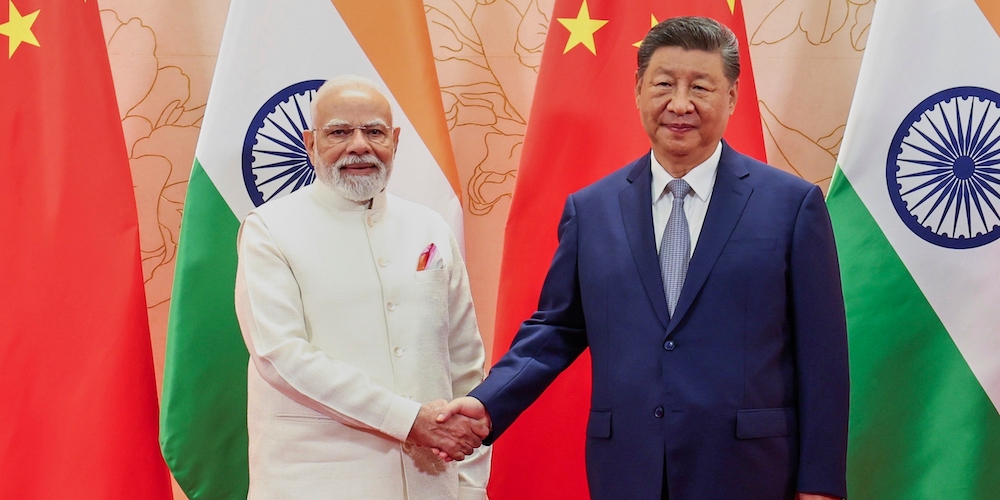
As the global order becomes increasingly fragmented, India faces a defining strategic choice: should its relationship with China be shaped primarily by its own national interests, or by the geopolitical priorities of others?
The answer should be obvious.
A country that has long championed strategic autonomy cannot afford to outsource its China policy.
Over the past decade, India has drawn closer to the United States and other Western partners, driven by shared concerns over China’s growing military and economic influence. That cooperation has brought tangible benefits — from technology partnerships to defence cooperation. Yet it should not become the sole prism through which New Delhi views Beijing.
India and China are neighbours. Geography is permanent; geopolitical alignments are not.
The unresolved boundary dispute, sharpened by the deadly clashes in Galwan in 2020, remains a serious obstacle. Trust has been damaged and security concerns are real.
But history also demonstrates that countries with profound disagreements can still cooperate where their interests converge. The world’s two largest Asian powers cannot allow every aspect of their relationship to remain hostage to the border.
Veteran journalist Shastri Ramachandaran argues in his recent book CHINDIA: Journey to an Asian Century that an Asian century will remain incomplete if its two largest civilizations remain locked in perpetual strategic rivalry.
Whether one agrees entirely with his thesis or not, his central proposition deserves serious consideration: Asia’s future prosperity depends on finding a stable modus vivendi between its two largest powers.
Economic realities reinforce that argument. China remains one of India’s largest trading partners despite years of political tension. Bilateral trade has continued to grow, illustrating that the economic interdependence between the two countries is deeper than political rhetoric often suggests. Rather than attempting an impractical economic decoupling, India should pursue a strategy of selective engagement — protecting sensitive sectors while expanding cooperation where it directly serves India’s development goals.

Technology should be one such area. China has become a global leader in artificial intelligence, advanced manufacturing, renewable energy, batteries and digital infrastructure. India possesses world-class scientific talent, a vibrant technology ecosystem and one of the world’s largest digital markets. Joint research programmes, university partnerships, collaborative innovation centres and carefully designed scientific exchanges could accelerate India’s technological capabilities while preserving national security safeguards. During an era defined by AI, countries that isolate themselves from leading centres of research risk slowing their own innovation.
This is not an argument for ignoring legitimate security concerns or returning to business as usual. It is an argument against allowing confrontation to become the default framework for every policy decision.
History offers sobering lessons. Regions divided into competing camps often become arenas where external powers pursue their own strategic interests. West Asia has repeatedly demonstrated how prolonged regional rivalries can invite outside intervention and delay indigenous solutions to regional problems. Asia should avoid repeating that pattern.
India has traditionally sought to maintain room for independent decision-making, engaging multiple power centres without becoming subordinate to any. That philosophy remains relevant today. Strategic autonomy should mean exactly that: making decisions based on India’s interests rather than the expectations of Washington, Beijing or any other capital.
There are encouraging signs that dialogue remains possible. India and China continue to work together in forums such as BRICS and the Shanghai Cooperation Organisation, even amid bilateral tensions. Recent efforts to stabilise border management also suggest that diplomacy still has space to reduce risks.
A durable rapprochement will inevitably require political imagination from both sides. India has long opposed the Belt and Road Initiative because of sovereignty concerns, particularly regarding projects in Pakistan-occupied Kashmir.
Those concerns remain legitimate. Yet if Beijing were willing to address India’s core security and sovereignty interests through meaningful concessions, New Delhi should not rule out discussing a broader political settlement that includes new forms of connectivity and regional economic integration. Diplomacy succeeds when both sides have something meaningful to offer.
The twenty-first century is unlikely to be shaped by one dominant power. It will be increasingly multipolar, with India playing a central role. To realise that ambition, New Delhi must avoid being drawn into binary choices that reduce its strategic flexibility.
A confident India does not need to choose between engaging the United States and engaging China. It can, and should, do both.
The true test of strategic autonomy is not choosing sides. It is having the confidence to pursue India’s own.