Of Tendulkar and Suryavanshi
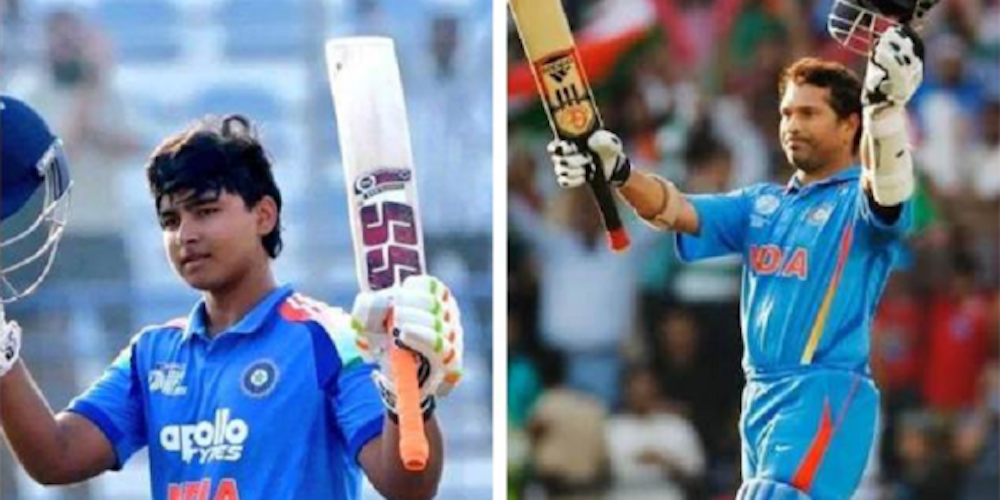
Vaibhav Suryavanshi is rightly the new phenomenon of international cricket, with even The New York Times, which has zero interest in the game, writing about him. The comparisons with Sachin Tendulkar are, therefore, obvious since they are both teenage phenomena, but as is the case with most comparisons, it requires understanding the context in which both have played and their skill sets.
Sachin Tendulkar made his Test debut at sixteen in Pakistan against the pace attack of Imran Khan, Wasim Akram, and Waqar Younis, combined with the spin of Abdul Qadir. In four tests, Sachin hit two fifties, and this displayed his maturity and his remarkable abilities. Playing in Pakistan is never easy for any team because of all the pressure associated with a game against that country. These pressures get magnified in Pakistan much in the same way that the Pakistani team faces a loud and partisan crowd in India.
Additionally, Imran, Wasim, and Waqar were one of the best pace bowling attacks ever assembled in cricketing history. The West Indians of the 1980s — Holding, Roberts, Marshall, and Garner — were just as hostile as were the Australians of 1975-1976, who had Lillee, Thomson, Gilmour, and Walker (while Lillee and Thomson decimated the West Indies in that series, Gilmour was good enough to take 21 wickets with his left-hand fast-medium bowling). In such a setting, Sachin was good enough to hold his place in the team and a year later to score his maiden century at Old Trafford (surprisingly it took Sachin nearly six years to score his first ODI century even though by then he had developed a fearsome international reputation). The rest, as they say, is history.
Not all players can achieve success at the highest levels at an early age or in foreign conditions. Don Bradman was able to do so at the age of 22 in England when he scored 974 runs in seven innings — still the highest series total by any individual (For the record, the top five scorers in a series are Bradman (974), Hammond (905), Mark Taylor (839), Neil Harvey (834), and Viv Richard (829)). Sunil Gavaskar was another player who went at an early age to the West Indies and got 774 runs.
Garry Sobers was a brilliant cricketer who made his international debut at seventeen as a left-arm spinner. His captains quickly realized he had batting talent and started sending him up the order, but his performance as a batsman did not quite live up to his reputation. While he got a set of fifties, it took Sobers sixteen tests to hit a century, and that was his 365 not out against Pakistan. In his next series against India he got three! Of those sixteen tests, nine were in the challenging conditions of New Zealand and England, and for the record, in the latter series he faced the bowling of Statham, Trueman, and Bailey.
The achievements of these players are particularly impressive since they got their runs against partisan umpires who tended to favor the home side. In one series in New Zealand, the gentlemanly Michael Holding was so disgusted by the umpiring that he kicked out the stumps. And we all know that Javed Miandad (now related to Dawood Ibrahim if you need another reason to hate him) was never given out LBW in Pakistan until the introduction of neutral umpires — something for which one has to thank Imran Khan.

For most players, however, being thrown into the rigors of international cricket at an early age is difficult to say the least. Graham Gooch became one of England’s most dependable batsmen against fast bowling, but his test debut was a disaster. He was out for a pair against Australia, dismissed by Walker in the first innings and Thomson in the second. Gooch was confined to county cricket for three years and came back in 1978, and he eventually made his first test century in 1980.
Most batsmen are different from fast bowlers and, in fact, more akin to spinners. Fast bowlers — Lillie, Marshall, Holding, Cummins, Johnson, Waqar, and Wasim—generally emerge at a young age with explosive pace. Few are like Imran Khan and John Snow who developed pace and accuracy in their late twenties. Spinners, on the other hand, need time to mature. Prasanna and Chandrashekhar, for example, both reached the peak of their abilities in their mid to late twenties. On the other hand, young spinners like Naren Hirwani and Laxman Sivramakrishnan floundered and disappeared from the test circuit after a promising start. Yes, Ravichandran Ashwin was a phenomenon, but his record abroad was far less impressive than his performances on the spin-friendly wickets in South Asia. So, what is the relevance of this discussion to Vaibhav Sooryavanshi?
The teenager may be a once-in-a-generation player given his performances in Indian domestic cricket, but he needs to be carefully nurtured before being let loose to face the pressures of international cricket. In that context, sending him to England was probably a premature decision. Yes, he had hammered Jofra Archer in the IPL, but the English bowler is a very different proposition in conditions where the ball seams and swings and the pitches are pace-friendly.
What would have been better would have been to start him up against friendlier opposition in South Asian conditions or in a series in Zimbabwe. In South Asia, against Bangladesh or Sri Lanka, he would have gained the necessary confidence to be a world-class batsman. Instead, by playing in England with little international experience, he has had a tough initiation.
Further, one needs to remember why batsmen like Viv Richards, Garry Sobers, Clive Lloyd, and Brian Lara became so good at playing in foreign conditions. They all played county and league cricket in England, and Sobers has acknowledged that it made him a better player.
The BCCI in its attempts to preserve the brand quality of the IPL and Indian cricket has refused to allow present-day cricketers to play abroad in other T20 franchises, but this is a short-sighted policy. Viraat Kohli does not have the type of fan base in England that he has in India and is unlikely to sell out a stadium. But playing in English conditions would make anyone a better player because they would have to adapt to pitches which are not the flat-tracks of South Asia.
As for Sooryavanshi, the fact is that we can make a judgement on him when he reaches twenty-one, which is a long way away. Till then, lower the expectations and enjoy his batting.
(Amit Gupta is a Senior Fellow of the National Institute for Deterrence Studies, USA and regularly writes on issues of international security as well as on Sports and Politics. The views in the article are personal. He may be contacted at agupta1856@yahoo.com)