Challenge Ahead of Modi
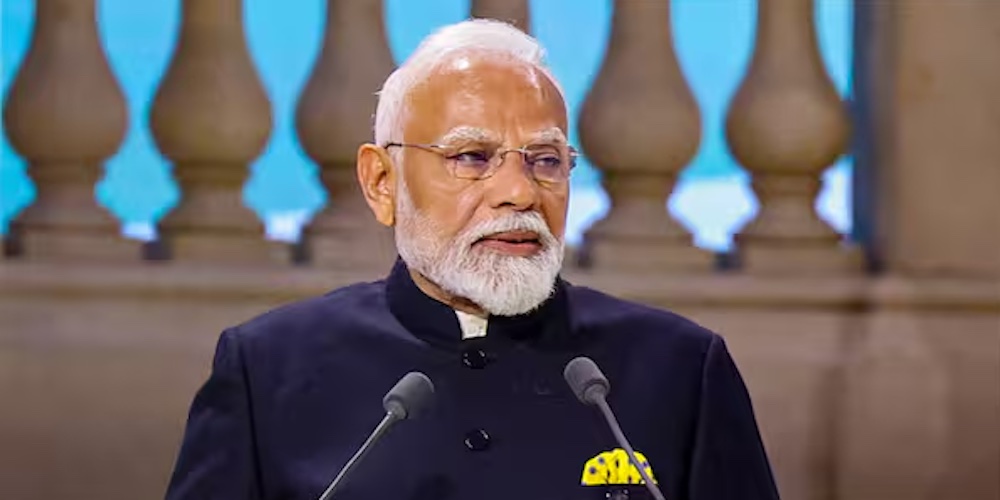
The publisher of my book “ Prime Minister Modi: Challenges Ahead”, which came out in the year 2016, has been requesting me to update the book in a revised edition. I do not know whether it is worth the endeavour, but the fact remains that, howsoever great the Prime Minister may be, the challenges will always remain. There will always be critics. The important thing is whether Modi has been taking the corrective steps.
There are no doubts that since taking office in May 2014, Modi has overseen a period of significant transformation in India, marked by ambitious policy shifts, a distinct governance style, and a reshaping of India’s global posture.
One of Modi’s most visible impacts has been the push for infrastructure modernisation and formalisation of the economy. Flagship programmes like Digital India, Make in India, Swachh Bharat Abhiyan, and PM Gati Shakti have accelerated highway construction, railway upgrades, rural electrification, and digital payment adoption.
India became the world’s 4th largest economy in 2025, and UPI now processes over 18 billion transactions monthly, changing how millions transact. The Goods and Services Tax (GST), implemented in 2017, simplified a fragmented tax structure, even if initial rollout issues hurt small traders.
Yet the critics talk of uneven outcomes. Demonetisation in 2016 aimed to curb black money but caused short-term economic disruption with debated long-term gains. Employment remains a structural concern. While GDP growth has been strong, job creation in formal sectors has lagged population growth, and youth unemployment is a recurring point of public anxiety.
As I had written in my book, the expectations raised by the mandate in 2014 were enormous, and translating aspiration into institutional capacity was the central test. That test continues, especially in manufacturing growth versus targets and in agricultural reform, where the 2020 farm laws were later repealed after protests.
Modi’s government has emphasised welfare delivery through direct benefit transfers, Jan Dhan accounts, Ujjwala LPG connections, and housing under PM Awas Yojana. These schemes reduced leakages and expanded the social safety net for millions. The government also pursued cultural and identity themes, including the abrogation of Article 370 in Jammu & Kashmir, the Ram Mandir construction, and a stronger articulation of civilisational heritage.
However, critics argue that the tenor of political discourse has hardened. Concerns have been raised by domestic and international observers about press freedom rankings, treatment of NGOs, and the tone of majoritarian politics. Communal incidents and polarisation are cited as risks to India’s pluralist fabric. Critics are not impressed that law-and-order issues are state subjects and that decisive leadership of Modi was needed after decades of coalition fragility.
Therefore, the balance between national identity projects and safeguarding institutional space for dissent remains a key challenge, which I had mentioned in 2016: “ managing the diversity of India while projecting a coherent national purpose is a big challenge ”.
Under Modi, India’s foreign policy has been more assertive and multi-aligned. The government’s deepened ties with the US may have weakened with a transactional American President like Donald Trump, but there have been obvious gains, with expanded defence cooperation with France and Israel, maintained energy ties with Russia, and positioning of India as a “Vishwa Mitra” during its 2023 G20 presidency. Evacuations like Operation Ganga evacuated over 18,000 Indians from Ukraine in 2022, while Operation Kaveri successfully rescued over 4,000 individuals from Sudan in 2023. This showed India’s improved crisis response capacity. The shift from non-alignment to “strategic autonomy” has given India more leverage in a multipolar world.
However, it is also true that border management with China remains tense after the 2020 Galwan clash, and South Asian neighborhood dynamics are complex, with China’s influence growing in Sri Lanka, Nepal, and Maldives. Balancing economic reliance on China with security competition is a tightrope that will define the next decade.
Modi’s centralised communications-driven style has been proven to be effective for campaign-mode governance and scheme rollout. The PRAGATI platform for project monitoring and the use of technology in administration are tangible innovations. At the same time, however, critics point to concerns about institutional independence — of the Election Commission, investigative agencies, and judiciary — and the space for parliamentary debate. A constructive view would say strong executive drive needs to be matched by equally strong institutional checks to sustain democratic credibility long term.
After 12 years of his rule, I can say that his challenges are less about winning mandates and more about converting growth into broad-based opportunity, preserving social cohesion while pursuing cultural goals, and institutionalising reforms beyond personality-driven delivery.
Four main areas that Modi needs to focus on are employment and skilling; consultations with and co-option of states on reforms like agriculture, labour, and land; transparent processes for agency actions, media regulation; and addressing perception gaps domestically and abroad.
I would like to concentrate on the last of the above areas. The Modi government has often found itself on the defensive in perceptual battles, both domestically and internationally. Critics — including sections of the diaspora, NGOs, academics, and Western media — have crafted narratives that gain traction even when their narratives are completely devoid of facts.
Governments communicate in policy briefs, data points, and PIB releases. Critics communicate in stories. A 2% drop in a freedom index or a single incident of communal violence makes for a compelling headline and video, while a 10-year trend of rural electrification or DBT (Direct Benefit Transfer) savings does not.
That is why I had written in my book, “ governance is about delivery, but politics is about perception, and the two don’t always move in sync”. The government has delivered on infrastructure and welfare on a large scale, yet themes of dissent, minority rights, and institutional health dominate the perception space.
The Prime Minister’s direct-to-people style via Mann Ki Baat, rallies, and social media is effective for mobilisation and scheme awareness. But perception battles with elites, media, and foreign audiences need a different toolkit: third-party validation, independent data, and room for contestation.

Critics gain appeal when they appear to “speak truth to power” while the government appears to be “controlling the message.” Examples: The BBC documentary controversy, the Pegasus issue, and debates on FCRA for NGOs. In each case, the government’s legal/administrative response was robust, but the narrative response ceded space. When only one side is telling the story, that side wins the perception.
Similarly, several major decisions of the Modi government have had clear governance logic but high perception cost:
1. Article 370 abrogation: Security and integration logic vs. “autonomy curbed” narrative.
2. CAA/NRC debate: Refugee protection logic vs. “citizenship test for Muslims” narrative.
3. Action on NGOs/media: Compliance and FCRA logic vs. “crackdown on dissent” narrative.
In each of the above, the government has had solid reasons, and the decisions were the needs of the hour, but the critics won the perception battle that influenced the global op-eds.
As I had pointed out in my book, unlike the 2004-2014 period where the Congress-led UPA had a wider bench of academia, think tanks, and English media creating supportive narratives, the BJP’s ecosystem is much thinner in universities, global journals, and mainstream English media. So when The Economist, The New York Times or Freedom House publish, there are fewer institutional voices abroad to contextualise or rebut with equal credibility. The government often has to do it itself, which looks self-serving.
This problem can be managed, but the Modi government is systematically avoiding it for reasons that are beyond my comprehension. In my considered view, the following needs to be done:
1. Decouple governance data from political messaging – Let independent Indian institutions — universities, NITI Aayog, CAG — release granular data proactively. Third-party validation beats government statements.
2. Engage, don’t dismiss – Not every critic is “anti-national.” Creating forums where contested claims on jobs data, press freedom, or minority issues are debated with data can puncture the “no space for dissent” claim itself.
3. Tell human stories, not just scheme names – Ujjwala’s impact is better conveyed through one beneficiary’s life than through “10 crore connections”.
4. Diaspora bridge-building – Acknowledge that diaspora critics often act from genuine concern, not conspiracy. Institutional channels with them can convert some from amplifiers of criticism to sources of feedback.
Let me give two examples of how wonderful policy intentions were neutralised by bad perception management.
Take the case of the three Farm Laws, 2020–2021. The government was right that these would liberalise agricultural trade by:
1. Allowing farmers to sell outside APMC mandis to private buyers and e-commerce platforms.
2. Creating a framework for contract farming with price assurance.
3. Removing stock limits on traders for essential commodities.
The core logic was to break the middleman monopoly, give farmers choice, and attract private investment into storage and supply chains. This was all the more necessary as 85% of Indian farmers operate below two hectares, too small to benefit from MSP procurement; so market access was the reform lever.
But the dominant narrative by the critics took hold, especially in Punjab, Haryana, and among diaspora Sikhs abroad. The government lost to it because it explained the benefits of the laws after protests began. The “corporate takeover” meme was already global within two weeks of passage. Agriculture experts who supported reform were drowned out by protest leaders who had ground presence at Singhu/Tikri borders with tractors and social media reach.
While Modi’s ministers used press conferences, protesters used langar videos and tractor rallies. And then there was Diaspora amplification. Rihanna, Greta Thunberg, and Canadian MPs tweeted support. That internationalised a domestic issue and made it about “human rights,” not agri-economics.
What was the outcome? Modi surrendered, and laws were repealed in November 2021.
The second example is the Citizenship Amendment Act (CAA), 2019, and the proposed NRC. It was indeed a noble intention by the Modi government to fast-track citizenship for persecuted religious minorities — Hindus, Sikhs, Buddhists, Jains, Parsis, Christians — from Afghanistan, Pakistan, and Bangladesh who entered India before Dec 31, 2014. After all, India is a civilisational refuge for minorities facing blasphemy laws and forced conversion in theocratic neighbours. The Government argued that it did not affect existing Indian Muslims because it was about granting, not taking away, citizenship.
NRC was proposed separately as an administrative exercise to create a national register of citizens, already done in Assam under Supreme Court’s supervision.
But Modi’s critics and opponents linked the two into a single narrative. And that was made easier, and the perception battle was lost because CAA was passed before any clarity on NRC rules. Protests at Shaheen Bagh and Jamia gave a human face to the fear. And the global media template was that it reflected Modi’s “majoritarian nationalism”.
What was the outcome? CAA rules were notified only in March 2024, after a 4-year delay. By then, protests had a long-term impact on how the government’s “secular” credentials are viewed abroad.
In other words, as I had written in my book, “the challenge is managing diversity while projecting national purpose” — the purpose was clear to the base, but diversity management failed in narrative terms.
Viewed thus, Modi is not “losing” perception battles because achievements are absent. He is losing them because in politics, the side that sets the moral vocabulary often wins. Therefore, the challenge ahead is to match delivery with a narrative that is persuasive beyond the base — one that treats skepticism as a problem to solve, not a motive to expose.
Finally, what then explains the Modi government winning elections? I think Modi is winning because the delivery of his government is visible at the last mile and its best asset is Rahul Gandhi, something that I have pointed out many a time in this column. But invariably, Modi is losing the perception battles, with the narratives being decided at the first mile. Closing that gap is the real “challenge ahead” for Modi.