The Final Go Ahead to the Landmark Trade Deal between the UK and India
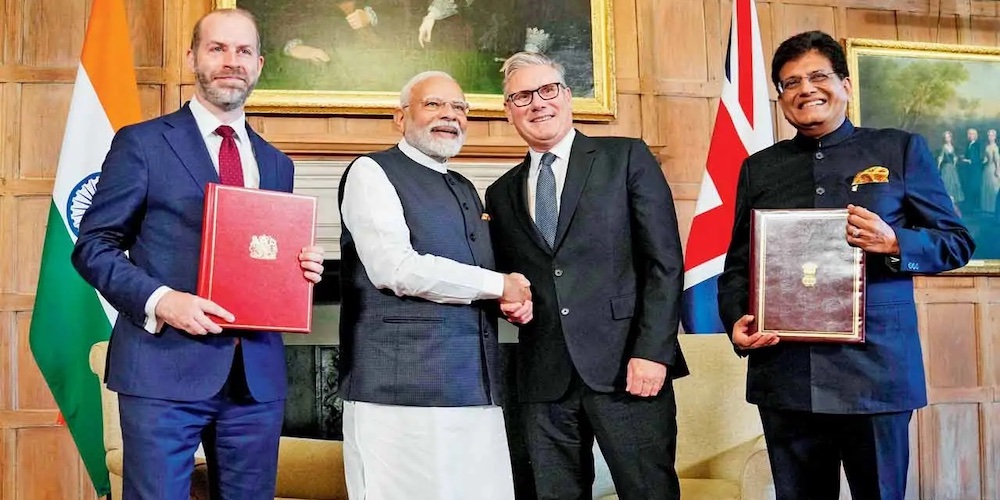
UK India Business Council Celebrates the EIF Announcement, the Final Go-Ahead to the Landmark Trade Deal between UK and India
The landmark India-UK Comprehensive Economic and Trade Agreement (CETA) will officially enter into force on 15 July 2026. This definitive rollout date was finalised by Indian Prime Minister Narendra Modi and British Prime Minister Keir Starmer on the sidelines of the G7 Summit in France.
The deal resolves last-minute implementation standoffs regarding the UK’s upcoming steel safeguard measures. In tandem, the two nations will operationalise the Double Contribution Convention (DCC) social security agreement.
Core Economic Framework
• Trade Boost: Long-term projections estimate a bilateral trade increase of £25.5 billion ($34 billion) annually.
•. GDP Expansion: The deal is anticipated to add £5.1 billion to India’s GDP and £4.8 billion to the UK’s economy annually.
• Quickest Execution: The formal implementation takes effect roughly one year after its initial signing in London on 24 July 2025.
Direct Impact on Goods and Tariffs
What Indian Exporters Gain
• Zero-Duty Entry: The UK is removing tariffs on 99% of Indian product lines immediately.
• Competitive Levelling: Sectors like textiles, leather, footwear, marine products, and gems/jewellery get zero-duty access. This helps them compete equally against zero-duty rivals.
• Agricultural Upside: Indian processed foods and farm products stand to capture part of the high-value UK import market.
What Indian Consumers and UK Exporters Gain
• Cheaper Scotch Whisky: India is systematically lowering its steep 150% whisky tariff down to 40% over 10 years.
• Automobile Quotas: Existing 100% tariffs on UK luxury vehicle imports will drop to 10% under an agreed quota system.
• Consumer Goods: Immediate or progressive tariff removals will cut costs on UK-made cosmetics, medical devices, and aerospace components.
• Indian Safeguards: India has strictly insulated sensitive domestic sectors, excluding dairy, grains, pulses, and lab-grown diamonds from immediate duty cuts.
Professional Mobility & The DCC Breakthrough
• Social Security Exemption: Under the companion Double Contribution Convention (DCC), temporary cross-border workers are exempt from paying dual social security contributions.
• Extended Protection: The DCC exemption period has been successfully increased from 3 years to 5 years, protecting over 75,000 Indian IT professionals and skilled workers.
• Dedicated Talents: The framework grants dedicated, visa-supported annual mobility quotas for 1,800 specialised Indian professionals, explicitly covering chefs, yoga instructors, and classical musicians.
Strategic and Geopolitical Gains
• Supply Chain Security: The 30-chapter pact establishes modern rules covering digital trade, telecommunications, intellectual property, and mutual government procurement access.
• Strategic Shielding: The agreement’s closure provides both economies with a robust bilateral buffer amidst volatile global tariff structures.
• Viksit Bharat Alignment: For India, CETA serves as a key foundational pillar for its “Viksit Bharat 2047” vision to achieve developed-nation status.
Incidentally, the UK India Business Council (UKIBC) has celebrated the Entry Into Force Announcement, becoming the final go-ahead for the Comprehensive Economic Trade Agreement (CETA), a landmark deal that promises to unlock unprecedented trade and investment opportunities between two of the world’s largest and most dynamic economies. UK and India encourage businesses to prepare for entry-into-force to use the benefits of the mega deal, entering into force commencing July 15, 2026.

The leadership of the UK and India have repeatedly underscored the importance of building a forward-looking partnership anchored in advanced defence technology, innovation, and trade collaboration. This strategic intent has gained momentum through a series of high-level bilateral engagements in recent years, including discussions between Prime Minister Narendra Modi, Sir Keir Starmer’s visit to India in 2025, Deputy PM David Lammy’s visit to India two years ago, UK Secretary of State for Business and Trade Peter Kyle’s recent visit; all echo the same sentiment.
The numbers on trade are a testament of the ongoing partnership between the UK and India. The total bilateral trade between India and the UK reached approximately £47.9 billion (roughly USD 56-60 billion) in the four quarters ending Q4 2025, representing a 10% increase from previous years. India’s large and fast-growing economy, with a 1.4 billion market and an expanding middle class, offers UK businesses significant export and investment opportunities. Tariff reductions under the CETA are expected to boost UK exports. With the deal, Britain welcomes almost £6 billion in new investment and export wins, which aim to create over 2,200 British jobs across the country as Indian firms expand their operations in the UK and British companies secure new business opportunities in India.
For India, CETA will bring significant benefits to India’s services sector by creating opportunities in Information Technology and IT-enabled Services (IT/ITeS), Financial Services, Professional Services such as management consultancy, architectural and engineering, Other Business Services, and Education Services. One of the most significant aspects of the UK-India trade agreement is the enhanced market access it provides to both countries. The economic implications of the India-UK FTA are profound. It is projected to increase the UK’s GDP by £3.3 billion by 2035 and double bilateral trade by 2030. This growth trajectory is expected to create significant job creation in India.
Dr. Kishore Jayaraman, Group CEO, UK-India Business Council, said, “The UK-India CETA marks a historic milestone in the bilateral relationship. Businesses across both countries have long called for an agreement that reduces barriers, enhances market access, and creates a clear framework for long-term, sustainable growth. We congratulate both governments for their commitment and ambition in 1 bringing this complex structure to fruition. Success in the CETA will support further economic growth for the world’s 4th and 6th largest economies. It will catalyse collaboration into other areas too. As India charges ahead towards Viksit Bharat@2047, UKIBC and more broadly, British businesses recognise that a successful agreement is a critical milestone in a longer-term journey and are keen to support India’s ambitions. As a trusted partner to both governments and businesses, UKIBC has actively supported the CETA journey through consultation, policy input, and sector-specific insight.”
UKIBC has played an active role in supporting the process, facilitating consultations with industry, providing evidence-based recommendations, and ensuring the voices of UK and Indian businesses — especially mid-sized and sector-specific players — are heard and reflected in the negotiations. As the UK and India gear up to implement the agreement, UKIBC will continue to support members in understanding and leveraging the provisions in the agreement with a particular focus on sectors like digital trade, services, manufacturing, education, and innovation-led collaboration.
It may be noted that UKIBC is a policy advocacy and strategic consulting not-for-profit, with a mission to grow the UK-India trade and investment. To do that, we provide strategic and practical support to businesses and universities to explore, enter, and expand in both markets. We want to help more UK businesses to uncover opportunities and succeed in India. Businesses looking at the India opportunity need to develop a strategy based on factual market insights, and then implement that strategy. The UK India Business Council has the knowledge, networks, and people to help do this. UK-India collaboration creates prosperity and jobs in both countries, and UK and Indian business have ideas, technology, services and products which improve lives. We work closely with the UK and Indian governments, the devolved administrations, England’s city regions, and State governments across India. We believe a strong UK-India economic partnership is a force for positive change globally.