Empowering the Farmers
Over the past 12 years, India’s agricultural sector has witnessed a comprehensive expansion in farmers’ empowerment. The focus has widened beyond welfare support towards strengthening productivity, income security, market access, infrastructure, and institutional resilience
Empowering farmers in India is essential for the nation’s economic growth, food security, and social equity. Agriculture employs over 40% of India’s workforce and ensures food security for 1.4 billion people.
Over the past decade, India’s agriculture and allied sectors have witnessed significant expansion, supported by sustained policy focus and increased public investment. Targeted interventions have contributed to rising agricultural output, improved productivity, and enhanced resilience of the rural economy.
The agriculture and allied sector accounts for about 18 percent of total Gross Value Added (GVA). The GVA of this sector increased significantly from Rs.20.9 lakh crore in 2014-15 to Rs.48.7 lakh crore in 2023-2024. During this period, the sector registered a compound annual growth rate (CAGR) of 8.83 percent at current prices.
Growth has also been supported by improvements within the crop segment. The GVA of crops rose from Rs. 12,92,874 crore in 2014-15 to Rs. 26,52,891 crore in 2023-24.
Technological advancement and infrastructure development serve as the primary drivers for modernizing Indian agriculture. Access to reliable irrigation through schemes like the Pradhan Mantri Krishi Sinchayee Yojana (PMKSY) reduces dependence on unpredictable monsoon rains. Simultaneously, digital tools are transforming traditional farming practices. Soil Health Cards inform farmers about exact fertilizer requirements, preventing soil degradation and saving input costs.
Mobile applications and SMS alerts deliver real-time weather forecasts and expert agricultural advice directly to remote villages, allowing farmers to make data-driven decisions.
True independence, however, is achieved when farmers gain control over marketing and pricing. Historically, long chains of intermediaries and middlemen eroded farmers’ profits. The introduction of the Electronic National Agriculture Market (e-NAM) has begun to dismantle these barriers by creating a unified digital marketplace. This platform allows farmers to showcase their produce to buyers nationwide, ensuring transparent bidding and better price discovery.
Additionally, the formation of Farmer Producer Organizations (FPOs) allows smallholders to pool their resources. By bargaining collectively, FPOs enable farmers to buy inputs at wholesale prices and sell their harvests directly to large buyers, significantly boosting their profit margins.
The Rise of India’s Agricultural Sector: Growth, Investment and Resilience
A Decade of Growth in Agriculture and Allied Gross Value Added
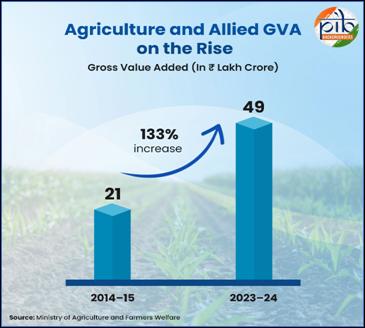
The agriculture and allied sector accounts for about 18 percent of total Gross Value Added (GVA). The GVA of this sector increased significantly from Rs.20.9 lakh crore in 2014-15 to Rs.48.7 lakh crore in 2023-2024. During this period, the sector registered a compound annual growth rate (CAGR) of 8.83 percent at current prices.
Growth has also been supported by improvements within the crop segment. The GVA of crops rose from Rs. 12,92,874 crore in 2014-15 to Rs. 26,52,891 crore in 2023-24.
Enhanced Financial Support for Agriculture
Public investment in the agricultural sector has increased substantially over this period. Budgetary allocation for the Department of Agriculture and Farmers Welfare increased from Rs.27,663 crore in 2013-14 to Rs.1,40,528.78 crore for 2026-27. This significant rise reflects the sustained policy support and continued investment in agricultural infrastructure, strengthening overall agricultural expansion.
Growth Momentum in Foodgrain Production
Total foodgrain production has increased from 265.05 million tonnes in 2013-14 to 357.73 million tonnes in 2024-25. The growth has been driven by higher production of rice, wheat, maize, and coarse cereals. This also included millets, now promoted as Shree Anna. This growth has been supported by the National Food Security and Nutrition Mission (NFSNM). The mission promotes higher production of rice, wheat, pulses, and coarse cereals. It supports improved seeds, better agronomic practices, and technology adoption.
Rice touched a record production of 150.18 Mt in 2024-25, a 42.38 percent increase compared to 2014-15 (105.48 Mt). India became the world’s largest rice producer.
Wheat recorded the highest production of 117.94 Mt in 2024-25, rising over 36 percent since 2014-15.
Maize production also reached 43.40 Mt in 2024-25, an increase of around 79 percent from 2014-15 (24.17 Mt).
Efforts towards self-reliance are also visible in the oilseeds sector. Oilseeds registered the highest production of 42.99 Mt (2024-25), which is 56 percent higher than 2014-15 (27.51 Mt).
Edible oil import dependence declined from 63.2 percent in 2015-16 to 56.25 percent in 2023-24, indicating gradual progress. During this period, the area under oilseeds increased by over 18 percent. Production rose nearly 55 percent, while productivity increased about 31 percent.
The horticulture sector has also emerged as a key contributor to agricultural growth. It accounts for nearly 37 percent of the Gross Value Output within the crop sector. Production has increased from 280.70 million tonnes in 2013-14 to 369.05 million tonnes in 2024-25. This expansion indicates diversification towards high-value crops, supported by improved practices and market demand.
Alongside these sectoral improvements, agricultural policy has steadily expanded to strengthen production systems, support farmers, and build long-term resilience.
A Roadmap for Reforms: Strengthening India’s Agricultural Policy (2014-2026)
Over the past twelve years, agricultural policy has expanded across irrigation, soil health, markets, risk mitigation, and infrastructure. A series of focused initiatives has shaped this transition towards a more integrated and farmer-centric agricultural framework.
Initial reforms concentrated on improving productivity and resource efficiency. Pradhan Mantri Krishi Sinchayee Yojana (PMKSY) expanded irrigation coverage and promoted water-use efficiency. The Soil Health Card Scheme enabled scientific nutrient management. Rashtriya Gokul Mission supported indigenous breeds and dairy productivity.
The focus then widened to reducing production risks and improving market access. Pradhan Mantri Fasal Bima Yojana (PMFBY) expanded crop insurance coverage, while e-NAM enabled digital agricultural trading and wider market integration. The MSP reform of 2018 strengthened price assurance by fixing MSP at 1.5 times the cost of production.
Farmer income support and social security gained greater emphasis in subsequent years. Pradhan Mantri Kisan Samman Nidhi (PM-KISAN) introduced direct income support. Pradhan Mantri Kisan Maandhan Yojana (PM-KMY) created a pension framework for small and marginal farmers. Agriculture Infrastructure Fund (AIF) and PM Kisan Sampada Yojana (PMKSY) increased Investment in post-harvest infrastructure and value addition.
Institutional reforms and cooperative-led development also gained momentum. The Ministry of Cooperation strengthened cooperative governance and expanded cooperative-based economic activities.

Further, recent initiatives have focused on diversification and self-reliance. National Mission on Edible Oils- Oil Palm (NMEO-OP) and National Mission on Edible Oils-Oilseeds (NMEO-OS) promoted domestic edible oil production. Pradhan Mantri Kisan Samriddhi Kendras (PMKSK) improved access to inputs and advisory services. Newer interventions, such as the Pradhan Mantri-Dhan Dhaanya Krishi Yojana (PM-DDKY), aim to strengthen productivity in key crops. The Mission for Aatmanirbharta in Pulses focuses on reducing import dependence and improving domestic production.
Empowering the Indian Farmer: Financial Stability and Social Security
Over the past twelve years, government initiatives expanded across the agricultural cycle, from cultivation and insurance coverage to procurement. These interventions also strengthened direct income assistance for farmers.
Institutionalizing Farmer Income Support through Direct Benefit Transfers
The Pradhan Mantri Kisan Samman Nidhi (PM-KISAN) provides assured income support to small and marginal farmers. It ensures meeting agricultural and household expenses while reducing dependence on informal credit sources.
Under the scheme, each eligible farmer family receives an annual financial assistance of Rs. 6,000. The amount is transferred in three equal instalments of Rs. 2,000 through the Direct Benefit Transfer (DBT) mechanism.
Since its inception in March 2026, PM-KISAN has disbursed over Rs. 4.28 lakh crore through 22 instalments. This has benefitted more than 9.44 crore farmer families nationwide. Over 25 percent of benefits have accrued to women beneficiaries, reflecting the scheme’s inclusive outreach across rural households.
The scheme has emerged as one of the world’s largest DBT initiatives for farmers. It reflects a large-scale institutional mechanism for delivering income assistance directly to beneficiaries.
Securing the Harvest through Crop Insurance and Risk Mitigation
Agriculture remains highly vulnerable to droughts, floods, cyclones, pest attacks, and other natural uncertainties. Such risks can cause significant income losses and disrupt agricultural continuity.
Pradhan Mantri Fasal Bima Yojana (PMFBY) provides farmers with a simple, affordable, and comprehensive crop insurance system. PMFBY covers the entire crop cycle, including pre-sowing and post-harvest losses. The scheme follows the principle of “One Nation, One Crop, One Premium”, ensuring uniform premium rates across the country.
To strengthen grievance redressal mechanisms under PMFBY, the Krishi Rakshak Portal and Helpline (KRPH) number 14447 have been launched. The grievance redressal mechanism is supported by around 500 executives nationwide.
More than 4 crore farmers are insured annually under the scheme, reflecting its wide outreach and growing acceptance among cultivators. Since 2016-17, 92.46 crore farmer applications have been insured. The claims worth Rs.1.96 lakh crore have been disbursed up to 31st December 2025, benefiting around 24.31 crore farmers. Thus, strengthening farmers’ ability to cope with uncertainties and continue agricultural activities with greater resilience and confidence.
The Decadal Growth in Agricultural Procurement and MSP Value
The Minimum Support Price (MSP) acts as a safeguard by ensuring pre-determined prices for agricultural produce. MSPs are announced annually for 22 mandated crops. Since 2018-19, MSPs have been fixed at a minimum of 50 percent above the cost of production.
Public procurement expanded significantly alongside MSP support. Public procurement supports farmers by purchasing crops such as wheat, paddy, pulses, oilseeds, and cotton at MSP rates. Total procurement increased from 698.7 million tonnes during 2004-2014 to 1,229.2 million tonnes during 2014-2026. This recorded a growth of about 76 percent. The total MSP value reached Rs.26.32 lakh crore from 2014-2026 (up to February 2026). This was 3.5 times higher than the previous decade, i.e., Rs. 7.41 lakh crore from 2004-2014. The growth indicates the scale of market support available to farmers.
Among Kharif crops, Ragi recorded the highest MSP growth of 236 percent since 2014-15. This was followed by Nigerseed at 179 percent and Jowar (Hybrid) at 163 percent. Among Rabi and commercial crops, Jute recorded a growth of 147 percent, while Masur registered an increase of 128 percent. These trends reflect sustained efforts to strengthen assured pricing across diverse crop categories.
The Growth of Institutional Agricultural Credit
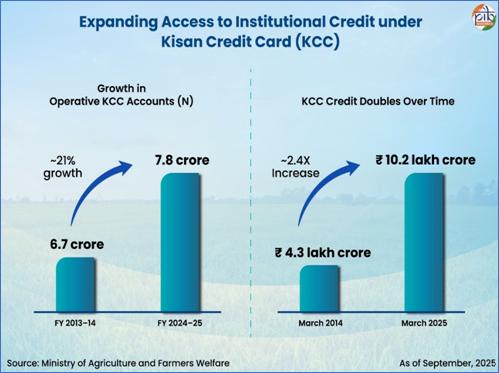
Access to timely and affordable credit has improved through the Kisan Credit Card (KCC) scheme. The scheme provides a single window for farmers to meet their short-term and investment needs in agriculture and allied activities.
As of September 2025, the number of Operative KCC Accounts has increased from 6.46 crore in 2013-2014 to 7.81 crore in 2024-25. The amount in these accounts doubled from Rs 4.26 lakh crore in March 2014 to Rs 10.20 lakh crore in March 2025.
This highlights the scale of institutional credit outreach among farmers. The scope of the scheme covers cultivation expenses, post-harvest requirements, and marketing.
Further, Ground Level Credit (GLC) provides focused credit support to the agriculture and allied sectors from banks and financial institutions. The GLC Flow to agriculture increased from Rs 7.30 lakh crore in 2013-2014 to Rs 28.67 lakh crore in 2024-2025. This indicates the structural expansion of institutional finance to the farm sector.
Advancing Inclusive Social Security for Farmers
The Pradhan Mantri Kisan Maandhan Yojana (PM-KMY) provides a pension-based social security framework for small and marginal farmers. The scheme offers a monthly pension of Rs.3,000 after the age of 60, subject to eligibility conditions. The scheme is voluntary and contributory, with eligibility for individuals aged 18 to 40 years.
As of February 2026, around 24.95 lakh farmers have been enrolled under the scheme. This shows the gradual expansion of social security coverage among farmers.
Shifting Towards Resource Efficiency and Sustainability
Efficient management of water, soil, seeds, and energy resources has become central to agricultural development. Pradhan Mantri Krishi Sinchaee Yojana (PMKSY) has strengthened irrigation coverage and water efficiency. The coverage of irrigation area increased from 49.3 percent to 55 percent of the gross cropped area between FY16-FY21.
The Sub Mission on Seeds and Planting Materials (SMSP) focuses on expanding the supply of certified seeds. Under this initiative, about 6.85 lakh seed villages have been established, producing 1,649 lakh quintals of quality seeds.
The Soil Health Card (SHC) Scheme provides farmers with information on soil nutrients and guidance on fertiliser use. Since 2014-15, nearly 26 crore cards have been issued as of March 2026, steadily expanding soil health management. 8,313 soil testing laboratories support this effort. In addition, over 70,000 Krishi Sakhis have been trained to provide soil health advisories and support informed farm practices.
Sustainable farming practices have gained importance in recent years. The Paramparagat Krishi Vikas Yojana (PKVY) promotes organic farming through cluster-based approaches. The Mission Organic Value Chain Development for North Eastern Region (MOVCDNER) supports organic production and market linkages in the North Eastern Region.
As of December 2025, 18.84 lakh hectares have been covered under PKVY, benefiting 33.93 lakh farmers. Under MOVCDNER, 2.36 lakh hectares have been covered, with 2.70 lakh farmers supported, since its inception in 2015-16.
The National Mission on Natural Farming (NMNF) promotes chemical-free farming practices to improve soil health and reduce input costs. So far, the scheme has covered 9 lakh hectares and registered 19 lakh farmers.
Additionally, 2,996 climate-resilient crop varieties have been released during 2014-2025. The government also promoted climate-resilient village models in 448 villages, benefiting 8.5 lakh farmers across agriculture and allied sectors. Integrated Farming Systems (IFS) were expanded to 1.04 lakh farm households across 79 districts. These interventions increased farm incomes to Rs. 1.5-3.6 lakh per hectare annually.
From Farm Gate to Market: Strengthening Agricultural Infrastructure
Improving market access and infrastructure has been a key focus in recent years. Launched in 2020-21, the Agriculture Infrastructure Fund (AIF) supports investment in post-harvest infrastructure. It focuses on storage, logistics, and processing at the farm gate. As of March 2026, loans worth Rs. 84,202 crore have been sanctioned for 1.68 lakh projects under AIF. The scheme has also mobilised investment of Rs. 1.33 lakh crore, strengthening rural infrastructure.
The National Agriculture Market (e-NAM) has improved market integration. It provides a unified electronic platform for trading agricultural commodities. As of March 2026, 1,656 mandis have been integrated, with over 1.80 crore farmers and 4,724 FPOs registered. The platform enables transparent price discovery and direct payments to farmers.
Physical and service infrastructure have also expanded. Pradhan Mantri Kisan Samriddhi Kendras (PMKSK), launched in 2022, serve as one-stop centres for inputs and advisory services. As of August 2025, about 1.8 lakh Kendras have been established across the country.
The Mega Food Park scheme has strengthened linkages between farmers and markets. The number of Mega Food Parks has increased from 2 in 2014 to 41 in 2025, including 24 operational and 17 under implementation. These parks provide modern infrastructure for processing, storage, and logistics. Improved infrastructure, digital platforms, and processing capacity have enhanced efficiency and supported better income opportunities for farmers.
In conclusion, empowering India’s farmers requires a comprehensive strategy that links financial aid, technological innovation, market reforms, and sustainable practices. When farmers transition from vulnerable laborers to self-reliant entrepreneurs, the entire rural economy thrives. Ensuring the prosperity of the farming community is not just a policy goal; it is the foundational requirement for a resilient, self-reliant, and developed India. The government seems to be aware of it and is doing the needful.