India among the largest military spenders in world
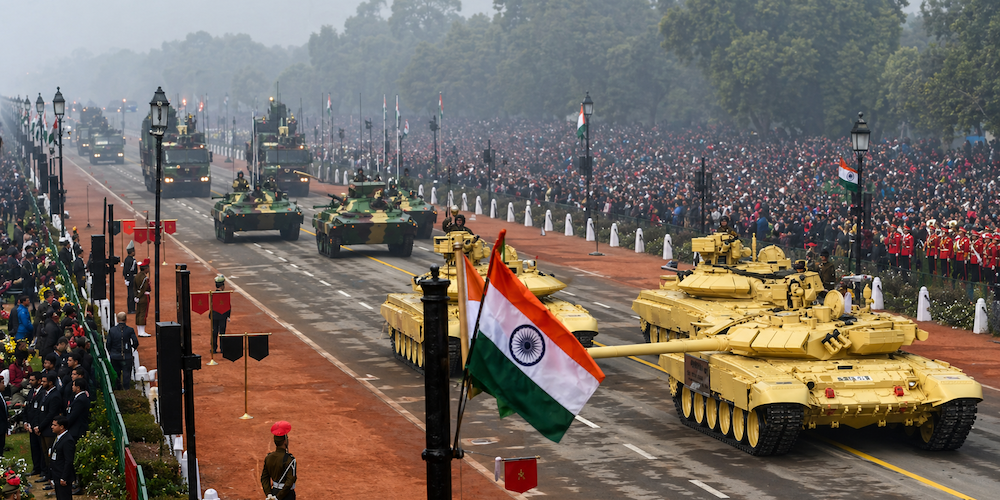
India ranked fifth in global military spending with an expenditure of $92.1 billion. This spending represents an 8.9% increase from the previous year, reflecting India’s accelerating focus on border security, modernization, and regional strategic challenges
Global geopolitics is shifting rapidly, and military expenditure serves as a clear indicator of national priorities and regional anxieties.
India was the fifth largest military spender in the world, with an expenditure of US$ 92.1 billion in 2025, the Stockholm International Peace Research Institute (SIPRI) has stated in its latest annual assessment report.
This massive financial commitment — representing roughly 3.2% of total global military spending — is not merely a matter of prestige. Instead, it is a calculated response to complex territorial disputes, a push for technological modernisation, and an effort to achieve strategic autonomy.
In its annual assessment report launched on Monday, the Stockholm International Peace Research Institute (SIPRI) also said that India has approximately 190 nuclear warheads as of January 2026, compared to Pakistan’s estimated stockpile of 170.
“Key findings of SIPRI Yearbook 2026 are that states are increasingly relying on nuclear weapons as instruments of national power – reversing decades of efforts to reduce the numbers and role of nuclear weapons – even as the risks of miscalculation and escalation are rising,” SIPRI said in a statement.
The Stockholm-based think-tank said India is believed to have once again “slightly expanded its nuclear arsenal” in 2025 and continued development of new types of nuclear delivery systems. “The modernisation programme is increasingly focused on developing long-range weapons capable of reaching targets throughout China, although planning also continues to be focused on India’s long-standing rivalry with Pakistan,” it said.
SIPRI further said, “Pakistan continued to develop new delivery systems and accumulate fissile material in 2025, suggesting that its nuclear arsenal might expand over the coming decade”.
It then added, “The brief armed conflict between India and Pakistan in May 2025 saw India attacking Pakistani air and missile bases that are likely to have nuclear-related roles, but both sides took steps to avoid escalation”.
At the start of 2026, nine states – the US, Russia, the UK, France, China, India, Pakistan, North Korea and Israel – together possessed approximately 12,187 nuclear weapons, of which 9,745 were in military stockpiles and considered to be potentially operationally available, the report said.
Overall, the number of nuclear warheads in the world continues to decline, but this is only due to the US and Russia “dismantling retired warheads,” the report said.
According to the report, the US remained by far the largest military spender in the world; its expenditure of US$ 954 billion in 2025 (7.5 per cent lower than in 2024) accounted for 33 per cent of total global spending.
China is the second largest military spender (US$ 336 billion), while Russia stands at the third (US$ 190 billion).
Germany was the fourth largest military spender, and India was at the fifth spot, with an expenditure of with US 92.1 billion, it said, noting that many of them were involved – either directly or indirectly – in the wars in Gaza and Ukraine in 2025.
Taken together, the 15 largest military spenders accounted for 80 per cent of the world’s military expenditure in 2025 (US$ 2,304 billion),” it said, noting that many of them were involved – either directly or indirectly – in the wars in Gaza and Ukraine in 2025.
The estimated global military expenditure rose for the 11th consecutive year in 2025, to reach US$ 2.9 trillion – or 2.5 per cent of the world’s GDP — pushing world spending to the highest level recorded by SIPRI, the report said.
SIPRI said several critical regional flashpoints remained “at risk of escalating into major interstate armed conflicts; for example, an unusually severe military crisis erupted between India and Pakistan in May 2025”.
The think-tank said it has identified 162 states as recipients of major arms in 2021 – 25. The five largest recipients were Ukraine, India, Saudi Arabia, Qatar and Pakistan, which together accounted for 35 per cent of total arms imports in the period.
It further said cyber operations continued to evolve as an integral component of modern conflict, citing Russia and Ukraine as notable examples.

“India and Pakistan overtly integrating cyber operations into armed conflict for the first time when an unusually severe military crisis erupted in May 2025; and Iran and Israel employing coordinated digital retaliation during their confrontation,” it added.
In its list of major events, the report mentioned “May 7-10 India and Pakistan exchange intense cross-border fire”.
SIPRI said over the course of the past two decades, there has been a gradual shift away from the liberal paradigm of peacemaking that previously dominated conflict resolution efforts towards a “more power-based and transactional approach”.
In 2025, the global landscape of armed conflict retained the form it took in 2024, with large-scale and sustained violence across multiple regions. The number of locations of armed conflict fell slightly, from 50 states in 2024 to 49 in 2025.
The Strategic Drivers: Threats on Two Fronts
India’s high military expenditure is primarily driven by its unique and volatile geopolitical environment. Unlike many global powers, India faces active, militarised border disputes with two nuclear-armed neighbours: China and Pakistan.
The primary catalyst for India’s recent 8.9% surge in defence spending is the ongoing strategic competition with China along the Line of Actual Control (LAC). China’s rapid military modernisation and assertive infrastructure building in Tibet have forced New Delhi to heavily invest in high-altitude warfare equipment, logistics, and border roads. Concurrently, traditional rivalries persist. Long-standing frictions with Pakistan — underscored by serious cross-border military flashpoints as recently as May 2025 — ensure that India must maintain high combat readiness across its western frontier. This “two-front” threat matrix necessitates a massive standing army and continuous capital investments.
The Modernisation Challenge: Nuclear Capability and Conventional Upgrades
A significant portion of India’s budget is dedicated to shifting from legacy systems to a high-tech, modern fighting force. A critical highlight of this transformation is the expansion of India’s nuclear triad. India’s operational nuclear stockpile has grown to approximately 190 warheads, surpassing Pakistan’s arsenal for the first time. This growth is paired with the development of long-range ballistic missiles and nuclear-powered submarines, aimed at establishing a credible deterrence posture against China’s superior numbers.
On the conventional side, India is heavily upgrading its air power, naval fleets, and cyber warfare capabilities. The nation remains the world’s second-largest importer of major arms, accounting for 8.2% of global arms imports. However, maintaining such a high reliance on foreign hardware creates vulnerabilities, particularly regarding supply chain bottlenecks and diplomatic leverage.
The Shift Toward Self-Reliance: Aatmanirbhar Bharat
To mitigate the risks of foreign dependency, the Indian government has linked its massive military budget to economic growth through the Aatmanirbhar Bharat (Self-Reliant India) initiative. The defence budget increasingly mandates that a dominant percentage of capital procurement be earmarked for domestic defence manufacturers.
This policy has catalysed India’s public and private defence sectors, leading to the local production of advanced hardware such as the INS Vikrant aircraft carrier, the Tejas fighter aircraft, and various missile defence systems. By leveraging its military spending to build a domestic industrial base, India aims to transition from a top arms importer to a self-sustaining defence exporter.
Economic Constraints vs. National Security
While a $92.1 billion defence budget projects immense power, it also poses an economic dilemma. India is a developing country with pressing needs in healthcare, education, infrastructure, and poverty alleviation. Every rupee spent on a fighter jet is a rupee diverted from social welfare. Furthermore, a large portion of India’s budget is swallowed by “revenue expenditure” — the day-to-day costs of salaries and pensions for its 1.4 million-strong active personnel. Balancing personnel costs with the capital required for high-tech modernisation remains a persistent fiscal challenge for New Delhi.
Conclusion
India’s status as the fifth-largest military spender is a reflection of its geopolitical reality. It is a necessary financial burden borne by a nation seeking to safeguard its sovereignty in a volatile region. As global military spending hits a record $2.9 trillion, India’s investments ensure it cannot be easily coerced by regional rivals. The true test for India moving forward will not be how much money it spends, but how efficiently it can transition those billions into high-tech, self-reliant defence capabilities without stalling its vital domestic economic development.