RIGHT ANGLE – No Uncondtional Funding of Minority Educational Institutions
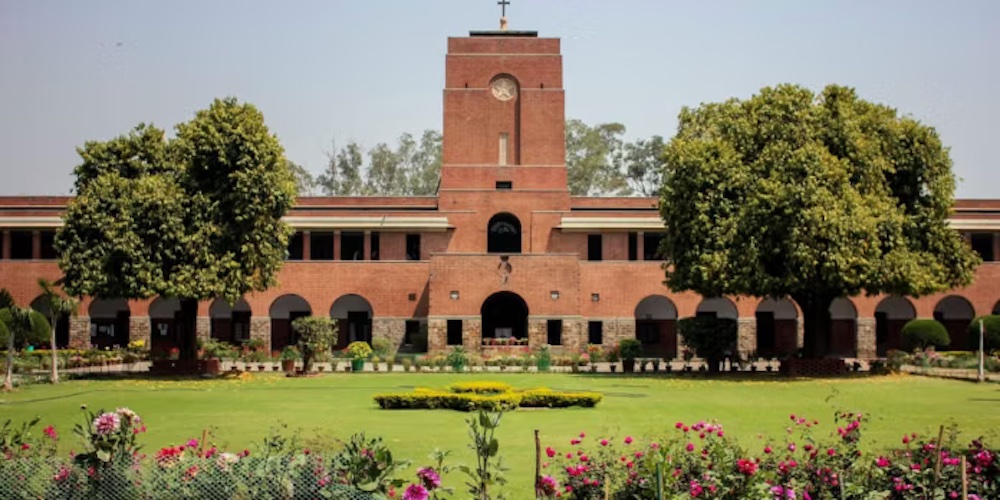
As I write this, Delhi University has asked the University Grants Commission to stop the salary of the newly appointed Principal of St. Stephen’s College, who has been appointed by flouting the university rules. In fact, this college, which is principally funded by the Government of India, and in that sense, by the taxpayers like you and me, is notorious for defiance of the university rules always. It says that being a minority institution, it has got its own rules and it will not give a damn about what the Delhi University wants.
But then, this is not the problem with St. Stephen’s alone. All minority institutions like the Aligarh Muslim University, or for that matter Jamia Milia, want, rather demand, unconditional government funds. They are very particular about maintaining exclusive cultural and administrative autonomy under Article 30 (1) of the Constitution, which gives religious and linguistic minorities the right “to establish and administer educational institutions of their choice.”
They argue that their minority character — such as the right to reserve up to 50% of seats for their community and autonomy in staff recruitment — is non-negotiable. For them, surrendering this identity threatens the very preservation of their heritage and traditions.
But then, utilising public exchequer funds necessitates broader societal responsibility. When institutions receive substantial University Grants Commission grants or state aid, I agree with those who point out that these minority institutions should serve the broader public interest, align with national educational standards, and adhere to secular, non-discriminatory admission and hiring policies.
This principle of “unconditional funding” — the idea that the state must finance minority institutions without oversight, accountability, or performance metrics — is increasingly difficult to defend on grounds of equity, fiscal prudence, and the long-term health of the institutions themselves. The time has come for a shift from dependence to self-reliance, from entitlement to partnership.
It may be noted that the Supreme Court in T.M.A. Pai Foundation v. State of Karnataka case (2002) and the one of P.A. Inamdar v. State of Maharashtra (2005) clarified that minority status confers autonomy in admissions and administration, but not immunity from reasonable regulation and financial self-responsibility. Government aid is a policy choice, not a constitutional mandate.
When aid is given, Article 29(2) prohibits denial of admission to citizens on grounds of religion, race, caste, or language. Thus, public funding already comes with conditions. Demanding unconditional funds therefore contradicts the legal framework that minority institutions themselves invoke for protection.
India spends about 3% of GDP on education, well below the 6% recommended by the Kothari Commission and NEP 2020. Within that constrained envelope, the government must fund 1.5 million government schools, mid-day meals for 120 million children, RTE reimbursements, higher education expansion, and skilling programs. Data from UDISE+ shows that 65% of Indian children study in government schools, which are disproportionately attended by SC, ST, and OBC students from poor households.
When minority institutions — many of which charge fees, have strong alumni networks, and sit on valuable urban real estate — claim unconditional grants, they compete directly with under-funded government schools in tribal blocks and urban slums. Equity demands that public money flow where need is greatest and accountability is strongest. A policy of “fund us, but don’t question us” undermines the state’s ability to target resources to first-generation learners who lack any institutional backers.
Unconditional funding also creates a principal-agent problem. The taxpayer is the principal, but if the institution is accountable neither for learning outcomes nor for financial transparency, the link between outlay and outcome snaps.
CAG reports have repeatedly flagged irregularities in aided minority institutions: ghost faculty, inflated enrolment, and diversion of grants to non-educational purposes. Because Article 30 is sometimes interpreted as barring “interference,” audit and inspection mechanisms are weaker than for other aided colleges.

This harms the very students the system is meant to protect. NAS 2021 data shows that learning levels in many aided minority schools lag behind Kendriya Vidyalayas and private unaided schools of similar cost. Without performance-linked funding, there is no incentive to reform pedagogy, upgrade labs, or train teachers. Self-reliance, by contrast, forces institutions to compete for students and philanthropy, which rewards quality.
Dependence shapes culture. Institutions that rely on annual government grants tend to optimise for compliance and political patronage rather than innovation. Fee structures are kept artificially low to justify aid, which then creates recurring deficits, which then become the basis for more aid. The cycle discourages endowment building, alumni engagement, and industry partnerships — the three pillars that sustain world-class universities globally.
Harvard, Oxford, and the National University of Singapore are not great because governments wrote blank cheques. They are great because they leveraged autonomy to build diversified revenue: tuition, research grants, consulting, patents, and endowments. India’s own IIMs and IITs are moving in that direction. Minority institutions that remain in a “grant-seeking” mode risk becoming the educational equivalent of sick PSUs — protected, but uncompetitive.
Let it be emphasised that the premise behind Article 30 in 1950 was that minorities were educationally and economically backward and needed special protection. In 2026, that premise requires nuance. India’s religious minorities are not monolithic. Sikhs and Jains exceed national averages in literacy and per capita income. Christians run some of India’s most expensive private schools and medical colleges. Zoroastrians have among the highest education levels globally. Even within Muslims, regional disparities are vast: Kerala Muslims have literacy above 93%, while outcomes in parts of UP and Bihar lag.
Moreover, minority communities control substantial economic assets. The Waqf Boards alone are estimated to hold 6 lakh acres of property. Church networks run hospitals and colleges with fees comparable to other private institutions. The capacity for self-funding exists, though it is unevenly distributed. A policy that treats all minority institutions as financially helpless is factually outdated and infantilizes communities that have produced entrepreneurs, professionals, and philanthropists.
Unconditional aid to minority institutions creates a horizontal equity problem with non-minority private institutions. A linguistic minority college run by a trust gets a 95% salary grant from the state, while a Hindu-run private college of identical quality must pay faculty fees. This distorts competition and pushes non-minority institutions to seek “minority status” for the financial benefit, not for cultural preservation. No wonder that between 2005 and 2023, the number of institutions with minority certificates grew sharply, many without a clear linguistic or religious justification. When a benefit is delinked from need and attached only to identity, it invites misuse and breeds resentment.
The global experience here may be instructive. The US gives no direct operational grants to religious schools; funding flows via vouchers or student aid, not to the institution. The UK funds “faith schools” but requires them to teach the national curriculum and admit students of other faiths. Canada’s Ontario funds Catholic schools fully, but they are part of the public system with public accountability. In each case, public money buys public purpose. Viewed thus, India’s unconditional model is an outlier.
There is a moral angle too to look at this issue beyond economics and law. Communities that build and sustain their own institutions command respect. The early Aligarh movement, the Singh Sabha, and Christian missionary colleges were funded by community effort, not state largesse. They produced leaders precisely because they were accountable to their supporters, not to a government department. Unconditional dependence risks creating a “client” mindset that weakens community initiative. On the other hand, self-reliance, supported by targeted state partnership, restores agency.
If that is not going to be the case with St. Stephen’s, AMU or Jamia Malia, then they must undergo introspection to strike a balance between their constitutional rights and their obligations to the public that funds them.
As has been argued above, by practicing transparency and opening doors to a wider pool of talent, these institutions can redefine their legacy. They must prove that their core identity is a source of strength that contributes to the nation’s broader educational goals, rather than an excuse for exclusion.
And still, if they desire absolute autonomy to operate “in their own way” without external regulation or standard government oversight, it is time they transitioned to a completely self-financed, unaided model. They must be made to realise that true independence requires financial self-reliance.